


Page 92 - ACCCN's Critical Care Nursing
P. 92
Recovery and Rehabilitation 69


               BOX 4.1  Purpose of an intensive care                TABLE 4.7  Sample clinic assessment tool
               follow-up service
                                                                    Subject area    Rationale
               ●  Review and assess patient progress
               ●  Early  identification  of  problems  and  refer  to  appropriate   General health  Assessed on a linear analogue or forced
                                                                                     choice response to elicit a patient’s
                  specialties where necessary                                        subjective account of how they view
               ●  Coordinate care                                                    their general health and how it has
               ●  Support a rehabilitation program                                   changed since critical illness
               ●  Discuss the intensive care experience and offer patient the   Medications  Review of medications commenced during
                  opportunity to comment on care                                     the critical illness and continued
               ●  Offer patient opportunity to visit the ICU                         post-discharge, with advice provided to
                                                                                                           146
               ●  Provide a forum for relatives to ask questions                     the patient’s General Practitioner
               ●  Use information to inform delivery of intensive care  Movement and   Assess mobility problems, often due to
                                                                      mobility,      continuing fatigue and weakness, but
                                                                      household      also perhaps joint problems; 190,191
                                                                      management     identify impact on daily activities 109,192,193
                                                                      and joints
             Common  practice  is  to  invite  patients  to  attend  a  first   Breathing and   Breathlessness is common after critical
                                                                                         192
             clinic appointment approximately 2–3 months after dis-   tracheostomy   illness  and there are a number of
             charge from intensive care or hospital, although timing                 potential difficulties post-tracheostomy;
             has  to  be  flexible  given  the  length  of  hospital  stay  for      these can be identified and the patient
                                                                                     referred to the appropriate specialist
                                                            152
             some patients. For many, one appointment is sufficient,
             but others have continuing problems and may need to    Sleep and eating  Sleep and concentration disturbances are
             return on a number of occasions. Some clinics routinely                 common, and muscle loss and weakness
                                                                                     are important contributors to delayed
             offer return appointments up to one year after discharge,               recovery 109
             determined  on  an  individual  patient  basis.  Attendance                                   192,194
             can be problematic; only 70–90% in some studies. 146,153    Urology/   Patients may have sexual problems
                                                                                                        192
                                                                      reproduction,
                                                                                     and skin and nail problems
             Non-attendance can occur because a patient has no iden-  skin and senses
             tified  problems  (shorter  ICU  LOS;  less  ill);  or  more
             importantly  because  of  individual  limitations  (limited   Recreation, work   Patients may experience difficulties
                                                                      and lifestyle
                                                                                     reintegrating into society and in
             mobility; living a distance away from the clinic, or signifi-  change   particular returning to work 192
             cant post-traumatic stress symptoms including avoidant
             behaviours). 153                                       Intensive care   Patients rarely remember factual events of
                                                                      experience
                                                                                     their time in ICU, but their memories are
             While  these  services  developed  in  a  relatively  ad  hoc           often of unpleasant and disturbing
                                                                                          54,58,85
             manner, tended to be underfunded and used a variety of                  events;   offering an opportunity to
                                                                                     discuss actual events and sometimes
             models in their delivery, the purposes for such a service               distressing memories can be
             are similar (see Box 4.1).                                              beneficial 152
                                                                    Quality of life  The ultimate aim of treatment and care is
             Clinic Activities                                                       to return a patient to an acceptable and
             Patient  progress  is  reviewed  for  identification  of  subse-        optimal quality of life; it is important to
                                                                                     gauge how patients perceive their life
             quent problems, and timely referral to appropriate ser-                 quality, and may identify areas for
             vices for further treatment. A major advantage of follow-up             practice improvement 53
             clinics is the increased understanding of patient recovery,
             as a range of physical and psychological assessments can
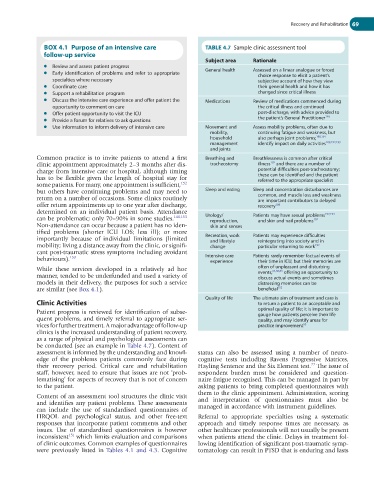
             be conducted (see an example in Table 4.7). Content of
             assessment is informed by the understanding and knowl-  status  can  also  be  assessed  using  a  number  of  neuro-
             edge  of  the  problems  patients  commonly  face  during   cognitive  tests  including  Ravens  Progressive  Matrices,
             their  recovery  period.  Critical  care  and  rehabilitation   Hayling Sentence and the Six Element test.  The issue of
                                                                                                       77
             staff, however, need to ensure that issues are not ‘prob-  respondent  burden  must  be  considered  and  question-
             lematising’ for aspects of recovery that is not of concern   naire fatigue recognised. This can be managed in part by
             to the patient.                                      asking patients to bring completed questionnaires with
                                                                  them to the clinic appointment. Administration, scoring
             Content of an assessment tool structures the clinic visit   and  interpretation  of  questionnaires  must  also  be
             and  identifies  any  patient  problems.  These  assessments   managed in accordance with instrument guidelines.
             can  include  the  use  of  standardised  questionnaires  of
             HRQOL  and  psychological  status,  and  other  free-text   Referral  to  appropriate  specialties  using  a  systematic
             responses that incorporate patient comments and other   approach  and  timely  response  times  are  necessary,  as
             issues.  Use  of  standardised  questionnaires  is  however   other healthcare professionals will not usually be present
                       151
             inconsistent  which limits evaluation and comparisons   when patients attend the clinic. Delays in treatment fol-
             of clinic outcomes. Common examples of questionnaires   lowing identification of significant post-traumatic symp-
             were  previously  listed  in  Tables  4.1  and  4.3.  Cognitive   tomatology can result in PTSD that is enduring and lasts

