


Page 240 - Concise Pathology for Exam Preparation ( PDFDrive )
P. 240
9 Environmental and Nutritional Pathology 225
enhances immunity and may control free radical production by modulating inflamma-
tory reactions.
Q. Write briefly about obesity.
Ans. Obesity is defined as abnormal or excessive fat accumulation that presents a risk to
health. A crude population measure of obesity is the body mass index (BMI)—a person’s
weight (in kilograms) divided by the square of his or her height (in meters). A person with
a BMI of 30 or more is generally considered obese. A person with a BMI equal to or more
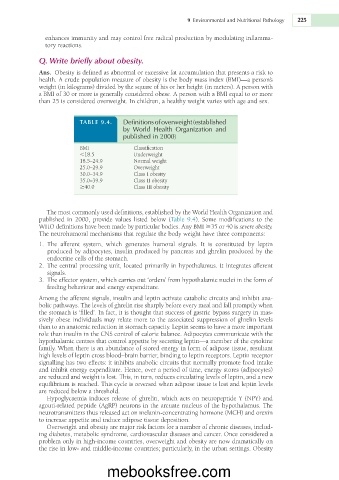
than 25 is considered overweight. In children, a healthy weight varies with age and sex.
TABLE 9.4. Definitions of overweight (established
by World Health Organization and
published in 2000)
BMI Classification
,18.5 Underweight
18.5–24.9 Normal weight
25.0–29.9 Overweight
30.0–34.9 Class I obesity
35.0–39.9 Class II obesity
40.0 Class III obesity
The most commonly used definitions, established by the World Health Organization and
published in 2000, provide values listed below (Table 9.4). Some modifications to the
WHO definitions have been made by particular bodies. Any BMI 35 or 40 is severe obesity.
The neurohumoral mechanisms that regulate the body weight have three components:
1. The afferent system, which generates humoral signals. It is constituted by leptin
produced by adipocytes, insulin produced by pancreas and ghrelin produced by the
endocrine cells of the stomach.
2. The central processing unit, located primarily in hypothalamus. It integrates afferent
signals.
3. The effector system, which carries out ‘orders’ from hypothalamic nuclei in the form of
feeding behaviour and energy expenditure.
Among the afferent signals, insulin and leptin activate catabolic circuits and inhibit ana-
bolic pathways. The levels of ghrelin rise sharply before every meal and fall promptly when
the stomach is ‘filled’. In fact, it is thought that success of gastric bypass surgery in mas-
sively obese individuals may relate more to the associated suppression of ghrelin levels
than to an anatomic reduction in stomach capacity. Leptin seems to have a more important
role than insulin in the CNS control of calorie balance. Adipocytes communicate with the
hypothalamic centres that control appetite by secreting leptin—a member of the cytokine
family. When there is an abundance of stored energy in form of adipose tissue, resultant
high levels of leptin cross blood–brain barrier, binding to leptin receptors. Leptin receptor
signalling has two effects: it inhibits anabolic circuits that normally promote food intake
and inhibit energy expenditure. Hence, over a period of time, energy stores (adipocytes)
are reduced and weight is lost. This, in turn, reduces circulating levels of leptin, and a new
equilibrium is reached. This cycle is reversed when adipose tissue is lost and leptin levels
are reduced below a threshold.
Hypoglycaemia induces release of ghrelin, which acts on neuropeptide Y (NPY) and
agouti-related peptide (AgRP) neurons in the arcuate nucleus of the hypothalamus. The
neurotransmitters thus released act on melanin-concentrating hormone (MCH) and orexin
to increase appetite and induce adipose tissue deposition.
Overweight and obesity are major risk factors for a number of chronic diseases, includ-
ing diabetes, metabolic syndrome, cardiovascular diseases and cancer. Once considered a
problem only in high-income countries, overweight and obesity are now dramatically on
the rise in low- and middle-income countries; particularly, in the urban settings. Obesity
mebooksfree.com

