


Page 236 - Concise Pathology for Exam Preparation ( PDFDrive )
P. 236
9  Environmental and Nutritional Pathology  221

             Q. Write briefly about the sources, functions and deficiency of vitamin C.

             Ans. The sources of vitamin C includes Milk, fish, liver, fruits and vegetables; cannot be
             synthesized endogenously, thus humans are dependent on dietary intake.

             Functions of Vitamin C
             •  Role in collagen synthesis:
               •  Accelerates hydroxylation and amidation reactions
               •  Activates prolyl and lysyl hydroxylases for hydroxylation of procollagen (hydroxyl-
                 ation important for a stable helical structure and cross linking)
             •  Antioxidant action:
               •  Scavenges free radicals and regenerates the antioxidant form of vitamin E; vitamins C
                 and E act in concert to reduce atherosclerosis by reducing the oxidation of LDL
             Deficiency of Vitamin C (Scurvy)

             Clinical manifestations of vitamin C deficiency are:
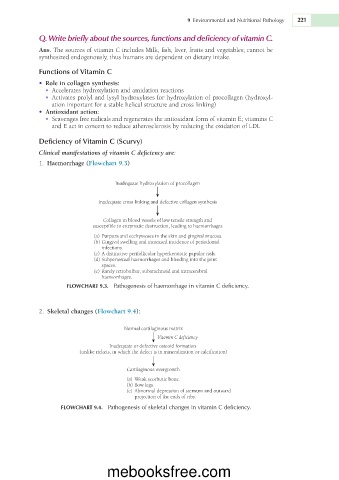
               1.  Haemorrhage (Flowchart 9.3)


                                     Inadequate hydroxylation of procollagen

                               Inadequate cross linking and defective collagen synthesis


                                 Collagen in blood vessels of low tensile strength and
                              susceptible to enzymatic destruction, leading to haemorrhages
                              (a) Purpura and ecchymoses in the skin and gingival mucosa.
                              (b) Gingival swelling and increased incidence of periodontal
                                 infections.
                              (c) A distinctive perifollicular hyperkeratotic papular rash.
                              (d) Subperiosteal haemorrhages and bleeding into the joint
                                 spaces.
                              (e) Rarely retrobulbar, subarachnoid and intracerebral
                                 haemorrhages.
                      FLOWCHART 9.3.  Pathogenesis of haemorrhage in vitamin C deficiency.


               2.  Skeletal changes (Flowchart 9.4):


                                       Normal cartilaginous matrix
                                                 Vitamin C deficiency
                                   Inadequate or defective osteoid formation
                          (unlike rickets, in which the defect is in mineralization or calcification)

                                        Cartilaginous overgrowth
                                        (a) Weak scorbutic bone.
                                        (b) Bow legs.
                                        (c) Abnormal depression of sternum and outward
                                           projection of the ends of ribs.
                    FLOWCHART 9.4.  Pathogenesis of skeletal changes in vitamin C deficiency.


                                  mebooksfree.com

