


Page 357 - Concise Pathology for Exam Preparation ( PDFDrive )
P. 357
342    SECTION II  Diseases of Organ Systems


                                                                                Mature-
                                                                                appearing
                                                                                lymphocytes


                                                                                Smudge cells


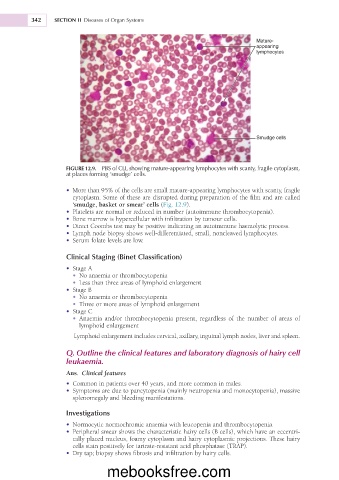
                     FIGURE 12.9.  PBS of CLL showing mature-appearing lymphocytes with scanty, fragile cytoplasm,
                     at places forming ‘smudge’ cells.

                     •  More than 95% of the cells are small mature-appearing lymphocytes with scanty, fragile
                       cytoplasm. Some of these are disrupted during preparation of the film and are called
                       ‘smudge, basket or smear’ cells (Fig. 12.9).
                     •  Platelets are normal or reduced in number (autoimmune thrombocytopenia).
                     •  Bone marrow is hypercellular with infiltration by tumour cells.
                     •  Direct Coombs test may be positive indicating an autoimmune haemolytic process.
                     •  Lymph node biopsy shows well-differentiated, small, noncleaved lymphocytes.
                     •  Serum folate levels are low.
                     Clinical Staging (Binet Classification)

                     •  Stage A
                       •  No anaemia or thrombocytopenia
                       •  Less than three areas of lymphoid enlargement
                     •  Stage B
                       •  No anaemia or thrombocytopenia
                       •  Three or more areas of lymphoid enlargement
                     •  Stage C
                       •  Anaemia  and/or  thrombocytopenia  present,  regardless  of  the  number  of  areas  of
                         lymphoid enlargement
                        Lymphoid enlargement includes cervical, axillary, inguinal lymph nodes, liver and spleen.

                     Q. Outline the clinical features and laboratory diagnosis of hairy cell
                     leukaemia.

                     Ans.  Clinical	features
                     •  Common in patients over 40 years, and more common in males.
                     •  Symptoms are due to pancytopenia (mainly neutropenia and monocytopenia), massive
                       splenomegaly and bleeding manifestations.
                     Investigations

                     •  Normocytic normochromic anaemia with leucopenia and thrombocytopenia.
                     •  Peripheral smear shows the characteristic hairy cells (B cells), which have an eccentri-
                       cally placed nucleus, foamy cytoplasm and hairy cytoplasmic projections. These hairy
                       cells stain positively for tartrate-resistant acid phosphatase (TRAP).
                     •  Dry tap; biopsy shows fibrosis and infiltration by hairy cells.


                                  mebooksfree.com

