


Page 359 - Concise Pathology for Exam Preparation ( PDFDrive )
P. 359
344    SECTION II  Diseases of Organ Systems


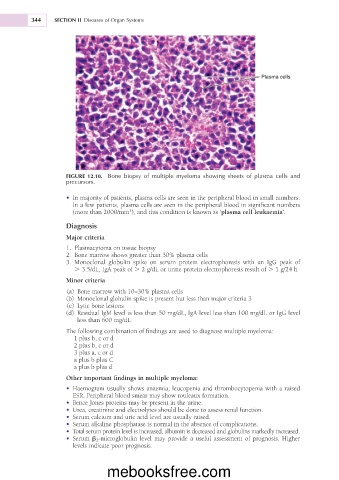
                                                                                 Plasma cells


                     FIGURE  12.10.  Bone  biopsy  of  multiple  myeloma  showing  sheets  of  plasma  cells  and
                     precursors.

                     •  In majority of patients, plasma cells are seen in the peripheral blood in small numbers.
                       In a few patients, plasma cells are seen in the peripheral blood in significant numbers
                       (more than 2000/mm ), and this condition is known as ‘plasma cell leukaemia’.
                                         3
                     Diagnosis
                     Major criteria
                       1.  Plasmacytoma on tissue biopsy
                       2.  Bone marrow shows greater than 30% plasma cells
                       3.  Monoclonal  globulin  spike  on  serum  protein  electrophoresis  with  an  IgG  peak  of
                        . 3.5/dL, IgA peak of . 2 g/dL or urine protein electrophoresis result of . 1 g/24 h
                     Minor criteria
                      (a)  Bone marrow with 10–30% plasma cells
                      (b)  Monoclonal globulin spike is present but less than major criteria 3
                      (c)  Lytic bone lesions
                       (d)  Residual IgM level is less than 50 mg/dL, IgA level less than 100 mg/dL or IgG level
                         less than 600 mg/dL.
                     The following combination of findings are used to diagnose multiple myeloma:
                        1 plus b, c or d
                        2 plus b, c or d
                        3 plus a, c or d
                        a plus b plus C
                        a plus b plus d
                     Other important findings in multiple myeloma:
                     •  Haemogram usually shows anaemia, leucopenia and thrombocytopenia with a raised
                       ESR. Peripheral blood smear may show rouleaux formation.
                     •  Bence Jones proteins may be present in the urine.
                     •  Urea, creatinine and electrolytes should be done to assess renal function.
                     •  Serum calcium and uric acid level are usually raised.
                     •  Serum alkaline phosphatase is normal in the absence of complications.
                     •  Total serum protein level is increased, albumin is decreased and globulins markedly increased.
                     •  Serum b 2 -microglobulin level may provide a useful assessment of prognosis. Higher
                       levels indicate poor prognosis.


                                  mebooksfree.com

