


Page 362 - Concise Pathology for Exam Preparation ( PDFDrive )
P. 362
12  Haematology  347


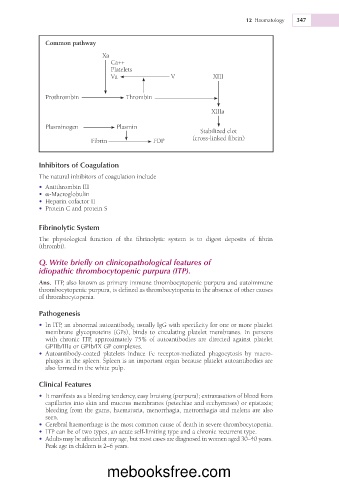
               Common pathway
                                 Xa
                                   Ca++
                                   Platelets
                                   Va                 V            XIII


               Prothrombin              Thrombin

                                                                  XIIIa

               Plasminogen           Plasmin
                                                               Stabilized clot
                             Fibrin             FDP         (cross-linked fibrin)


             Inhibitors of Coagulation
             The natural inhibitors of coagulation include
             •  Antithrombin III
             •  a-Macroglobulin
             •  Heparin cofactor II
             •  Protein C and protein S


             Fibrinolytic System
             The  physiological  function  of  the  fibrinolytic  system  is  to  digest  deposits  of  fibrin
             (thrombi).

             Q. Write briefly on clinicopathological features of
             idiopathic thrombocytopenic purpura (ITP).

             Ans.  ITP, also known as primary immune thrombocytopenic purpura and autoimmune
             thrombocytopenic purpura, is defined as thrombocytopenia in the absence of other causes
             of thrombocytopenia.

             Pathogenesis

             •  In ITP, an abnormal autoantibody, usually IgG with specificity for one or more platelet
               membrane  glycoproteins  (GPs),  binds  to  circulating  platelet  membranes.  In  persons
               with  chronic  ITP,  approximately  75%  of  autoantibodies  are  directed  against  platelet
               GPIIb/IIIa or GPIb/IX GP complexes.
             •  Autoantibody-coated  platelets  induce  Fc  receptor-mediated  phagocytosis  by  macro-
               phages in the spleen. Spleen is an important organ because platelet autoantibodies are
               also formed in the white pulp.

             Clinical Features
             •  It manifests as a bleeding tendency, easy bruising (purpura); extravasation of blood from
               capillaries into skin and mucous membranes (petechiae and ecchymoses) or epistaxis;
               bleeding from the gums, haematuria, menorrhagia, metrorrhagia and melena are also
               seen.
             •  Cerebral haemorrhage is the most common cause of death in severe thrombocytopenia.
             •  ITP can be of two types, an acute self-limiting type and a chronic recurrent type.
             •  Adults may be affected at any age, but most cases are diagnosed in women aged 30–40 years.
               Peak age in children is 2–6 years.


                                  mebooksfree.com

