


Page 106 - Hematology_ Basic Principles and Practice ( PDFDrive )
P. 106
Chapter 7  Signaling Transduction and Metabolomics  77


                Glutamine                  Glucose                synthesis  is  necessary  for  differentiation  of T  helper  17.  Bioactive
                                                                  lipids have also been profiled in different types of blood cells. For
                                                                  example, sphingosine-1-phosphate is stored in erythrocytes, and is
                           Plasma membrane                        found highly elevated in the blood of sickle cell disease patients owing
                                                                  to increased erythrocyte sphingosine kinase 1.

                                           Glucose
                Glutamine                                         Metabolomics of Nucleotide Metabolism
                               Polyamines            Pentose
                                                     Phosphate    Measurements  of  the  different  polar  metabolites  in  nucleotide
                                                     Pathway
                                                                  metabolism are linked to particular stages of cell growth. For example,
                                                                  unbiased metabolomics has identified that pyrimidine starvation is a
                                                                  mechanism for specific types of cell death in multiple myeloma cells.
                               Amino Acids
                               Nucleotides
                Glutamate      Lipids
                                                                  Metabolomics of Amino Acid Metabolism
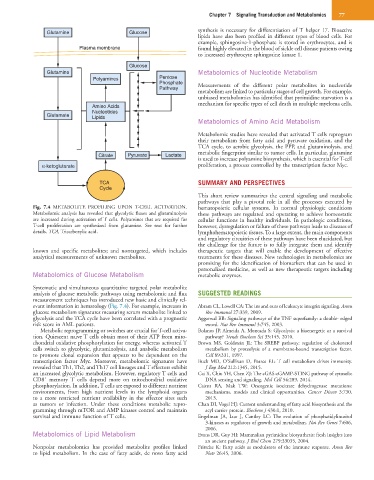
                                                                  Metabolomic studies have revealed that activated T cells reprogram
                                                                  their  metabolism  from  fatty  acid  and  pyruvate  oxidation,  and  the
                                                                  TCA cycle, to aerobic glycolysis, the PPP, and glutaminolysis, and
                                 Citrate   Pyruvate    Lactate    metabolic fingerprint similar to tumor cells. In particular, glutamine
                                                                  is used to increase polyamine biosynthesis, which is essential for T-cell
               α-ketoglutarate                                    proliferation, a process controlled by the transcription factor Myc.


                                  TCA                             SUMMARY AND PERSPECTIVES
                                  Cycle
                                                                  This  short  review  summarizes  the  central  signaling  and  metabolic
                                                                  pathways  that  play  a  pivotal  role  in  all  the  processes  executed  by
            Fig.  7.4  METABOLITE  PROFILING  UPON  T-CELL  ACTIVATION.   hematopoietic  cellular  systems.  In  normal  physiologic  conditions
            Metabolomic analysis has revealed that glycolytic fluxes and glutaminolysis   these pathways are regulated and operating to achieve homeostatic
            are increased during activation of T cells. Polyamines that are required for   cellular  functions  in  healthy individuals.  In  pathologic conditions,
            T-cell  proliferation  are  synthesized  from  glutamine.  See  text  for  further   however, dysregulation or failure of these pathways leads to diseases of
            details. TCA, Tricarboxylic acid.                     lymphohematopoietic tissues. To a large extent, the main components
                                                                  and regulatory circuitries of these pathways have been elucidated, but
                                                                  the challenge for the future is to fully integrate them and identify
            known  and  specific  metabolites;  and  nontargeted,  which  includes   therapeutic  targets  that  will  enable  the  development  of  effective
            analytical measurements of unknown metabolites.       treatments for these diseases. New technologies in metabolomics are
                                                                  promising for the identification of biomarkers that can be used in
                                                                  personalized medicine, as well as new therapeutic targets including
            Metabolomics of Glucose Metabolism                    metabolic enzymes.

            Systematic and simultaneous quantitative targeted polar metabolite
            analysis of glucose metabolic pathways using metabolomic and flux   SUGGESTED READINGS
            measurement techniques has introduced new basic and clinically rel-
            evant information in hematology (Fig. 7.4). For example, increases in   Abram CL, Lowell CA: The ins and outs of leukocyte integrin signaling. Annu
            glucose metabolism signatures measuring serum metabolite linked to   Rev Immunol 27:339, 2009.
            glycolysis and the TCA cycle have been correlated with a prognostic   Aggarwal BB: Signaling pathways of the TNF superfamily: a double- edged
            risk score in AML patients.                             sword. Nat Rev Immunol 3:745, 2003.
              Metabolic reprogramming or switches are crucial for T-cell activa-  Bolanos JP, Almeida A, Moncada S: Glycolysis: a bioenergetic or a survival
            tion. Quiescent naive T cells obtain most of their ATP from mito-  pathway? Trends Biochem Sci 35:145, 2010.
            chondrial oxidative phosphorylation for energy, whereas activated T   Brown  MS,  Goldstein  JL: The  SREBP  pathway:  regulation  of  cholesterol
            cells switch to glycolytic, glutaminolysis, and anabolic metabolism   metabolism  by  proteolysis  of  a  membrane-bound  transcription  factor.
            to promote clonal expansion that appears to be dependent on the   Cell 89:331, 1997.
            transcription  factor  Myc.  Moreover,  metabolomic  signatures  have   Buck  MD,  O’Sullivan  D,  Pearce  EL: T  cell  metabolism  drives  immunity.
            revealed that Th1, Th2, and Th17 cell lineages and T effectors exhibit   J Exp Med 212:1345, 2015.
            an increased glycolytic metabolism. However, regulatory T cells and   Cai X, Chiu YH, Chen ZJ: The cGAS-cGAMP-STING pathway of cytosolic
                +
            CD8   memory  T  cells  depend  more  on  mitochondrial  oxidative   DNA sensing and signaling. Mol Cell 54:289, 2014.
            phosphorylation. In addition, T cells are exposed to different nutrient   Cairns  RA,  Mak  TW:  Oncogenic  isocitrate  dehydrogenase  mutations:
            environments,  from  high  nutrient  levels  in  the  lymphoid  organs   mechanisms,  models  and  clinical  opportunities.  Cancer  Discov  3:730,
            to  a  more  restricted  nutrient  availability  in  the  effector  sites  such   2013.
            as  tumors  or  infection.  Under  these  conditions  metabolic  repro-  Chan DI, Vogel HJ: Current understanding of fatty acid biosynthesis and the
            gramming through mTOR and AMP kinases control and maintain   acyl carrier protein. Biochem J 430:1, 2010.
            survival and immune function of T cells.              Engelman  JA,  Luo  J,  Cantley  LC:  The  evolution  of  phosphatidylinositol
                                                                    3-kinases as regulators of growth and metabolism. Nat Rev Genet 7:606,
                                                                    2006.
            Metabolomics of Lipid Metabolism                      Evans DR, Guy HI: Mammalian pyrimidine biosynthesis: fresh insights into
                                                                    an ancient pathway. J Biol Chem 279:33035, 2004.
            Nonpolar  metabolomics  has  provided  metabolite  profiles  linked   Fritsche  K:  Fatty  acids  as  modulators  of  the  immune  response.  Annu  Rev
            to  lipid  metabolism.  In  the  case  of  fatty  acids,  de  novo  fatty  acid   Nutr 26:45, 2006.

