


Page 109 - Hematology_ Basic Principles and Practice ( PDFDrive )
P. 109
80    Part I  Molecular and Cellular Basis of Hematology


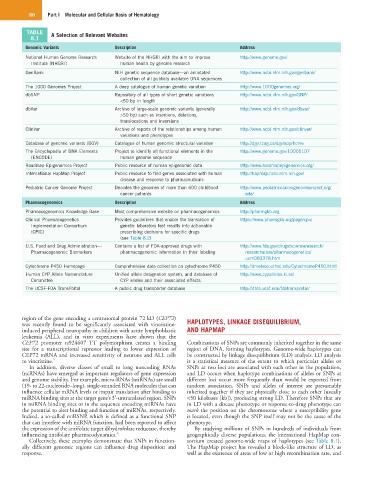
          TABLE   A Selection of Relevant Websites
           8.1
         Genomic Variants              Description                             Address
         National Human Genome Research   Website of the NHGRI with the aim to improve   http://www.genome.gov/
           Institute (NHGRI)            human health by genome research
         GenBank                       NIH genetic sequence database—an annotated   http://www.ncbi.nlm.nih.gov/genbank/
                                        collection of all publicly available DNA sequences
         The 1000 Genomes Project      A deep catalogue of human genetic variation  http://www.1000genomes.org/
         dbSNP                         Repository of all types of short genetic variations   http://www.ncbi.nlm.nih.gov/SNP/
                                        <50 bp in length
         dbVar                         Archive of large-scale genomic variants (generally   http://www.ncbi.nlm.nih.gov/dbvar/
                                        >50 bp) such as insertions, deletions,
                                        translocations and inversions
         ClinVar                       Archive of reports of the relationships among human   http://www.ncbi.nlm.nih.gov/clinvar/
                                        variations and phenotypes
         Database of genomic variants (DGV)  Catalogue of human genomic structural variation  http://dgv.tcag.ca/dgv/app/home
         The Encyclopedia of DNA Elements   Project to identify all functional elements in the   http://www.genome.gov/10005107
           (ENCODE)                     human genome sequence
         Roadmap Epigenomics Project   Public resource of human epigenomic data  http://www.roadmapepigenomics.org/
         International HapMap Project  Public resource to find genes associated with human   http://hapmap.ncbi.nlm.nih.gov/
                                        disease and response to pharmaceuticals
         Pediatric Cancer Genome Project  Decodes the genomes of more than 600 childhood   http://www.pediatriccancergenomeproject.org/
                                        cancer patients                          site/
         Pharmacogenomics              Description                             Address
         Pharmacogenomics Knowledge Base  Most comprehensive website on pharmacogenomics  http://pharmgkb.org
         Clinical Pharmacogenetics     Provides guidelines that enable the translation of   https://www.pharmgkb.org/page/cpic
           Implementation Consortium    genetic laboratory test results into actionable
           (CPIC)                       prescribing decisions for specific drugs
                                        (see Table 8.2)
         U.S. Food and Drug Administration—  Contains a list of FDA-approved drugs with   http://www.fda.gov/drugs/scienceresearch/
           Pharmacogenomic Biomarkers   pharmacogenomic information in their labeling  researchareas/pharmacogenetics/
                                                                                 ucm083378.htm
         Cytochrome P450 Homepage      Comprehensive data collection on cytochrome P450  http://drnelson.uthsc.edu/CytochromeP450.html
         Human CYP Allele Nomenclature   Unified allele designation system, and database of   http://www.cypalleles.ki.se/
           Committee                    CYP alleles and their associated effects
         The UCSF-FDA TransPortal      A public drug transporter database      http://dbts.ucsf.edu/fdatransportal/


        region of the gene encoding a centrosomal protein 72 kD (CEP72)
        was  recently  found  to  be  significantly  associated  with  vincristine-  HAPLOTYPES, LINKAGE DISEQUILIBRIUM,
        induced peripheral neuropathy in children with acute lymphoblastic   AND HAPMAP
        leukemia  (ALL),  and  in  vitro  experiments  have  shown  that  the
        CEP72  promoter  rs924607  TT  polymorphism  creates  a  binding   Combinations of SNPs are commonly inherited together in the same
        site  for  a  transcriptional  repressor  leading  to  lower  expression  of   region of DNA, forming haplotypes. Genome-wide haplotypes can
        CEP72 mRNA and increased sensitivity of neurons and ALL cells   be constructed by linkage disequilibrium (LD) analysis. LD analysis
        to vincristine. 5                                     is  a  statistical  measure  of  the  extent  to  which  particular  alleles  or
           In  addition,  diverse  classes  of  small  to  long  noncoding  RNAs   SNPs at two loci are associated with each other in the population,
        (ncRNAs) have emerged as important regulators of gene expression   and LD occurs when haplotype combinations of alleles or SNPs at
        and genome stability. For example, micro-RNAs (miRNAs) are small   different loci occur more frequently than would be expected from
        (19- to 22-nucleotide–long), single-stranded RNA molecules that can   random  association.  SNPs  and  alleles  of  interest  are  presumably
        influence cellular mRNA levels or impair translation after binding to   inherited together if they are physically close to each other (usually
        miRNA binding sites at the target gene’s 3′-untranslated region. SNPs   <50 kilobases [kb]), producing strong LD. Therefore SNPs that are
        in miRNA binding sites or in the sequence encoding miRNAs have   in LD with a disease phenotype or response-to-drug phenotype can
        the potential to alter binding and function of miRNAs, respectively.   mark the position on the chromosome where a susceptibility gene
        Indeed, a so-called miRSNP, which is defined as a functional SNP   is located, even though the SNP itself may not be the cause of the
        that can interfere with miRNA function, had been reported to affect   phenotype.
        the expression of the antifolate target dihydrofolate reductase, thereby   By  studying  millions  of  SNPs  in  hundreds  of  individuals  from
        influencing antifolate pharmacodynamics. 6            geographically diverse populations, the international HapMap con-
           Collectively, these examples demonstrate that SNPs in function-  sortium  created  genome-wide  maps  of  haplotypes  (see Table  8.1).
        ally  different  genomic  regions  can  influence  drug  disposition  and   The HapMap project has revealed a block-like structure of LD, as
        response.                                             well as the existence of areas of low or high recombination rate, and

