


Page 1204 - Hematology_ Basic Principles and Practice ( PDFDrive )
P. 1204
1052   Part VII  Hematologic Malignancies


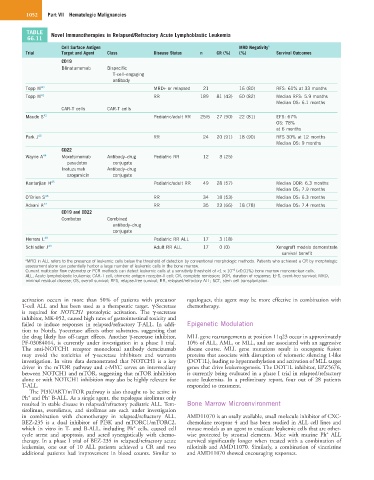
          TABLE   Novel Immunotherapies in Relapsed/Refractory Acute Lymphoblastic Leukemia
          66.11
                     Cell Surface Antigen                                      MRD Negativity   a
         Trial       Target and Agent  Class       Disease Status  n    CR (%)  (%)        Survival Outcomes
                     CD19
                     Blinatumomab   Bispecific
                                      T-cell–engaging
                                      antibody
         Topp M 40                                 MRD+ or relapsed  21        16 (80)     RFS: 61% at 33 months
         Topp M 41                                 RR              189  81 (43)  60 (82)   Median RFS: 5.9 months
                                                                                           Median OS: 6.1 months
                     CAR-T cells    CAR-T cells
         Maude S 42                                Pediatric/adult RR  25/5  27 (90)  22 (81)  EFS: 67%
                                                                                           OS: 78%
                                                                                           at 6 months
         Park J 43                                 RR              24   20 (91)  18 (90)   RFS 30% at 12 months
                                                                                           Median OS: 9 months
                     CD22
         Wayne A 44  Moxetumomab    Antibody–drug   Pediatric RR   12    3 (25)
                       pasudotox      conjugate
                     Inotuzumab     Antibody–drug
                       ozogamicin     conjugate
         Kantarjian H 45                           Pediatric/adult RR  49  28 (57)         Median DOR: 6.3 months
                                                                                           Median OS; 7.9 months
         O’Brien S 46                              RR              34   18 (53)            Median OS: 6.3 months
         Advani A 47                               RR              35   23 (66)  18 (78)   Median OS: 7.4 months
                     CD19 and CD22
                     Combotox       Combined
                                      antibody–drug
                                      conjugate
         Herrera L 48                              Pediatric RR ALL  17  3 (18)
         Schindler J 49                            Adult RR ALL    17    0 (0)             Xenograft models demonstrate
                                                                                             survival benefit
         a MRD in ALL refers to the presence of leukemic cells below the threshold of detection by conventional morphologic methods. Patients who achieved a CR by morphologic
         assessment alone can potentially harbor a large number of leukemic cells in the bone marrow.
                                                                             −4
         Current multicolor flow cytometry or PCR methods can detect leukemic cells at a sensitivity threshold of <1 × 10  (<0.01%) bone marrow mononuclear cells.
         ALL, Acute lymphoblastic leukemia; CAR-T cell, chimeric antigen receptor-T cell; CR, complete remission; DOR, duration of response; EFS, event-free survival; MRD,
         minimal residual disease; OS, overall survival; RFS, relapse-free survival; RR, relapsed/refractory ALL; SCT, stem cell transplantation.
        activation  occurs  in  more  than  50%  of  patients  with  precursor   rapalogues,  this  agent  may  be  more  effective  in  combination  with
        T-cell  ALL  and  has  been  used  as  a  therapeutic  target.  γ-Secretase   chemotherapy.
        is  required  for  NOTCH1  proteolytic  activation.  The  γ-secretase
        inhibitor, MK-052, caused high rates of gastrointestinal toxicity and
        failed  to  induce  responses  in  relapsed/refractory  T-ALL.  In  addi-  Epigenetic Modulation
        tion  to  Notch,  γ-secretase  affects  other  substrates,  suggesting  that
        the drug likely has off-target effects. Another γ-secretase inhibitor,   MLL gene rearrangements at position 11q23 occur in approximately
        PF-03084014,  is  currently  under  investigation  in  a  phase  I  trial.   10% of ALL, AML, or MLL, and are associated with an aggressive
        The  anti-NOTCH1  receptor  monoclonal  antibody  demcizumab   disease  course.  MLL  gene  mutations  result  in  oncogenic  fusion
        may  avoid  the  toxicities  of  γ-secretase  inhibitors  and  warrants   proteins that associate with disruption of telomeric silencing 1-like
        investigation.  In  vitro  data  demonstrated  that  NOTCH1  is  a  key   (DOT1L), leading to hypermethylation and activation of MLL target
        driver  in  the  mTOR  pathway  and  c-MYC  serves  an  intermediary   genes that drive leukemogenesis. The DOT1L inhibitor, EPZ5676,
        between NOTCH1 and mTOR, suggesting that mTOR inhibition   is currently being evaluated in a phase I trial in relapsed/refractory
        alone or with NOTCH1 inhibition may also be highly relevant for    acute  leukemias.  In  a  preliminary  report,  four  out  of  28  patients
        T-ALL.                                                responded to treatment.
           The PI3K/AKT/mTOR pathway is also thought to be active in
          +
                 –
        Ph  and Ph  B-ALL. As a single agent, the rapalogue sirolimus only
        resulted in stable disease in relapsed/refractory pediatric ALL. Tem-  Bone Marrow Microenvironment
        sirolimus,  everolimus,  and  sirolimus  are  each  under  investigation
        in  combination  with  chemotherapy  in  relapsed/refractory  ALL.   AMD11070 is an orally available, small molecule inhibitor of CXC-
        BEZ-235  is  a  dual  inhibitor  of  PI3K  and  mTORC1/mTORC2,   chemokine receptor 4 and has been studied in ALL cell lines and
                                             +
        which  in  vitro  in T-  and  B-ALL,  including  Ph   cells,  caused  cell   mouse models as an agent to eradicate leukemic cells that are other-
                                                                                                            +
        cycle  arrest  and  apoptosis,  and  acted  synergistically  with  chemo-  wise  protected  by  stromal  elements.  Mice  with  murine  Ph   ALL
        therapy. In a phase I trial of BEZ-235 in relapsed/refractory acute   survived  significantly  longer  when  treated  with  a  combination  of
        leukemias,  one  out  of  10  ALL  patients  achieved  a  CR  and  two   nilotinib  and  AMD11070.  Similarly,  a  combination  of  vincristine
        additional  patients  had  improvement  in  blood  counts.  Similar  to   and AMD11070 showed encouraging responses.

