


Page 1199 - Hematology_ Basic Principles and Practice ( PDFDrive )
P. 1199
Chapter 66  Acute Lymphoblastic Leukemia in Adults  1047


                          A                              B               C
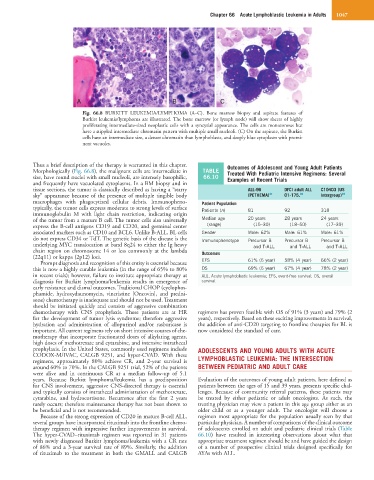
                            Fig.  66.8  BURKITT  LEUKEMIA/LYMPHOMA  (A–C).  Bone  marrow  biopsy  and  aspirate  features  of
                            Burkitt leukemia/lymphoma are illustrated. The bone marrow (or lymph node) will show sheets of highly
                            proliferating intermediate-sized neoplastic cells with a syncytial appearance. The cells are monotonous but
                            have a stippled intermediate chromatin pattern with multiple small nucleoli. (C) On the aspirate, the Burkitt
                            cells have an intermediate size, a denser chromatin than lymphoblasts, and deeply blue cytoplasm with promi-
                            nent vacuoles.


            Thus a brief description of the therapy is warranted in this chapter.   Outcomes of Adolescent and Young Adult Patients
            Morphologically (Fig. 66.8), the malignant cells are intermediate in   TABLE   Treated With Pediatric Intensive Regimens: Several
            size, have round nuclei with small nucleoli, are intensely basophilic,   66.10  Examples of Recent Trials
            and frequently have vacuolated cytoplasms. In a BM biopsy and in
            tissue sections, the tumor is classically described as having a “starry   ALL-96   DFCI adult ALL   C10403 (US
            sky” appearance because of the presence of multiple tingible body     (PETHEMA) 37  01-175. 38  Intergroup) 39
            macrophages  with  phagocytized  cellular  debris.  Immunopheno-  Patient Population
            typically, the tumor cells express moderate to strong levels of surface   Patients (n)  81  92  318
            immunoglobulin  M  with  light  chain  restriction,  indicating  origin
            of the tumor from a mature B cell. The tumor cells also universally   Median age   20 years   28 years   24 years
            express the B-cell antigens CD19 and CD20, and germinal center   (range)  (15–30)   (18–50)     (17–39)
            associated markers such as CD10 and BCL6. Unlike B-ALL, BL cells   Gender  Male: 62%  Male: 61%  Male: 61%
            do not express CD34 or TdT. The genetic basis of the disease is the   Immunophenotype  Precursor B   Precursor B   Precursor B
            underlying MYC translocation at band 8q24 to either the Ig heavy        and T-ALL   and T-ALL   and T-ALL
            chain region on chromosome 14 or less commonly at the lambda   Outcomes
            (22q11) or kappa (2p12) loci.
              Prompt diagnosis and recognition of this entity is essential because   EFS  61% (6 year)  58% (4 year)  66% (2 year)
            this is now a highly curable leukemia (in the range of 65% to 80%   OS  69% (6 year)  67% (4 year)  78% (2 year)
            in recent trials); however, failure to institute appropriate therapy at   ALL, Acute lymphoblastic leukemia; EFS, event-free survival; OS, overall
            diagnosis  for  Burkitt  lymphoma/leukemia  results  in  emergence  of   survival.
            early resistance and dismal outcomes. Traditional CHOP (cyclophos-
            phamide,  hydroxydaunomycin,  vincristine  [Oncovin],  and  predni-
            sone) chemotherapy is inadequate and should not be used. Treatment
            should be initiated quickly and consists of aggressive combination
            chemotherapy  with  CNS  prophylaxis.  These  patients  are  at  HR   regimens has proven feasible with OS of 91% (3 years) and 79% (2
            for  the  development  of  tumor  lysis  syndrome;  therefore  aggressive   years), respectively. Based on these exciting improvements in survival,
            hydration  and  administration  of  allopurinol  and/or  rasburicase  is   the addition of anti-CD20 targeting to frontline therapies for BL is
            important. All current regimens rely on short intensive courses of che-  now considered the standard of care.
            motherapy that incorporate fractionated doses of alkylating agents,
            high doses of methotrexate and cytarabine, and intensive intrathecal
            prophylaxis. In the United States, commonly used regimens include   ADOLESCENTS AND YOUNG ADULTS WITH ACUTE
            CODOX-M/IVAC,  CALGB  9251,  and  hyper-CVAD. With  these
            regimens,  approximately  80%  achieve  CR,  and  2-year  survival  is   LYMPHOBLASTIC LEUKEMIA: THE INTERSECTION
            around 60% to 70%. In the CALGB 9251 trial, 52% of the patients   BETWEEN PEDIATRIC AND ADULT CARE
            were  alive  and  in  continuous  CR  at  a  median  follow-up  of  5.1
            years.  Because  Burkitt  lymphoma/leukemia  has  a  predisposition   Evaluation of the outcomes of young adult patients, here defined as
            for CNS involvement, aggressive CNS-directed therapy is essential   patients between the ages of 15 and 39 years, presents specific chal-
            and typically consists of intrathecal administration of methotrexate,   lenges. Because of community referral patterns, these patients may
            cytarabine,  and  hydrocortisone.  Recurrence  after  the  first  2  years   be  treated  by  either  pediatric  or  adult  oncologists.  As  such,  the
            rarely occurs; therefore maintenance therapy has not been shown to   treating physician may view a patient in this age group either as an
            be beneficial and is not recommended.                 older  child  or  as  a  younger  adult.  The  oncologist  will  choose  a
              Because of the strong expression of CD20 in mature B-cell ALL,   regimen  most  appropriate  for  the  population  usually  seen  by  that
            several groups have incorporated rituximab into the frontline chemo-  particular physician. A number of comparisons of the clinical outcome
            therapy regimen with impressive further improvements in survival.   of adolescents enrolled on adult and pediatric clinical trials (Table
            The  hyper-CVAD–rituximab  regimen  was  reported  in  31  patients   66.10)  have  resulted  in  interesting  observations  about  what  that
            with newly diagnosed Burkitt lymphoma/leukemia with a CR rate   appropriate treatment regimen should be and have guided the design
            of 86% and a 3-year survival rate of 89%. Similarly, the addition   of  a  number  of  prospective  clinical  trials  designed  specifically  for
            of  rituximab  to  the  treatment  in  both  the  GMALL  and  CALGB   AYAs with ALL.

