


Page 1235 - Hematology_ Basic Principles and Practice ( PDFDrive )
P. 1235
Chapter 68  The Polycythemias  1081


                              Asymptomatic                        evaluation to differentiate this disorder from other causes of spurious
                              Splenomegaly                        or absolute erythrocytosis. The diagnosis of PV has been simplified
                           Isolated erythrocytosis                by the identification of PV-associated mutations (JAK2V617F and
                           Isolated thrombocytosis                JAK2  exon  12  mutations),  permitting  for  the  first  time  molecular
                                                                  epidemiologic studies. The prevalence of the JAK2V617F mutation
                                                                  in a normal population in Denmark was recently determined to be
                                                                  0.2%, with 63% of these individuals not having a previously detected
                            Erythrocytotic phase                  hematological malignancy. The presence of the mutation was associ-
                              Erythrocytosis                      ated with increasing age, male sex, and a lower cumulative survival.
                              Thrombocytosis                      Recently available 2001–2012 data from the Surveillance, Epidemiol-
                               Leukocytosis                       ogy and End Results (SEER) Program from the US National Cancer
                              Splenomegaly                        Institute provided new insight into the IR of the MPNs. This study
                               Thrombosis                         utilized the WHO Diagnostic Criteria and for the last 5 years of the
                               Hemorrhage                         study JAK2V617F testing was included. The age adjusted IR of PV
                                 Pruritus                         and essential thrombocythemia (ET) were 10.9 and 9.4 per 1 million
                                                                  per year, respectively. The IR for PMF was 3.1. In order to grasp the
                                                                  magnitude of the IR of these various MPNs, the IR of CML was 3.3,
                                                                                              −
                                                                  demonstrating that the IR of these Ph  MPNs were sevenfold higher
                          Post-PV MF, myelofibrosis               than CML. Both PV and PMF were more frequent in males while
                                 Anemia                           the IR for ET was greater in females. Several groups have reported
                            Leukoerythroblastosis
                            Thrombocytopenia or                   that 50% of patients with a splanchnic vein thrombosis without an
                              thrombocytosis                      overt MPN are JAK2V617F positive and that more than 50% of these
                           Enlarging splenomegaly                 individuals subsequently develop an MPN. However, the incidence
                            Systematic symptoms                   of  the  mutation  with  unprovoked  thromboembolism  in  the  more
                             (fever, weight loss)                 usual sites (deep venous thrombosis involving the leg veins or pul-
                                                                  monary embolism) ranges between 0.2 and 1.0%. Such data have led
                                                                  to the conclusion that systematic screening for JAK2V617 in such a
                                                                  patient population is not warranted.
                           Acute myeloid leukemia                   The prevalence of PV has been reported by several investigators
                                                                  to  be  higher  among  American  Jews  and  lower  among  African–
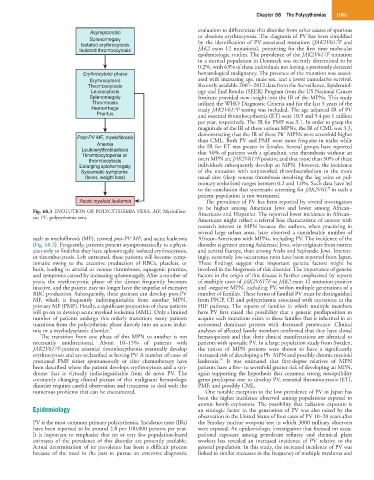
            Fig. 68.3  EVOLUTION OF POLYCYTHEMIA VERA. MF, Myelofibro-  Americans and Hispanics. The reported lower incidence in African–
            sis; PV, polycythemia vera.
                                                                  Americans might reflect a referral bias characteristic of centers with
                                                                  research interest in MPN because the authors, when practicing in
                                                                  several  large  urban  areas,  have  observed  a  considerable  number  of
            such as myelofibrosis (MF), termed post-PV MF, and acute leukemia   African–Americans with MPNs, including PV. The incidence of the
            (Fig. 68.3). Frequently, patients present asymptomatically to a physi-  disorder is greater among Ashkenazi Jews, who originate from eastern
            cian only to find that they have splenomegaly, isolated erythrocytosis,   and central Europe, than among Arabs and Sephardic Jews. Interest-
            or thrombocytosis. Left untreated, these patients will become symp-  ingly, extremely low occurrence rates have been reported from Japan.
            tomatic  owing  to  the  excessive  production  of  RBCs,  platelets,  or   These  findings  suggest  that  important  genetic  factors  might  be
            both, leading to arterial or venous thromboses, aquagenic pruritus,   involved in the biogenesis of this disorder. The importance of genetic
            and symptoms caused by increasing splenomegaly. After a number of   factors in the origin of this disease is further emphasized by reports
            years,  the  erythrocytotic  phase  of  the  disease  frequently  becomes   of multiple cases of JAK2V617F or JAK2 exon 12 mutation-positive
            inactive, and the patient may no longer have the sequelae of excessive   and -negative MPN, including PV, within multiple generations of a
            RBC production. Subsequently, these patients can develop post-PV   number of families. These forms of familial PV must be distinguished
            MF,  which  is  frequently  indistinguishable  from  another  MPN,   from PFCP, CP, and polycythemia associated with mutations in the
            primary MF (PMF). Finally, a significant proportion of these patients   HIF pathway. The reports of families in which multiple members
            will go on to develop acute myeloid leukemia (AML). Only a limited   have PV first raised the possibility that a genetic predisposition to
            number of patients undergo this orderly transition; many patients   acquire such mutations exists in these families that is inherited in an
            transition from the polycythemic phase directly into an acute leuke-  autosomal  dominant  pattern  with  decreased  penetrance.  Clinical
            mia or a myelodysplastic disorder. 9                  analyses of affected family members confirmed that they have clonal
              The  transition  from  one  phase  of  this  MPN  to  another  is  not   hematopoiesis and that their clinical manifestations are identical to
            necessarily  unidirectional.  About  10–15%  of  patients  with   patients with sporadic PV. In a large population study from Sweden,
            JAK2V617F-positive essential thrombocythemia eventually develop   the  ratives  of  MPN  patients  were  shown  to  have  a  significantly
                                                                                         −
            erythrocytosis and are reclassified as having PV. A number of cases of   increased risk of developing a Ph  MPN and possibly chronic myeloid
                                                                         10
            presumed  PMF  either  spontaneously  or  after  chemotherapy  have   leukemia.   It  was  estimated  that  first-degree  relatives  of  MPN
            been described where the patient develops erythrocytosis and a syn-  patients have a five- to sevenfold greater risk of developing an MPN,
            drome  that  is  virtually  indistinguishable  from  de  novo  PV.  The   again supporting the hypothesis that common strong susceptibility
            constantly changing  clinical  picture of this malignant  hematologic   genes predispose one to develop PV, essential thrombocytosis (ET),
            disorder requires careful observation and treatment to deal with the   PMF, and possibly CML.
            numerous problems that can be encountered.              One notable exception to the low prevalence of PV in Japan has
                                                                  been the higher incidence observed among populations exposed to
                                                                  atomic bomb explosions. The possibility that radiation exposure is
            Epidemiology                                          an  etiologic factor  in  the generation  of  PV  was also raised by the
                                                                  observation in the United States of four cases of PV 10–20 years after
            PV is the most common primary polycythemia. Incidence rates (IRs)   the Smokey nuclear weapons test in which 3000 military observers
            have been reported to be around 2.8 per 100,000 persons per year.   were exposed. An epidemiologic investigation that focused on occu-
            It is important to emphasize that no or very few population-based   pational  exposure  among  petroleum  refinery  and  chemical  plant
            estimates of the prevalence of this disorder are presently available.   workers  has  revealed  an  increased  incidence  of  PV  relative  to  the
            Actual  determination  of  its  prevalence  has  been  a  difficult  process   general population. In this study, the increased incidence of PV was
            because  of  the  need  in  the  past  to  pursue  an  extensive  diagnostic   linked to similar increases in the frequency of multiple myeloma and

