


Page 1237 - Hematology_ Basic Principles and Practice ( PDFDrive )
P. 1237
Chapter 68  The Polycythemias  1083


             A                                                     B
                                                                                               Cytokine
                                                                                               receptor
                                  JAK2                               Cell membrane
                                  V617F
                                                                                 SHP2
              NH                      JH2        JH1    COOH                                           P     P    P
                2           SH2                                                                      P          P
                    FERM         Pseudokinase  Kinase                            JAK2      JAK2     PIP2       PIP3
                    domain         domain      domain
                                                                                    P       P            PI3K
                                                                                      P    P

                                                                                          STAT
                                                                     GRB2    SHC
                                                                                                         AKT
                                                                         RAS
                                                                                        P     P
                                 Trafficking of                                        STAT  STAT
                               cytokine receptors                        MEK1

                                                                                 ERK
                                 Proliferation
                                 Differentiation                      Cytoplasm
                                   Survival
                                                                                         GATA1
                                                                                         NF-E2      SOCS
                                                                                                   BCL-x
                                                                             Nucleus               CyclinD L

                                                                                     Cytokines/receptors


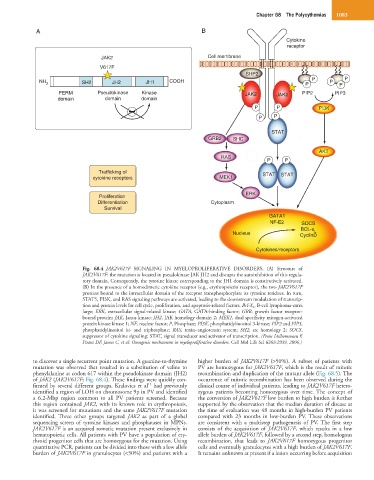
                            Fig.  68.4  JAK2V617F  SIGNALING  IN  MYELOPROLIFERATIVE  DISORDERS.  (A)  Structure  of
                            JAK2V617F: the mutation is located in pseudokinase JAK JH2 and disrupts the autoinhibition of this regula-
                            tory domain. Consequently, the tyrosine kinase corresponding to the JH1 domain is constitutively activated.
                            (B) In the presence of a homodimeric cytokine receptor (e.g., erythropoietin receptor), the two JAK2V617F
                            proteins bound to the intracellular domain of the receptor transphosphorylate its tyrosine residues. In turn,
                            STAT5, PI3K, and RAS signaling pathways are activated, leading to the downstream modulation of transcrip-
                            tion and protein levels for cell cycle, proliferation, and apoptosis-related factors. Bcl-X L, B-cell lymphoma-extra
                            large; ERK, extracellular signal-related kinase; GATA, GATA-binding factor; GRB, growth factor receptor-
                            bound protein; JAK, Janus kinase; JH2, JAK homology domain 2; MEK1, dual specificity mitogen-activated
                            protein kinase kinase 1; NF, nuclear factor; P, Phosphate; PI3K, phosphatidylinositol 3-kinase; PIP2 and PIP3,
                            phosphatidylinositol  bi-  and  triphosphate;  RAS,  renin–angiotensin  system;  SH2,  src  homology  2;  SOCS,
                            suppressor of cytokine signaling; STAT, signal transducer and activator of transcription. (From Delhommeau F,
                            Pisani DF, James C, et al: Oncogenic mechanisms in myeloproliferative disorders. Cell Mol Life Sci 6363:2939, 2006.)


            to discover a single recurrent point mutation. A guanine-to-thymine   higher  burden  of  JAK2V617F  (>50%).  A  subset  of  patients  with
            mutation was  observed  that resulted  in a  substitution  of  valine  to   PV are homozygous for JAK2V617F, which is the result of mitotic
            phenylalanine at codon 617 within the pseudokinase domain (JH2)   recombination and duplication of the mutant allele (Fig. 68.5). The
            of JAK2 (JAK2V617F; Fig. 68.4). These findings were quickly con-  occurrence of mitotic recombination has been observed during the
                                                 13
            firmed by several different groups. Kralovics et al  had previously   clinical course of individual patients, leading to JAK2V617F hetero-
            identified a region of LOH on chromosome 9p in PV and identified   zygous  patients  becoming  homozygous  over  time. The  concept  of
            a  6.2-Mbp  region  common  to  all  PV  patients  screened.  Because   the conversion of JAK2V617F low burden to high burden is further
            this region contained JAK2, with its known role in erythropoiesis,   supported by the observation that the median duration of disease at
            it was screened for mutations and the same JAK2V617F mutation   the time of evaluation was 48 months in high-burden PV patients
            identified.  Three  other  groups  targeted  JAK2  as  part  of  a  global   compared  with  23  months  in  low-burden  PV. These  observations
            sequencing  screen  of  tyrosine  kinases  and  phosphatases  in  MPNs.   are  consistent  with  a  multistep  pathogenesis  of  PV. The  first  step
            JAK2V617F is an acquired somatic mutation present exclusively in   consists  of  the  acquisition  of  JAK2V617F,  which  results  in  a  low
            hematopoietic cells. All patients with PV have a population of ery-  allele burden of JAK2V617F, followed by a second step, homologous
            throid progenitor cells that are homozygous for the mutation. Using   recombination,  that  leads  to  JAK2V617F  homozygous  progenitor
            quantitative PCR, patients can be divided into those with a low allele   cells and eventually granulocytes with a high burden of JAK2V617F.
            burden of JAK2V617F in granulocytes (<50%) and patients with a   It remains unknown at present if a lesion occurring before acquisition

