


Page 1238 - Hematology_ Basic Principles and Practice ( PDFDrive )
P. 1238
1084   Part VII  Hematologic Malignancies


                                                                       Homozygous
                                                                      V617F mutation


                                                         9p
                                                                  9pLOH
                                  Hypothetical  Heterozygous
                                  mutation in  V167F mutation
                                   unknown      in JAK2
                                   gene “X”      gene
                                                                                        Expansion of
                                                                                       9pLOH subclone

                                                                               Clonal
                                                                             regression
                       Normal
                       stem cell
                                    Model B     Model A
                                                          Clonal expansion
                                         Onset of
                                      myeloproliferative
                                          disease                                      9pLOH-negative
                                                                                           cells
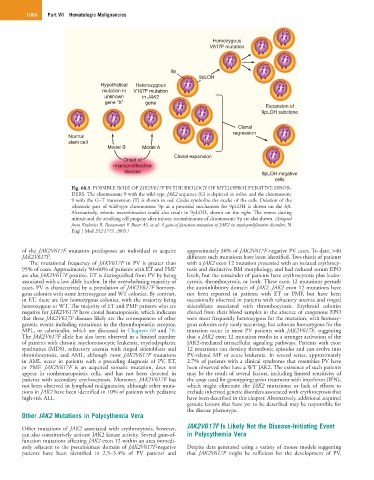
                        Fig. 68.5  POSSIBLE ROLE OF JAK2V617F IN THE BIOLOGY OF MYELOPROLIFERATIVE DISOR-
                        DERS. The chromosome 9 with the wild-type JAK2 sequence (G) is depicted in white, and the chromosome
                        9 with the G–T transversion (T) is shown in red. Circles symbolize the nuclei of the cells. Deletion of the
                        telomeric  part  of  wild-type  chromosome  9p  as  a  potential  mechanism  for  9pLOH  is  shown  on  the  left.
                        Alternatively,  mitotic  recombination  could  also  result  in  9pLOH,  shown  on  the  right. The  events  during
                        mitosis and the resulting cell progeny after mitotic recombination of chromosome 9p are also shown. (Adapted
                        from Kralovics R, Passamonti F, Buser AS, et al: A gain-of-function mutation of JAK2 in myeloproliferative disorders. N
                        Engl J Med 352:1779, 2005.)


        of  the  JAK2V617F  mutation  predisposes  an  individual  to  acquire   approximately 30% of JAK2V617F-negative PV cases. To date, >40
        JAK2V617F.                                            different such mutations have been identified. Two-thirds of patients
           The  mutational  frequency  of  JAKV617F  in  PV  is  greater  than   with a JAK2 exon 12 mutation presented with an isolated erythrocy-
        95% of cases. Approximately 50–60% of patients with ET and PMF   tosis and distinctive BM morphology, and had reduced serum EPO
        are also JAK2V617F positive. ET is distinguished from PV by being   levels, but the remainder of patients have erythrocytosis plus leuko-
        associated with a low allele burden. In the overwhelming majority of   cytosis, thrombocytosis, or both. These exon 12 mutations perturb
        cases, PV is characterized by a population of JAK2V617F homozy-  the autoinhibitory domain of JAK2. JAK2 exon 12 mutations have
        gous colonies with some heterozygous and WT colonies. By contrast,   not  been  reported  in  patients  with  ET  or  PMF,  but  have  been
        in ET, there are few homozygous colonies, with the majority being   occasionally observed in patients with refractory anemia and ringed
        heterozygous or WT. The majority of ET and PMF patients who are   sideroblasts  associated  with  thrombocytosis.  Erythroid  colonies
        negative for JAK2V617F have clonal hematopoiesis, which indicates   cloned from their blood samples in the absence of exogenous EPO
        that these JAK2V617F diseases likely are the consequences of other   were most frequently heterozygous for the mutation, with homozy-
        genetic events including mutations in the thrombopoietin receptor,   gous colonies only rarely occurring, but colonies homozygous for the
        MPL, or calreticulin, which are discussed in Chapters 69 and 70.   mutation occur in most PV patients with JAK2V617F, suggesting
        The JAK2V617F allele has also been observed in a limited number   that a JAK2 exon 12 mutation results in a stronger activation of the
        of patients with chronic myelomonocytic leukemia, myelodysplastic   JAK2-mediated intracellular signaling pathways. Patients with exon
        syndromes (MDS), refractory  anemia  with  ringed  sideroblasts  and   12 mutations can develop thrombotic episodes and can evolve into
        thrombocytosis,  and  AML,  although  most  JAK2V617F  mutations   PV-related  MF  or  acute  leukemia.  In  several  series,  approximately
        in  AML  occur  in  patients  with  a  preceding  diagnosis  of  PV,  ET,   2.7% of patients with a clinical syndrome that resembles PV have
        or  PMF.  JAK2V617F  is  an  acquired  somatic  mutation,  does  not   been observed who have a WT JAK2. The existence of such patients
        appear  in  nonhematopoietic  cells,  and  has  not  been  detected  in   may be the result of several factors, including limited sensitivity of
        patients  with  secondary  erythrocytosis.  Moreover,  JAK2V617F  has   the assay used for genotyping; prior treatment with interferon (IFN),
        not been observed in lymphoid malignancies, although other muta-  which  might  eliminate  the  JAK2  mutations;  or  lack  of  efforts  to
        tions in JAK2 have been identified in 10% of patients with pediatric   exclude inherited genetic disorders associated with erythrocytosis that
        high-risk ALL.                                        have been described in this chapter. Alternatively, additional acquired
                                                              genetic lesions that have yet to be described may be responsible for
                                                              the disease phenotype.
        Other JAK2 Mutations in Polycythemia Vera
                                                              JAK2V617F Is Likely Not the Disease-Initiating Event
        Other  mutations  of  JAK2  associated  with  erythrocytosis,  however,
        can also constitutively activate JAK2 kinase activity. Several gain-of-  in Polycythemia Vera
        function mutations affecting JAK2 exon 12 within an area immedi-
        ately adjacent to the pseudokinase domain of JAK2V617F-negative   Despite data generated using a variety of mouse models suggesting
        patients  have  been  identified  in  2.5–3.4%  of  PV  patients  and   that  JAK2V617F  might  be  sufficient  for  the  development  of  PV,

