


Page 1439 - Hematology_ Basic Principles and Practice ( PDFDrive )
P. 1439
Chapter 79  Marginal Zone Lymphomas (Extranodal/Malt, Splenic, and Nodal)  1285


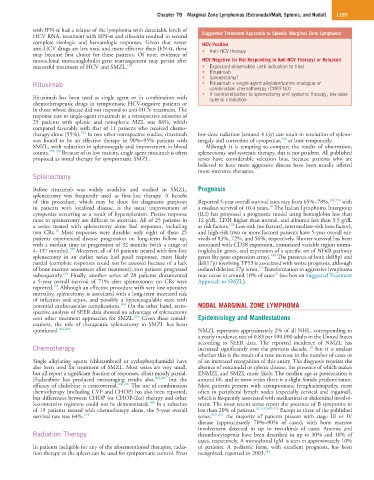
            with IFN-α had a relapse of the lymphoma with detectable levels of   Suggested Treatment Approach to Splenic Marginal Zone Lymphoma
            HCV RNA; treatment with IFN-α and ribavirin resulted in second
            complete  virologic  and  hematologic  responses.  Given  that  newer   HCV-Positive
            anti-HCV drugs are less toxic and more effective than IFN-α, these   •  Anti-HCV therapy
            may  become  first  choice  for  these  patients.  Of  note,  evidence  of
            monoclonal immunoglobulin gene rearrangement may persist after   HCV-Negative (or Not Responding to Anti-HCV Therapy) or Relapsed
            successful treatment of HCV and SMZL. 183              •  Expectant observation until indication to treat
                                                                   •  Rituximab
                                                                   •  Splenectomy?
            Rituximab                                              •  Rituximab + single-agent alkylator/purine analogue or
                                                                      combination chemotherapy (CVP/FND)
                                                                   •  If contraindication to splenectomy and systemic therapy, low-dose
            Rituximab  has  been  used  as  single  agent  or  in  combination  with   splenic irradiation
            chemotherapeutic drugs in symptomatic HCV-negative patients or
            in those whose disease did not respond to anti-HCV treatment. The
            response rate to single-agent rituximab in a retrospective subseries of
            25  patients  with  splenic  and  nonsplenic  MZL  was  88%,  which
            compared favorably with that of 11 patients who received chemo-
                           196
            therapy alone (55%).  In two other retrospective studies, rituximab   low-dose radiation (around 4 Gy) can result in resolution of spleno-
                                                                                             208
            was  found  to  be  an  effective  therapy  in  90%–95%  patients  with   megaly and correction of cytopenias,  at least temporarily.
            SMZL, with reduction in splenomegaly and improvement in blood   Although  it  is  tempting  to  compare  the  results  of  observation,
            counts. 197,198  Because of its low toxicity, single agent rituximab is often   splenectomy and systemic therapy, this is not prudent. All published
            proposed as initial therapy for symptomatic SMZL.     series  have  considerable  selection  bias,  because  patients  who  are
                                                                  believed  to have  more  aggressive  disease  have  been  usually  offered
                                                                  more-intensive therapies.
            Splenectomy
            Before  rituximab  was  widely  available  and  studied  in  SMZL,   Prognosis
            splenectomy  was  frequently  used  as  first-line  therapy.  A  benefit
            of  this  procedure,  which  may  be  done  for  diagnostic  purposes   Reported 5-year overall survival rates vary from 65%–78%, 180,194  with
                                                                                         10
            in  patients  with  localized  disease,  is  the  usual  improvement  of   a median survival of 10.4 years.  The Italian Lymphoma Intergroup
            cytopenias occurring as a result of hypersplenism. Precise response   (ILI) has proposed a prognostic model using hemoglobin less than
            rates to splenectomy are difficult to ascertain. All of 25 patients in   12 g/dL, LDH higher than normal, and albumin less than 3.5 g/dL
                                                                            178
            a  series  treated  with  splenectomy  alone  had  responses,  including   as risk factors.  Low-risk (no factors), intermediate-risk (one factor),
                   10
            two  CRs.   Most  responses  were  durable:  only  eight  of  these  25   and high-risk (two or more factors) patients have 5-year overall sur-
            patients  experienced  disease  progression  on  long-term  follow  up,   vivals of 83%, 72%, and 56%, respectively. Shorter survival has been
            with a median time to progression of 32 months (with a range of   associated with CD38 expression, unmutated variable region immu-
                        199
            4–137 months).  Moreover, all of 16 patients treated with first-line   noglobulin genes, and expression of a specific set of NFκB pathway
                                                                                          188
            splenectomy  in  an  earlier  series  had  good  responses,  most  likely   genes (by gene expression array).  The presence of both del(8p) and
            partial (complete responses could not be assessed because of a lack   del(17p) involving TP53 is associated with worse prognosis, although
                                                                                      77
            of bone marrow assessment after treatment); two patients progressed   isolated deletion 17p is not.  Transformation to aggressive lymphoma
                                                                                           10
                      195
            subsequently.   Finally,  another  series  of  28  patients  documented   may occur in around 10% of cases  (see box on Suggested Treatment
            a  5-year  overall  survival  of  71%  after  splenectomy;  no  CRs  were   Approach to SMZL).
                  194
            reported.  Although an effective procedure with very low operative
            mortality, splenectomy is associated with a long-term increased risk
            of  infection  and  sepsis,  and  possibly  a  hypercoagulable  state  with
                                         200
            potential cardiovascular complications.  On the other hand, retro-  NODAL MARGINAL ZONE LYMPHOMA
            spective analysis of SEER data showed no advantage of splenectomy
                                             201
            over other treatment approaches for SMZL.  Given these consid-  Epidemiology and Manifestations
            erations,  the  role  of  therapeutic  splenectomy  in  SMZL  has  been
            questioned. 202,203                                   NMZL represents approximately 2% of all NHL, corresponding to
                                                                  a yearly incidence rate of 0.83 per 100,000 adults in the United States
                                                                  according  to  SEER  data.  The  reported  incidence  of  NMZL  has
            Chemotherapy                                          increased significantly over the previous decade,   but it is unclear
                                                                                                      29
                                                                  whether this is the result of a true increase in the number of cases or
            Single  alkylating  agents  (chlorambucil  or  cyclophosphamide)  have   of an increased recognition of this entity. The diagnosis requires the
            also been used for treatment of SMZL. Most series are very small,   absence of extranodal or splenic disease, the presence of which makes
            but all report a significant fraction of responses, albeit mostly partial.   ENMZL and SMZL more likely. The median age at presentation is
            Fludarabine  has  produced  encouraging  results  also, 204,205   but  the   around 60, and in most series there is a slight female predominance.
            efficacy of cladribine is controversial. 206,207  The use of combination   Most  patients  present  with  asymptomatic  lymphadenopathy,  most
            chemotherapy (including CVP and CHOP) has also been reported,   often in peripheral lymph nodes (especially cervical and inguinal),
            but differences between CHOP (or CHOP-like) therapy and other   which is frequently associated with mediastinal or abdominal involve-
                                                  180
            less-intensive regimens could not be demonstrated.  In a subseries   ment. The most recent series report the presence of B symptoms in
            of 19 patients treated with chemotherapy alone, the 5-year overall   less than 20% of patients. 32,179,209–213  Except in three of the published
            survival rate was 64%. 194                            series, 210–212   the  majority  of  patients  present  with  stage  III  or  IV
                                                                  disease  (approximately  70%–80%  of  cases),  with  bone  marrow
                                                                  involvement  detected  in  up  to  two-thirds  of  cases.  Anemia  and
            Radiation Therapy                                     thrombocytopenia have been described in up to 30% and 10% of
                                                                  cases, respectively. A monoclonal IgM is seen in approximately 10%
            In patients ineligible for any of the aforementioned therapies, radia-  of  patients.  A  pediatric  form,  with  excellent  prognosis,  has  been
            tion therapy to the spleen can be used for symptomatic control. Even   recognized, reported in 2003. 214

