


Page 1438 - Hematology_ Basic Principles and Practice ( PDFDrive )
P. 1438
1284   Part VII  Hematologic Malignancies


           A                                            B                   C

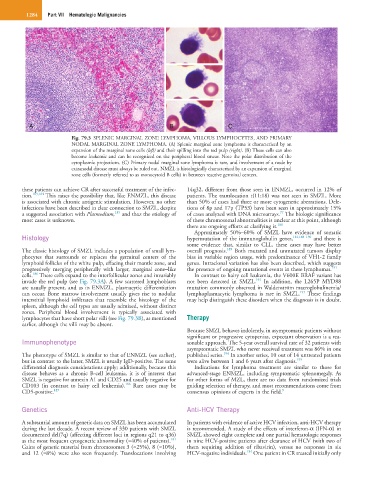
                        Fig. 79.3  SPLENIC MARGINAL ZONE LYMPHOMA, VILLOUS LYMPHOCYTES, AND PRIMARY
                        NODAL MARGINAL ZONE LYMPHOMA. (A) Splenic marginal zone lymphoma is characterized by an
                        expansion of the marginal zone cells (left) and their spilling into the red pulp (right). (B) These cells can also
                        become leukemic and can be recognized on the peripheral blood smear. Note the polar distribution of the
                        cytoplasmic projections. (C) Primary nodal marginal zone lymphoma is rare, and involvement of a node by
                        extranodal disease must always be ruled out. NMZL is histologically characterized by an expansion of marginal
                        zone cells (formerly referred to as monocytoid B cells) in between reactive germinal centers.

        these patients can achieve CR after successful treatment of the infec-  14q32, different from those seen in ENMZL, occurred in 12% of
        tion. 183,184  This raises the possibility that, like ENMZL, this disease   patients. The translocation t(11;18) was not seen in SMZL. More
        is associated with chronic antigenic stimulation. However, no other   than 50% of cases had three or more cytogenetic aberrations. Dele-
        infections have been described in clear connection to SMZL, despite   tions of 8p and 17p (TP53) have been seen in approximately 15%
                                       185
                                                                                             77
        a suggested association with Plasmodium,  and thus the etiology of   of cases analyzed with DNA microarrays.  The biologic significance
        most cases is unknown.                                of these chromosomal abnormalities is unclear at this point, although
                                                              there are ongoing efforts at clarifying it. 188
                                                                 Approximately  50%–60%  of  SMZL  have  evidence  of  somatic
        Histology                                             hypermutation of the immunoglobulin genes, 181,188–190  and there is
                                                              some  evidence  that,  similar  to  CLL,  these  cases  may  have  better
                                                                           189
        The classic histology of SMZL includes a population of small lym-  overall  prognosis.   Both  mutated  and  unmutated  tumors  display
        phocytes  that  surrounds  or  replaces  the  germinal  centers  of  the   bias in variable region usage, with predominance of VH1-2 family
        lymphoid follicles of the white pulp, effacing their mantle zone, and   genes. Intraclonal variation has also been described, which suggests
        progressively  merging  peripherally  with  larger,  marginal  zone–like   the presence of ongoing mutational events in these lymphomas. 191
            186
        cells.  These cells expand to the interfollicular zones and invariably   In contrast to hairy cell leukemia, the V600E BRAF variant has
                                                                                     192
        invade the red pulp (see Fig. 79.3A). A few scattered lymphoblasts   not  been  detected  in  SMZL.   In  addition,  the  L265P  MYD88
        are usually present, and as in ENMZL, plasmacytic differentiation   mutation commonly observed in Waldenström macroglobulinemia/
                                                                                                   193
        can occur. Bone marrow involvement usually gives rise to nodular   lymphoplasmacytic  lymphoma  is  rare  in  SMZL.  These  findings
        interstitial  lymphoid  infiltrates  that  resemble  the  histology  of  the   may help distinguish these disorders when the diagnosis is in doubt.
        spleen, although the cell types are usually admixed, without distinct
        zones.  Peripheral  blood  involvement  is  typically  associated  with
        lymphocytes that have short polar villi (see Fig. 79.3B), as mentioned   Therapy
        earlier, although the villi may be absent.
                                                              Because SMZL behaves indolently, in asymptomatic patients without
                                                              significant or progressive cytopenias, expectant observation is a rea-
        Immunophenotype                                       sonable approach. The 5-year overall survival rate of 32 patients with
                                                              asymptomatic SMZL who never received treatment was 86% in one
                                                                          194
        The phenotype of SMZL is similar to that of ENMZL (see earlier),   published series.  In another series, 10 out of 14 untreated patients
        but in contrast to the latter, SMZL is usually IgD-positive. The same   were alive between 1 and 6 years after diagnosis. 195
        differential diagnosis considerations apply; additionally, because this   Indications  for  lymphoma  treatment  are  similar  to  those  for
        disease  behaves  as  a  chronic  B-cell  leukemia,  it  is  of  interest  that   advanced-stage  ENMZL,  including  symptomatic  splenomegaly.  As
        SMZL is negative for annexin A1 and CD25 and usually negative for   for other forms of MZL, there are no data from randomized trials
                                          186
        CD103  (in  contrast  to  hairy  cell  leukemia).   Rare  cases  may  be   guiding selection of therapy, and most recommendations come from
        CD5-positive. 187                                     consensus opinions of experts in the field. 9

        Genetics                                              Anti-HCV Therapy

        A substantial amount of genetic data on SMZL has been accumulated   In patients with evidence of active HCV infection, anti-HCV therapy
        during the last decade. A recent review of 330 patients with SMZL   is recommended. A study of the effects of interferon-α (IFN-α) in
        documented del(7q) (affecting different loci in regions q21 to q36)   SMZL showed eight complete and one partial hematologic responses
                                                         181
        as the most frequent cytogenetic abnormality (≈40% of patients).    in nine HCV-positive patients after clearance of HCV (with two of
        Gains of genetic material from chromosomes 3 (≈25%), 8 (≈10%),   them  requiring  addition  of  ribavirin),  versus  no  responses  in  six
                                                                                  184
        and  12  (≈8%)  were  also  seen  frequently. Translocations  involving   HCV-negative individuals.  One patient in CR treated initially only

