


Page 1437 - Hematology_ Basic Principles and Practice ( PDFDrive )
P. 1437
Chapter 79  Marginal Zone Lymphomas (Extranodal/Malt, Splenic, and Nodal)  1283


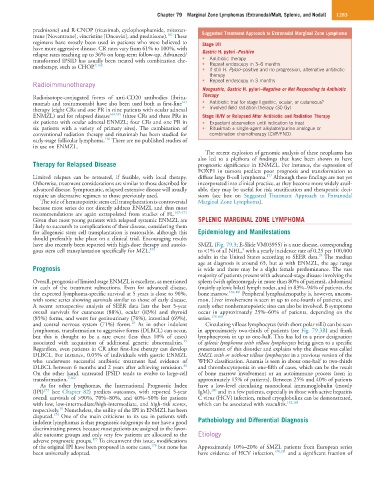
            prednisone) and R-CNOP (rituximab, cyclophosphamide, mitoxan-  Suggested Treatment Approach to Extranodal Marginal Zone Lymphoma
                                                        161
            trone [Novantrone], vincristine [Oncovin], and prednisone).  These
            regimens  have  mostly  been  used  in  patients  who  were  believed  to   Stage I/II
            have more aggressive disease. CR rates vary from 61% to 100%, with   Gastric H. pylori–Positive
            relapse rates reaching up to 36% on long-term follow-up. Advanced/
            transformed IPSID has usually been treated with combination che-  •  Antibiotic therapy
            motherapy, such as CHOP. 7,162                         •  Repeat endoscopy in 3–6 months
                                                                   •  If still H. Pylori–positive and no progression, alternative antibiotic
                                                                      therapy
                                                                   •  Repeat endoscopy in 3 months
            Radioimmunotherapy
                                                                   Nongastric, Gastric H. pylori–Negative or Not Responding to Antibiotic
            Radioisotope-conjugated  forms  of  anti-CD20  antibodies  (ibritu-  Therapy
                                                            163
            momab and tositumomab) have also been used both as first-line    •  Antibiotic trial for stage I gastric, ocular, or cutaneous?
            therapy (eight CRs and one PR in nine patients with ocular adnexal   •  Involved field radiation therapy (30 Gy)
            ENMZL) and for relapsed disease 164,165  (three CRs and three PRs in   Stage III/IV or Relapsed After Antibiotic and Radiation Therapy
            six patients with ocular adnexal ENMZL; four CRs and one PR in   •  Expectant observation until indication to treat
            six  patients  with  a  variety  of  primary  sites).  The  combination  of   •  Rituximab ± single-agent alkylator/purine analogue or
            conventional radiation therapy and rituximab has been studied for   combination chemotherapy (CVP/FND)
                                   166
            early-stage follicular lymphoma.  There are no published studies of
            its use on ENMZL.
                                                                    The recent explosion of genomic analysis of these neoplasms has
                                                                  also  led  to  a  plethora  of  findings  that  have  been  shown  to  have
            Therapy for Relapsed Disease                          prognostic significance in ENMZL. For instance, the expression of
                                                                  FOXP1  in  tumors  predicts  poor  prognosis  and  transformation  to
                                                                                        177
            Limited  relapses  can  be  retreated,  if  feasible,  with  local  therapy.   diffuse large B-cell lymphoma.  Although these findings are not yet
            Otherwise, treatment considerations are similar to those described for   incorporated into clinical practice, as they become more widely avail-
            advanced disease. Symptomatic, relapsed extensive disease will usually   able, they may be useful for risk stratification and therapeutic deci-
            require an alternative regimen to those previously used.  sions  (see  box  on  Suggested  Treatment  Approach  to  Extranodal
              The role of hematopoietic stem cell transplantation is controversial   Marginal Zone Lymphoma).
            because most series do not directly address ENMZL and thus most
            recommendations  are  again  extrapolated  from  studies  of  FL. 167–171
            Given that most young patients with relapsed systemic ENMZL are   SPLENIC MARGINAL ZONE LYMPHOMA
            likely to succumb to complications of their disease, considering them
            for allogeneic stem cell transplantation is reasonable, although this   Epidemiology and Manifestations
            should preferably take place on a clinical trial. Encouraging results
            have also recently been reported with high-dose therapy and autolo-  SMZL (Fig. 79.3; E-Slide VM03955) is a rare disease, corresponding
                                                                                8
            gous stem cell transplantation specifically for MZL. 172  to <1% of all NHL,  with a yearly incidence rate of 0.25 per 100,000
                                                                                                         29
                                                                  adults in the United States according to SEER data.  The median
                                                                  age at diagnosis is around 65, but as with ENMZL, the age range
            Prognosis                                             is  wide  and  there  may  be  a  slight  female  predominance. The  vast
                                                                  majority of patients present with advanced-stage disease involving the
            Overall, prognosis of limited stage ENMZL is excellent, as mentioned   spleen (with splenomegaly in more than 80% of patients), abdominal
            in  each  of  the  treatment  subsections.  Even  for  advanced  disease,   (mainly splenic hilar) lymph nodes, and in 83%–94% of patients, the
            the expected lymphoma-specific survival at 5 years is close to 90%,   bone marrow. 178–181  Peripheral lymphadenopathy is, however, uncom-
            with some series showing survivals similar to those of early disease.   mon. Liver involvement is seen in up to one-fourth of patients, and
            A  recent  retrospective  analysis  of  SEER  data  lists  the  best  5-year   rarely other nonhematopoietic sites can also be involved. B symptoms
            overall  survivals  for  cutaneous  (88%),  ocular  (83%)  and  thyroid   occur  in  approximately  25%–60%  of  patients,  depending  on  the
            (85%) forms, and worst for genitourinary (76%), intestinal (69%),   series. 179,180
                                            29
            and  central  nervous  system  (71%)  forms.   As  in  other  indolent   Circulating villous lymphocytes (with short polar villi) can be seen
            lymphomas, transformation to aggressive forms (DLBCL) can occur,   in approximately two-thirds of patients (see Fig. 79.3B) and frank
            but  this  is  thought  to  be  a  rare  event  (less  than  10%  of  cases)   lymphocytosis in up to one-half. This has led to a prior designation
                                                             35
            associated  with  acquisition  of  additional  genetic  abnormalities.    of splenic lymphoma with villous lymphocytes being given to a specific
            Regardless, even patients in CR after first-line therapy can develop   presentation of this disorder and explains why the disease was called
            DLBCL. For instance, 0.05% of individuals with gastric ENMZL   SMZL with or without villous lymphocytes in a previous version of the
            who  underwent  successful  antibiotic  treatment  had  evidence  of   WHO classification. Anemia is seen in about one-half to two-thirds
                                                             88
            DLBCL between 6 months and 2 years after achieving remission.    and thrombocytopenia in one-fifth of cases, which can be the result
            On  the  other  hand,  untreated  IPSID  tends  to  evolve  to  large-cell     of  bone  marrow  involvement  or  an  autoimmune  process  (seen  in
            transformation. 7,162                                 approximately 15% of patients). Between 25% and 40% of patients
              As  for  other  lymphomas,  the  International  Prognostic  Index   have  a  low-level  circulating  monoclonal  immunoglobulin  (mostly
                                                                      180
               173
            (IPI)   (see  Chapter  82)  predicts  outcomes,  with  reported  5-year   IgM),  and in a few patients, especially in those with active hepatitis
            overall survivals of >90%, 70%–80%, and 40%–50% for patients   C virus (HCV) infection, mixed cryoglobulins can be demonstrated,
            with low, low-intermediate/high-intermediate, and high-risk scores,   which can be associated with vasculitis. 182,183
                     30
            respectively.  Nonetheless, the utility of the IPI in ENMZL has been
                   174
            disputed.  One of the main criticisms to its use in patients with
            indolent lymphomas is that prognostic subgroups do not have a good   Pathobiology and Differential Diagnosis
            discriminating power, because most patients are assigned to the favor-
            able outcome groups and only very few patients are allocated to the   Etiology
                               175
            adverse prognostic groups.  To circumvent this issue, modifications
                                                   176
            of the original IPI have been proposed in some cases,  but none has   Approximately 10%–20% of SMZL patients from European series
            been universally adopted.                             have evidence of HCV infection, 178,181  and a significant fraction of

