


Page 1546 - Hematology_ Basic Principles and Practice ( PDFDrive )
P. 1546
Chapter 85  T-Cell Lymphomas  1373


            days. Mucositis (17% grade 3), skin toxicity (7% grade 3), and fatigue   TABLE   Response Rates Observed in Clinical Trials With
            (3% grade 3) were common with the use of this agent at the recom-  85.7  Purine Antimetabolite Agents
            mended dose. To date no comparison trials of pralatrexate to metho-
            trexate have been performed to assess the relative cost and benefit   Drug  Overall Response Rate (%)  Reference
            differences.                                           DCF                     66                 119
              Subsequently,  the  benefits  of  adding  5-fluorouracil  to  the
            methotrexate-based  regimen,  exploiting  the  synergy  between  these   DCF  100                 120
            agents,  were  evaluated.  The  methotrexate  was  administered  as  a   DCF   54                 121
                                            2
            24-hour  continuous  infusion  at  60 mg/m .  Immediately  after  this   DCF   66                 122
            infusion,  5-flourouracil  (20 mg/kg  every  24  hours)  was  continu-  Fludarabine  18           123
                                                             2
            ously infused for 36–48 hours. Oral citrovorum factor (10 mg/m )
            was  administered  intravenously  6  hours  after  cessation  of  the   2-CdA  28                 124
            methotrexate infusion and then orally for five additional doses. The   2-CdA   38                 125
                                                           2
            methotrexate  dose  was  escalated  to  a  maximum  of  120 mg/m ,  as   2-CdA  18                126
            allowed by toxicity and response. Ten patients were treated for an
            average duration of 33 months (range, 3–78 months). The number of   2-CdA     100                 127
            cycles administered ranged from 5 to 45. All patients achieved a PR.   2-CdA, 2-chlorodeoxyadenosine; DCF, 2′-deoxycoformycin.
            Initial cycles were given every 5–8 days. Once a good response was
            achieved, cycles were administered every 3 months as maintenance.
            Other  groups  anecdotally  reported  success  with  low  doses  of  oral
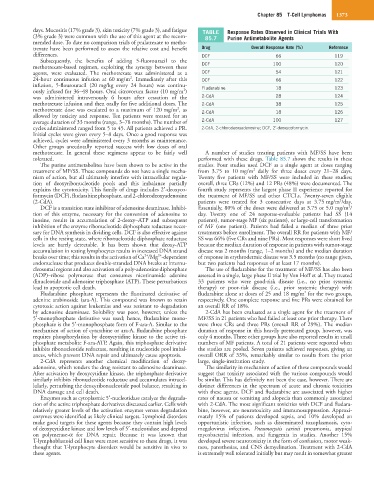
            methotrexate.  In  general  these  regimens  appear  to  be  fairly  well    A  number  of  studies  treating  patients  with  MF/SS  have  been
            tolerated.                                            performed with these drugs. Table 85.7 shows the results in these
              The purine antimetabolites have been shown to be active in the   studies. Four studies used DCF as a single agent at doses ranging
                                                                                    2
            treatment of MF/SS. These compounds do not have a single mecha-  from  3.75  to  10 mg/m   daily  for  three  doses  every  21–28  days.
            nism of action, but all ultimately interfere with intracellular regula-  Twenty  five  patients  with  MF/SS  were  included  in  these  studies;
            tion  of  deoxyribonucleotide  pools  and  this  imbalance  partially   overall, three CRs (12%) and 12 PRs (48%) were documented. The
            explains the cytotoxicity. This family of drugs includes 2′-deoxyco-  fourth study represents the largest phase II experience reported for
            formycin (DCF), fludarabine phosphate, and 2-chlorodeoxyadenosine   the  treatment  of  MF/SS  and  other  CTCLs. Twenty-seven  eligible
                                                                                                                2
            (2-CdA).                                              patients  were  treated  for  3  consecutive  days  at  3.75 mg/m /day.
                                                                                                                   2
              DCF is a transition state inhibitor of adenosine deaminase. Inhibi-  Essentially, 80% of the doses were delivered at 3.75 or 5.0 mg/m /
            tion  of  this  enzyme,  necessary  for  the  conversion  of  adenosine  to   day.  Twenty  one  of  24  response-evaluable  patients  had  SS  (14
            inosine,  results  in  accumulation  of  2-deoxy–ATP  and  subsequent   patients), tumor-stage MF (six patients), or large-cell transformation
            inhibition of the enzyme ribonucleotide diphosphate reductase neces-  of  MF  (one  patient).  Patients  had  failed  a  median  of  three  prior
            sary for DNA synthesis in dividing cells. DCF is also effective against   treatments before enrollment. The overall RR for patients with MF/
            cells in the resting state, where ribonucleotide diphosphate reductase   SS was 66% (five CRs and nine PRs). Most responses were short lived
            levels  are  barely  detectable.  It  has  been  shown  that  deoxy-ATP   because the median duration of response in patients with tumor-stage
            accumulation in resting lymphocytes results in increased DNA strand   disease was 2 months (range, 1–2 months) and the median duration
                                                2+
                                                     2+
            breaks over time; this results in the activation of Ca /Mg -dependent   of response in erythrodermic disease was 3.5 months (no range given,
            endonuclease that produces double-stranded DNA breaks at internu-  but two patients had responses of at least 17 months).
            cleosomal regions and also activation of a poly-adenosine diphosphate   The use of fludarabine for the treatment of MF/SS has also been
            (ADP)–ribose  polymerase  that  consumes  nicotinamide  adenine   assessed in a single, large phase II trial by Von Hoff et al. They treated
            dinucleotide and adenosine triphosphate (ATP). These perturbations   33  patients  who  were  good-risk  disease  (i.e.,  no  prior  systemic
            lead to apoptotic cell death.                         therapy)  or  poor-risk  disease  (i.e.,  prior  systemic  therapy)  with
                                                                                                     2
              Fludarabine  phosphate  represents  the  fluorinated  derivative  of   fludarabine alone at doses of 25 and 18 mg/m  for the two groups,
            adenine arabinoside (ara-A). This compound was known to retain   respectively. One complete response and five PRs were obtained for
            cytotoxic action against leukemias and was resistant to degradation   an overall RR of 18%.
            by  adenosine  deaminase.  Solubility  was  poor,  however,  unless  the   2-CdA has been evaluated as a single agent for the treatment of
            5′-monophosphate  derivative  was  used;  hence,  fludarabine  mono-  MF/SS in 21 patients who had failed at least one prior therapy. There
            phosphate is the 5′-monophosphate form of F-ara-A. Similar to the   were  three  CRs  and  three  PRs  (overall  RR  of  29%). The  median
            mechanism of action of cytarabine or ara-A, fludarabine phosphate   duration of response in this heavily pretreated group, however, was
            requires phosphorylation by deoxycytidine kinase to the active tri-  only 4 months. Three other groups have also reported results in small
            phosphate metabolite F-ara-ATP. Again, this triphosphate derivative   numbers of MF patients. A total of 21 patients were reported when
            inhibits ribonucleotide reductase, resulting in nucleotide pool imbal-  the studies are pooled. Seven patients achieved responses, giving an
            ances, which prevent DNA repair and ultimately cause apoptosis.  overall ORR of 33%, remarkably similar to results from the prior
              2-CdA  represents  another  chemical  modification  of  deoxy-  large, single-institution study.
            adenosine, which renders the drug resistant to adenosine deaminase.   The similarity in mechanism of action of these compounds would
            After activation by deoxycytidine kinase, the triphosphate derivative   suggest that toxicity associated with the various compounds would
            similarly inhibits ribonucleotide reductase and accumulates intracel-  be similar. This has definitely not been the case, however. There are
            lularly, perturbing the deoxyribonucleotide pool balance, resulting in   distinct differences in the spectrum of acute and chronic toxicities
            DNA damage and cell death.                            with these agents. DCF and fludarabine are associated with higher
              Enzymes such as cytoplasmic 5′-nucleotidase catalyze the degrada-  rates of nausea or vomiting and alopecia than commonly associated
            tion of the active triphosphate derivatives discussed earlier. Cells with   with 2-CdA. The most significant toxicities with DCF and fludara-
            relatively greater levels of the activation enzymes versus degradation   bine, however, are neurotoxicity and immunosuppression. Approxi-
            enzymes were identified as likely clinical targets. Lymphoid disorders   mately  15%  of  patients  developed  sepsis,  and  10%  developed  an
            make good targets for these agents because they contain high levels   opportunistic  infection,  such  as  disseminated  toxoplasmosis,  cyto-
            of deoxycytidine kinase and low levels of 5′-nucleotidase and depend   megalovirus  infection,  Pneumocystis  carinii  pneumonia,  atypical
            on  polymerase-α  for  DNA  repair.  Because  it  was  known  that   mycobacterial  infection,  and  fungemia  in  studies.  Another  15%
            T-lymphoblastoid cell lines were most sensitive to these drugs, it was   developed severe neurotoxicity in the form of confusion, motor weak-
            thought that T-lymphocyte disorders would be sensitive in vivo to   ness, paresthesias, and CNS demyelination. Treatment with 2-CdA
            these agents.                                         is extremely well tolerated initially but may result in somewhat greater

