


Page 1541 - Hematology_ Basic Principles and Practice ( PDFDrive )
P. 1541
1368   Part VII  Hematologic Malignancies


        Molecular and immunologic studies suggest a mature clonal helper   include  multiagent  chemotherapy  and  antibody  or  recombinant
        T-cell  process.  However,  reports  have  suggested  a  massive  reactive   toxins  directed  against  the  IL-2  receptor.  Patients  with  acute  ATL
        T-cell infiltrate driven by a small number of clonal B cells.  have  poor  survival  rates,  with  a  median  duration  of  4–6  months.
           EBV DNA sequences are frequently present, and their role in the   Patients  with  disease  that  is  not  “acute”  are  considered  to  have
        pathogenesis of this disorder remains poorly defined. Although the   “smoldering” disease and have lesions that may wax and wane in size
        clinical  course  is  variable,  the  prognosis  for  patients  with  diffuse   and shape despite treatment.
        pulmonary  involvement  or  evolution  to  high-grade  lymphoma  is
        poor, with a median survival of less than 2 years. Treatment depends
        on histologic findings and extent and location of disease, and may   Prognosis
        include  corticosteroids,  radiotherapy,  and  chemotherapy.  IFN  has
        shown  significant  activity  against  this  disease.  Related  conditions   The  goals  of  treatment  in  MF  are  the  relief  of  symptoms  with
        include  the  recently  reported  EBV-induced  mucocutaneous  ulcer   improved  quality  of  life,  generally  through  prevention  or  delay  in
        seen in immunosuppressed patients and B-cell lymphomas of older   development of advanced skin disease and improvement in cosmetics.
        adults.                                               Despite  some  uncontrolled  clinical  trial  results  that  have  been
                                                              reported  to  suggest  “cures”  in  this  disease,  the  general  perception
                                                              remains that this disease is not curable with standard therapies avail-
        Adult T-Cell Leukemia                                 able today. The disease behaves similarly to other low-grade lympho-
                                                              mas,  with  periods  of  remission  gradually  becoming  shorter  with
        ATL  is  in  most  instances  a  rapidly  progressive  T-cell  neoplasm   subsequent therapeutic interventions. Unlike B-cell low-grade lym-
        expressing a helper phenotype that is described earlier in this chapter.   phomas, however, advanced-stage MF is associated with a relatively
        It is endemic in southern Japan and the Caribbean islands, and is   short median life expectancy. Patients with significant nodal involve-
        associated  with  the  retrovirus  HTLV-1.  However,  most  HTLV-l–  ment (LN3 or LN4) or extensive skin involvement (T4) have median
        infected patients remain asymptomatic, and only 2%–4% develop   life expectancies of 30–55 months (Table 85.5). A driving force in
        ATL. The clinical presentation is polymorphous and can resemble   the development of treatments for this disease is the goal of altering
        MF or SS. Cutaneous lesions are variable, ranging from a rash simu-  the  natural  history  for  this  group  of  poor-prognosis  patients.  No
        lating  a  viral  exanthem,  to  annular  lesions  resembling  erythema   clinical trial has determined that aggressive early therapy is better than
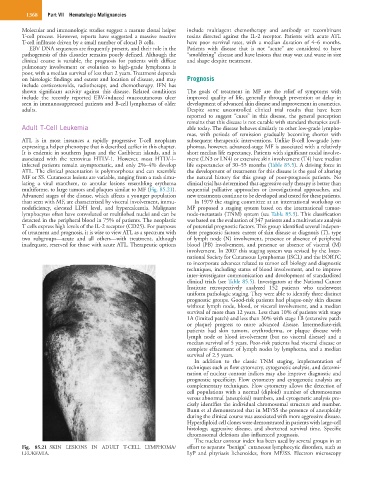
        multiforme, to large tumors and plaques similar to MF (Fig. 85.21).   sequential  palliative  approaches  or  investigational  approaches,  and
        Advanced stages of the disease, which affects a younger population   new treatments continue to be developed and tested for these patients.
        than seen with MF, are characterized by visceral involvement, immu-  In 1979 the staging committee at an international workshop on
        nodeficiency,  elevated  LDH  level,  and  hypercalcemia.  Malignant   MF  proposed  a  staging  system  based  on  the  international  tumor-
        lymphocytes often have convoluted or multilobed nuclei and can be   node-metastasis (TNM) system (see Table 85.5). This classification
        detected in the peripheral blood in 75% of patients. The neoplastic   was based on the evaluation of 347 patients and a multivariate analysis
        T cells express high levels of the IL-2 receptor (CD25). For purposes   of potential prognostic factors. This group identified several indepen-
        of treatment and prognosis, it is wise to view ATL as a spectrum with   dent prognostic factors: extent of skin disease at diagnosis (T), type
        two  subgroups—acute  and  all  others—with  treatment,  although   of lymph node (N) involvement, presence or absence of peripheral
        inadequate, reserved for those with acute ATL. Therapeutic options   blood  (PB)  involvement,  and  presence  or  absence  of  visceral  (M)
                                                              involvement. In 2007 this staging system was revised by the Inter-
                                                              national Society for Cutaneous Lymphomas (ISCL) and the EORTC
                                                              to incorporate advances related to tumor cell biology and diagnostic
                                                              techniques, including status of blood involvement, and to improve
                                                              inter-investigator communication and development of standardized
                                                              clinical trials (see Table 85.5). Investigators at the National Cancer
                                                              Institute  retrospectively  analyzed  152  patients  who  underwent
                                                              uniform pathologic staging. They were able to identify three distinct
                                                              prognostic groups. Good-risk patients had plaque-only skin disease
                                                              without lymph node, blood, or visceral involvement, and a median
                                                              survival of more than 12 years. Less than 10% of patients with stage
                                                              1A (limited patch) and less than 30% with stage 1B (extensive patch
                                                              or  plaque)  progress  to  more  advanced  disease.  Intermediate-risk
                                                              patients  had  skin  tumors,  erythroderma,  or  plaque  disease  with
                                                              lymph  node  or  blood  involvement  (but  no  visceral  disease)  and  a
                                                              median survival of 5 years. Poor-risk patients had visceral disease or
                                                              complete effacement of lymph nodes by lymphoma, and a median
                                                              survival of 2.5 years.
                                                                 In  addition  to  the  classic  TNM  staging,  implementation  of
                                                              techniques such as flow cytometry, cytogenetic analysis, and determi-
                                                              nation of nuclear contour indices may also improve diagnostic and
                                                              prognostic  specificity.  Flow  cytometry  and  cytogenetic  analysis  are
                                                              complementary techniques. Flow cytometry allows the detection of
                                                              cell  populations  with  a normal  (diploid)  number  of  chromosomes
                                                              versus abnormal (aneuploid) numbers, and cytogenetic analysis pre-
                                                              cisely identifies the individual chromosomal structure and number.
                                                              Bunn et al demonstrated that in MF/SS the presence of aneuploidy
                                                              during the clinical course was associated with more aggressive disease.
                                                              Hyperdiploid cell clones were demonstrated in patients with large-cell
                                                              histology,  aggressive  disease,  and  shortened  survival  time.  Specific
                                                              chromosomal deletions also influenced prognosis.
                                                                 The nuclear contour index has been used by several groups in an
        Fig.  85.21  SKIN  LESIONS  IN  ADULT  T-CELL  LYMPHOMA/  effort to separate “benign” cutaneous lymphocytic disorders, such as
        LEUKEMIA.                                             LyP  and  pityriasis  lichenoides,  from  MF/SS.  Electron  microscopy

