


Page 1542 - Hematology_ Basic Principles and Practice ( PDFDrive )
P. 1542
Chapter 85  T-Cell Lymphomas  1369


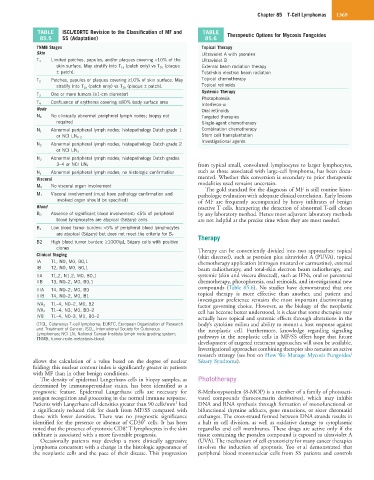
             TABLE   ISCL/EORTC Revision to the Classification of MF and   TABLE   Therapeutic Options for Mycosis Fungoides
              85.5   SS (Adaptation)                                85.6
             TNMB Stages                                           Topical Therapy
             Skin                                                  Ultraviolet A with psoralen
                  Limited patches, papules, and/or plaques covering <10% of the
             T 1                                                   Ultraviolet B
                   skin surface. May stratify into T 1a  (patch only) vs T 1b  (plaque   External beam radiation therapy
                    ± patch).                                      Total-skin electron beam radiation
                  Patches, papules or plaques covering ≥10% of skin surface. May   Topical chemotherapy
             T 2
                    stratify into T 2a  (patch only) vs T 2b  (plaque ± patch).  Topical retinoids
                                                                   Systemic Therapy
                  One or more tumors (≥1-cm diameter)
             T 3
                                                                   Photophoresis
                  Confluence of erythema covering ≥80% body surface area
             T 4                                                   Interferon-α
             Node                                                  Oral retinoids
                  No clinically abnormal peripheral lymph nodes; biopsy not
             N 0                                                   Targeted therapies
                   required                                        Single-agent chemotherapy
                  Abnormal peripheral lymph nodes; histopathology Dutch grade 1   Combination chemotherapy
             N 1
                                                                   Stem cell transplantation
                   or NCI LN 0–2
                                                                   Investigational agents
                  Abnormal peripheral lymph nodes; histopathology Dutch grade 2
             N 2
                   or NCI LN 3
             N 3  Abnormal peripheral lymph nodes; histopathology Dutch grades
                   3–4 or NCI LN 4                                from typical small, convoluted lymphocytes to larger lymphocytes,
             N x  Abnormal peripheral lymph nodes; no histologic confirmation  such as those associated with large-cell lymphoma, has been docu-
             Visceral                                             mented. Whether this conversion is secondary to prior therapeutic
                  No visceral organ involvement                   modalities used remains uncertain.
             M 0
                                                                    The gold standard for the diagnosis of MF is still routine histo-
                  Visceral involvement (must have pathology confirmation and
             M 1                                                  pathologic evaluation with adequate clinical correlation. Early lesions
                   involved organ should be specified)            of  MF  are  frequently  accompanied  by  heavy  infiltrates  of  benign
             Blood                                                reactive T cells, hampering the detection of abnormal T-cell clones
                  Absence of significant blood involvement: ≤5% of peripheral   by any laboratory method. Hence most adjuvant laboratory methods
             B 0
                    blood lymphocytes are atypical (Sézary) cells  are not helpful at the precise time when they are most needed.
                  Low blood tumor burden: >5% of peripheral blood lymphocytes
             B 1
                   are atypical (Sézary) but does not meet the criteria for B 2  Therapy
             B2   High blood tumor burden: ≥1000/µL Sézary cells with positive
                   clones                                         Therapy can be conveniently divided into two approaches: topical
             Clinical Staging                                     (skin directed), such as psoralen plus ultraviolet A (PUVA), topical
             IA   T1, N0, M0, B0,1                                chemotherapy application (nitrogen mustard or carmustine), external
             IB   T2, N0, M0, B0,1                                beam radiotherapy, and total-skin electron beam radiotherapy, and
             IIA  T1,2, N1,2, M0, B0,1                            systemic (skin and viscera directed), such as IFNs, oral or parenteral
             IIB  T3, N0–2, M0, B0,1                              chemotherapy, photopheresis, oral retinoids, and investigational new
             IIIA  T4, N0–2, M0, B0                               compounds  (Table  85.6).  No  studies  have  demonstrated  that  one
             IIIB  T4, N0–2, M0, B1                               topical  therapy  is  more  effective  than  another,  and  patient  and
                                                                  investigator  preference  remains  the  most  important  discriminating
                  T1–4, N0–2, M0, B2
             IVA 1                                                factor governing choice. However, as the biology of the neoplastic
                  T1–4, N3, M0, B0–2
             IVA 2                                                cell has become better understood, it is clear that some therapies may
             IVB  T1–4, N0–3, M1, B0–2                            actually have topical and systemic effects through alterations in the
             CTCL, Cutaneous T-cell lymphoma; EORTC, European Organization of Research   body’s cytokine milieu and ability to mount a host response against
             and Treatment of Cancer; ISCL, International Society for Cutaneous   the  neoplastic  cell.  Furthermore,  knowledge  regarding  signaling
             Lymphomas; NCI LN, National Cancer Institute lymph node grading system;   pathways  in  the  neoplastic  cells  in  MF/SS  offers  hope  that  future
             TNMB, tumor-node-metastasis-blood.
                                                                  development of targeted treatment approaches will soon be available.
                                                                  Investigational approaches combining therapies also remains an active
                                                                  research strategy (see box on How We Manage Mycosis Fungoides/
            allows  the  calculation  of  a  value  based  on  the  degree  of  nuclear   Sézary Syndrome).
            folding; this nuclear contour index is significantly greater in patients
            with MF than in other benign conditions.
              The density of epidermal Langerhans cells in biopsy samples, as   Phototherapy
            determined  by  immunoperoxidase  stains,  has  been  identified  as  a
            prognostic  feature.  Epidermal  Langerhans  cells  are  necessary  for   8-Methoxypsoralen (8-MOP) is a member of a family of photoacti-
            antigen recognition and processing in the normal immune response.   vated  compounds  (furocoumarin  derivatives),  which  may  inhibit
                                                          2
            Patients with Langerhans cell densities greater than 90 cells/mm  had   DNA and RNA synthesis through formation of monofunctional or
            a significantly reduced risk for death from  MF/SS  compared  with   bifunctional thymine adducts, gene mutations, or sister chromatid
            those  with  lower  densities.  There  was  no  prognostic  significance   exchanges. The cross-strand formed between DNA strands results in
                                                +
            identified for the presence or absence of CD30  cells. It has been   a  halt  in  cell  division,  as  well  as  oxidative  damage  to  cytoplasmic
                                          +
            noted that the presence of cytotoxic CD8  T lymphocytes in the skin   organelles  and  cell  membranes. These  drugs  are  active  only  if  the
            infiltrate is associated with a more favorable prognosis.  tissue containing the psoralen compound is exposed to ultraviolet A
              Occasionally  patients  may  develop  a  more  clinically  aggressive   (UVA). The mechanism of cell cytotoxicity for many cancer therapies
            lymphoma concurrent with a change in the histologic appearance of   involves  the  induction  of  apoptosis.  Yoo  et al  demonstrated  that
            the neoplastic cells and the pace of their disease. This progression   peripheral  blood  mononuclear  cells  from  SS  patients  and  controls

