


Page 1604 - Hematology_ Basic Principles and Practice ( PDFDrive )
P. 1604
1430   Part VII  Hematologic Malignancies


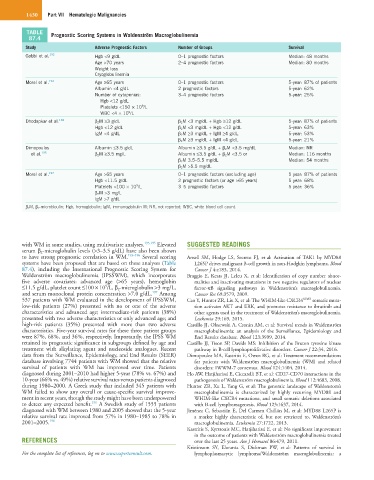
          TABLE   Prognostic Scoring Systems in Waldenström Macroglobulinemia
          87.4
         Study                  Adverse Prognostic Factors  Number of Groups                   Survival
         Gobbi et al. 192       Hgb <9 g/dL                0–1 prognostic factors              Median: 48 months
                                Age >70 years              2–4 prognostic factors              Median: 80 months
                                Weight loss
                                Cryoglobulinemia
         Morel et al. 193       Age ≥65 years              0–1 prognostic factors              5-year: 87% of patients
                                Albumin <4 g/dL            2 prognostic factors                5-year: 62%
                                Number of cytopenias:      3–4 prognostic factors              5-year: 25%
                                  Hgb <12 g/dL
                                  Platelets <150 × 10 /L
                                               9
                                  WBC <4 × 10 /L
                                           9
         Dhodapkar et al. 194   β 2 M ≥3 g/dL              β 2 M <3 mg/dL + Hgb ≥12 g/dL       5-year: 87% of patients
                                Hgb <12 g/dL               β 2 M <3 mg/dL + Hgb <12 g/dL       5-year: 63%
                                IgM <4 g/dL                β 2 M ≥3 mg/dL + IgM ≥4 g/dL        5-year: 53%
                                                           β 2 M ≥3 mg/dL + IgM <4 g/dL        5-year: 21%
         Dimopoulos             Albumin ≤3.5 g/dL          Albumin ≥3.5 g/dL + β 2 M <3.5 mg/dL  Median: NR
           et al. 195           β 2 M ≥3.5 mg/L            Albumin ≤3.5 g/dL + β 2 M <3.5 or   Median: 116 months
                                                           β 2 M 3.5–5.5 mg/dL                 Median: 54 months
                                                           β 2 M >5.5 mg/dL
         Morel et al. 197       Age >65 years              0–1 prognostic factors (excluding age)  5 year: 87% of patients
                                Hgb <11.5 g/dL             2 prognostic factors (or age >65 years)  5 year: 68%
                                Platelets <100 × 10 /L     3–5 prognostic factors              5 year: 36%
                                              9
                                β 2 M >3 mg/L
                                IgM >7 g/dL
         β 2 M, β 2 -microbloulin; Hgb, hemoglobulin; IgM, immunoglobulin M; NR, not reported; WBC, white blood cell count.


        with WM in some studies, using multivariate analyses. 193,195  Elevated   SUGGESTED READINGS
        serum β 2 -microglobulin levels (>3–3.5 g/dL) have also been shown
        to have strong prognostic correlation in WM. 193–196  Several scoring   Ansell  SM,  Hodge  LS,  Secreto  FJ,  et al:  Activation  of TAK1  by  MYD88
        systems have been proposed that are based on these analyses (Table   L265P drives malignant B-cell growth in non-Hodgkin lymphoma. Blood
        87.4),  including  the  International  Prognostic  Scoring  System  for   Cancer J 4:e183, 2014.
        Waldenström  macroglobulinemia  (IPSSWM),  which  incorporates   Braggio  E,  Keats  JJ,  Leleu  X,  et al:  Identification  of  copy  number  abnor-
        five  adverse  covariates:  advanced  age  (>65  years),  hemoglobin   malities and inactivating mutations in two negative regulators of nuclear
                                   9
        ≤11.5 g/dL, platelet count ≤100 × 10 /L, β 2 -microglobulin >3 mg/L,   factor-κB  signaling  pathways  in  Waldenström’s  macroglobulinemia.
                                                   197
        and serum monoclonal protein concentration >7.0 g/dL.  Among   Cancer Res 69:3579, 2009.
        537 patients with WM evaluated in the development of IPSSWM,   Cao Y, Hunter ZR, Liu X, et al: The WHIM-like CXCR4 S338X  somatic muta-
        low-risk  patients  (27%)  presented  with  no  or  one  of  the  adverse   tion activates AKT and ERK, and promotes resistance to ibrutinib and
        characteristics  and  advanced  age;  intermediate-risk  patients  (38%)   other agents used in the treatment of Waldenström’s macroglobulinemia.
        presented with two adverse characteristics or only advanced age; and   Leukemia 29:169, 2015.
        high-risk  patients  (35%)  presented  with  more  than  two  adverse   Castillo JJ, Olszewski A, Cronin AM, et al: Survival trends in Waldenström
        characteristics. Five-year survival rates for these three patient groups   macroglobulinemia:  an  analysis  of  the  Surveillance,  Epidemiology  and
        were 87%, 68%, and 36%, respectively. Importantly, the IPSS WM   End Results database. Blood 123:3999, 2014.
        retained its prognostic significance in subgroups defined by age and   Castillo JJ, Treon SP, Davids MS: Inhibition of the Bruton tyrosine kinase
        treatment  with  alkylating  agent  and  nucleoside  analogues.  Recent   pathway in B-cell lymphoproliferative disorders. Cancer J 22:34, 2016.
        data from the Surveillance, Epidemiology, and End Results (SEER)   Dimopoulos MA, Kastritis E, Owen RG, et al: Treatment recommendations
        database involving 7744 patients with WM showed that the relative   for  patients  with  Waldenström  macroglobulinemia  (WM)  and  related
        survival  of  patients  with  WM  has  improved  over  time.  Patients   disorders: IWWM-7 consensus. Blood 124:1404, 2014.
        diagnosed during 2001–2010 had higher 5-year (78% vs. 67%) and   Ho AW, Hatjiharissi E, Ciccarelli BT, et al: CD27-CD70 interactions in the
        10-year (66% vs. 49%) relative survival rates versus patients diagnosed   pathogenesis of Waldenström macroglobulinemia. Blood 112:4683, 2008.
        during 1980–2000. A Greek study that included 345 patients with   Hunter ZR, Xu L, Yang G, et al: The genomic landscape of Waldenstom’s
        WM failed to show any overall or cause-specific survival improve-  macroglobulinemia  is  characterized  by  highly  recurring  MYD88  and
        ment in recent years, though the study might have been underpowered   WHIM-like CXCR4 mutations, and small somatic deletions associated
                               196
        to detect any expected benefit.  A Swedish study of 1555 patients   with B-cell lymphomagenesis. Blood 123:1637, 2014.
        diagnosed with WM between 1980 and 2005 showed that the 5-year   Jiménez C, Sebastián E, Del Carmen Chillón M, et al: MYD88 L265P is
        relative survival rate improved from 57% in 1980–1985 to 78% in   a  marker  highly  characteristic  of,  but  not  restricted  to,  Waldenström’s
        2001–2005. 198                                           macroglobulinemia. Leukemia 27:1722, 2013.
                                                              Kastritis S, Kyrtsonis MC, Hatjiharissi E, et al: No significant improvement
                                                                 in the outcome of patients with Waldenström macroglobulinemia treated
        REFERENCES                                               over the last 25 years. Am J Hematol 86:479, 2011.
                                                              Kristinsson  SY,  Eloranta  S,  Dickman  PW,  et al:  Patterns  of  survival  in
        For the complete list of references, log on to www.expertconsult.com.  lymphoplasmacytic  lymphoma/Waldenström  macroglobulinemia:  a

