


Page 1603 - Hematology_ Basic Principles and Practice ( PDFDrive )
P. 1603
Chapter 87  Waldenström Macroglobulinemia/Lymphoplasmacytic Lymphoma  1429

            High-Dose Therapy and Stem Cell Transplant            progression-free survival. 155,165,176,179,188  Response assessments in WM
            The European Bone Marrow Transplant Registry (EBMT) reported   rely  primarily  on  serum  IgM  or  IgM  paraprotein  levels,  though
            the largest experience for both autologous as well as allogeneic SCT   complete  responses  require  disappearance  of  the  IgM  monoclonal
            in WM. 185,186  Among 158 patients with WM receiving an autologous   protein,  and  resolution  of  evidence  of  BM  and/or  extramedullary
                                                                       187
            SCT, which included primarily relapsed or refractory patients, the   disease.  An important concern with the use of IgM as a surrogate
            5-year  progression-free  and  overall  survival  rates  were  39.7%  and   marker of disease is that it can fluctuate independent of tumor cell
                           185
            68.5%,  respectively.   Nonrelapse  mortality  at  1  year  was  3.8%.   killing with some agents. By way of example, rituximab can induce
            Chemorefractory disease and the number of prior lines of therapy at   a  flare  in  serum  IgM  levels,  whereas  everolimus,  bortezomib,  and
            the time of the autologous SCT were the most important prognostic   ibrutinib can suppress IgM levels independent of tumor cell killing
            factors for progression-free and overall survival. In the allogeneic SCT   in  some  patients,  a  phenomenon  referred  to  as  IgM  discor-
            experience from the EBMT, the long-term outcomes of 86 patients   dance. 158,159,162,181,183,189   Moreover,  with  selective  B  cell–depleting
                              186
            with WM were reported.  A total of 86 patients received an allograft   agents such as rituximab and alemtuzumab, residual IgM-producing
            following  either  myeloablative  or  reduced-intensity  conditioning.   plasma cells are spared and persist, thus potentially skewing the rela-
                                                                                                  190
            The median age of patients in this series was 49 years, and 47 patients   tive  response  and  assessment  to  treatment.   Soluble  CD27  levels
            had undergone three or more previous lines of therapy. Eight patients   have  been  investigated  as  an  alternative  surrogate  marker  in WM,
            failed  prior  autologous  SCT.  Fifty-nine  patients  (68.6%)  had   given their correlation with WM disease burden, and may remain a
            chemotherapy-sensitive disease at the time of allogeneic SCT. Non-  faithful marker of disease in patients experiencing a rituximab-related
            relapse mortality rates at 3 years were 33% for patients receiving a   IgM flare, as well as after plasmapheresis. 60,191  The use of quantitative
            myeloablative transplant and 23% for those who received reduced-  allele-specific  PCR  assays  to  assess  serial  MYD88 L265P   burden  in
            intensity conditioning. The ORR was 75.6%. The relapse rates at 3   patients with WM is also under investigation. 36,38
            years  were  11%  for  myeloablative  and  25%  for  reduced-intensity
            conditioning recipients. Five-year progression-free and overall survival
            for patients with WM who received a myeloablative allogeneic SCT   Course and Prognosis
            were  56%  and  62%,  respectively,  and  for  patients  who  received
            reduced intensity conditioning, the rates were 49% and 64%, respec-  WM typically presents as an indolent disease. The presence of 6q
            tively. The occurrence of chronic graft-versus-host disease was associ-  deletions  may  have  prognostic  significance,  although  this  is  dis-
            ated  with  improved  progression-free  survival  and  suggested  the   puted. 20,21  Age is an important prognostic factor (>65 years), 192–194
            existence of a clinically relevant graft-versus-WM effect in this study.  but  it  is  influenced  by  comorbidities.  Anemia  that  reflects  both
                                                                  marrow  involvement  and  the  serum  level  of  the  IgM  monoclonal
            Response Criteria in Waldenström                      protein (because of the impact of IgM on intravascular fluid reten-
                                                                  tion) has emerged as a strong adverse prognostic factor with hemo-
            Macroglobulinemia                                     globin levels of <9 to 12 g/dL associated with decreased survival in
                                                                  several series. 192–194  Other cytopenias also may be significant predic-
                                                                              193
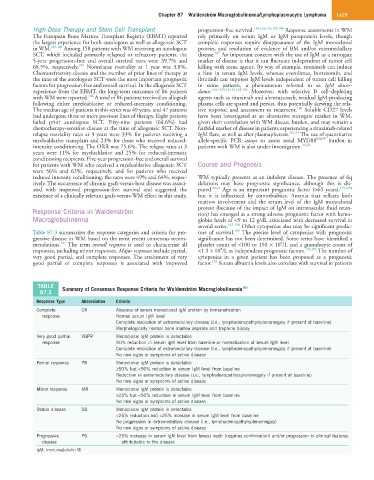
            Table 87.3 summarizes the response categories and criteria for pro-  tors  of  survival.  The  precise  level  of  cytopenias  with  prognostic
            gressive disease in WM based on the most recent consensus recom-  significance has not been determined. Some series have identified a
                     187
                                                                                             9
            mendations.  The  term  overall  response  is  used  to  characterize  all   platelet count of <100 to 150 × 10 /L and a granulocyte count of
                                                                         9
            responses, including minor responses. Major responses include partial,   <1.5 × 10 /L as independent prognostic factors. 193,194  The number of
            very good partial, and complete responses. The attainment of very   cytopenias  in  a  given  patient  has  been  proposed  as  a  prognostic
                                                                      193
            good  partial  or  complete  responses  is  associated  with  improved   factor.  Serum albumin levels also correlate with survival in patients
             TABLE   Summary of Consensus Response Criteria for Waldenström Macroglobulinemia 187
              87.3
             Response Type  Abbreviation  Criteria
             Complete       CR         Absence of serum monoclonal IgM protein by immunofixation
               response                Normal serum IgM level
                                       Complete resolution of extramedullary disease (i.e., lymphadenopathy/splenomegaly if present at baseline)
                                       Morphologically normal bone marrow aspirate and trephine biopsy
             Very good partial   VGPR  Monoclonal IgM protein is detectable
               response                90% reduction in serum IgM level from baseline or normalization of serum IgM level
                                       Complete resolution of extramedullary disease (i.e., lymphadenopathy/splenomegaly if present at baseline)
                                       No new signs or symptoms of active disease
             Partial response  PR      Monoclonal IgM protein is detectable
                                       ≥50% but <90% reduction in serum IgM level from baseline
                                       Reduction in extramedullary disease (i.e., lymphadenopathy/splenomegaly if present at baseline)
                                       No new signs or symptoms of active disease
             Minor response  MR        Monoclonal IgM protein is detectable
                                       ≥25% but <50% reduction in serum IgM level from baseline
                                       No new signs or symptoms of active disease
             Stable disease  SD        Monoclonal IgM protein is detectable
                                       <25% reduction and <25% increase in serum IgM level from baseline
                                       No progression in extramedullary disease (i.e., lymphadenopathy/splenomegaly)
                                       No new signs or symptoms of active disease
             Progressive    PD         >25% increase in serum IgM level from lowest nadir (requires confirmation) and/or progression in clinical features
               disease                   attributable to the disease
             IgM, Immunoglobulin M.

