


Page 162 - Hematology_ Basic Principles and Practice ( PDFDrive )
P. 162
120    Part II  Cellular Basis of Hematology

                                                                                                                9
        providing signals required for maintenance, quiescence and retention   HSPC number further supporting the notion of a perivascular niche.
        of HSPCs in the BM. However, the location of HSPC niche within   Although the debate about location of the HSPC niche, and conse-
                                          6
        the marrow has been a subject of controversy.  The endosteal surface   quently,  cell  types  that  serve  as  niche  participants,  continues  it  is
        has long been considered the zone in which HSPCs are preferentially   important to bear in mind that HSPCs themselves are molecularly
        located.  In  the  setting  of  irradiation  conditioning,  this  has  been   and functionally heterogeneous, and that several distinct niches may
        directly  demonstrated  by  intravital  imaging  studies,  which  allow   coexist  to  support  this  heterogeneity,  particularly  under  different
        dynamic assessment of the interaction between transplanted HSPC   conditions such as the stress of transplantation.
        and the niche. Currently, in vivo imaging is limited to calvarial BM,
        an area in the mouse skull where the bone is very thin, thus permit-
        ting penetration of the laser beam into the BM cavity. Using this   Cellular Components of the HSPC Niche
        technique and simultaneous multicolor fluorescent labeling of osteo-
        lineage  cells  (OLCs),  HSPCs,  and  the  vasculature,  studies  showed   Over  recent  years,  animal  studies  revealed  marked  complexity  in
        that in irradiated recipients, transplanted HSPCs home closest to the   cellular and molecular organization of the HSPC BM niche. Major
        endosteal surface and individual OLCs as compared with more dif-  cellular components of the HSPC niche and the factors that they
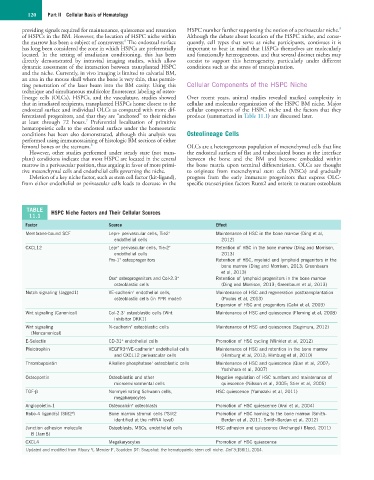
        ferentiated progenitors, and that they are “anchored” to their niches   produce (summarized in Table 11.1) are discussed later.
                             7
        at  least  through  72  hours.   Preferential  localization  of  primitive
        hematopoietic cells to the endosteal surface under the homeostatic
        conditions  has  been  also  demonstrated,  although  this  analysis  was   Osteolineage Cells
        performed using immunostaining of histologic BM sections of either
        femoral bones or the sternum. 8                       OLCs are a heterogeneous population of mesenchymal cells that line
           However,  other  studies  performed  under  steady state  (not  trans-  the endosteal surfaces of flat and trabeculated bones at the interface
        plant) conditions indicate that most HSPC are located in the central   between  the  bone  and  the  BM  and  become  embedded  within
        marrow in a perivascular position, thus arguing in favor of more primi-  the  bone  matrix  upon  terminal  differentiation.  OLCs  are  thought
        tive mesenchymal cells and endothelial cells governing the niche.  to  originate  from  mesenchymal  stem  cells  (MSCs)  and  gradually
           Deletion of a key niche factor, such as stem cell factor (kit-ligand),   progress  from  the  early  immature  progenitors  that  express  OLC-
        from either endothelial or perivascular cells leads to decrease in the   specific transcription factors Runx2 and osterix to mature osteoblasts


          TABLE   HSPC Niche Factors and Their Cellular Sources
          11.1
         Factor                      Source                             Effect
                                                        +
         Membrane-bound SCF          Lepr+ perivascular cells, Tie2     Maintenance of HSC in the bone marrow (Ding et al,
                                      endothelial cells                  2012)
                                        +
         CXCL12                      Lepr  perivascular cells, Tie-2    Retention of HSC in the bone marrow (Ding and Morrison,
                                                        +
                                      endothelial cells                  2013)
                                        +
                                     Prx-1  osteoprogenitors            Retention of HSC, myeloid and lymphoid progenitors in the
                                                                         bone marrow (Ding and Morrison, 2013; Greenbaum
                                                                         et al, 2013)
                                       +
                                                           +
                                     Osx  osteoprogenitors and Col-2.3    Retention of lymphoid progenitors in the bone marrow
                                      osteoblastic cells                 (Ding and Morrison, 2013; Greenbaum et al, 2013)
                                             +
         Notch signaling (Jagged1)   VE-cadherin  endothelial cells,    Maintenance of HSC and regeneration posttransplantation
                                      osteoblastic cells (in PPR model)  (Poulos et al, 2013)
                                                                        Expansion of HSC and progenitors (Calvi et al, 2003)
                                         +
         Wnt signaling (Canonical)   Col-2.3  osteoblastic cells (Wnt   Maintenance of HSC and quiescence (Fleming et al, 2008)
                                      inhibitor DKK1)
                                            +
         Wnt signaling               N-cadherin  osteoblastic cells     Maintenance of HSC and quiescence (Sugimura, 2012)
           (Noncanonical)
                                         +
         E-Selectin                  CD-31  endothelial cells           Promotion of HSC cycling (Winkler et al, 2012)
                                          +
                                                   +
         Pleiotrophin                VEGFR3 /VE-cadherin  endothelial cells   Maintenance of HSC and retention in the bone marrow
                                      and CXCL12 perivascular cells      (Himburg et al, 2012; Himburg et al, 2010)
                                                   +
         Thrombopoietin              Alkaline phosphatase  osteoblastic cells  Maintenance of HSC and quiescence (Qian et al, 2007;
                                                                         Yoshihara et al, 2007)
         Osteopontin                 Osteoblastic and other             Negative regulation of HSC numbers and maintenance of
                                      microenvironmental cells           quiescence (Nilsson et al, 2005; Stier et al, 2005)
         TGF-β                       Nonmyelinating Schwann cells,      HSC quiescence (Yamazaki et al, 2011)
                                      megakaryocytes
         Angiopoietin-1              Osteocalcin  osteoblasts           Promotion of HSC quiescence (Arai et al, 2004)
                                            +
                                                       a
                         a
         Robo-4 ligand(s) (Slit2 )   Bone marrow stromal cells ( Slit2   Promotion of HSC homing to the bone marrow (Smith-
                                      identified at the mRNA level)      Berdan et al, 2011; Smith-Berdan et al, 2012)
         Junction adhesion molecule   Osteoblasts, MSCs, endothelial cells  HSC adhesion and quiescence (Archangeli Blood, 2011)
           B (JamB)
         CXCL4                       Megakaryocytes                     Promotion of HSC quiescence
         Updated and modified from Kfoury Y, Mercier F, Scadden DT: Snapshot: the hematopoietic stem cell niche. Cell 3;158(1), 2014.

