


Page 157 - Hematology_ Basic Principles and Practice ( PDFDrive )
P. 157
Chapter 10  Stem Cell Model of Hematologic Diseases  115


                                                                 Early       Late     Immature     Mature
                               HSC         CLP        Pro-B
                                                                 Pre-B       Pre-B     B cell       B cell


                       CD34
                       CD38
                       CD19
                       CD10
                       CD20


                                 CD34+                        CD34+                      CD19+
                                 CD19–                        CD19+                      CD20+

                      B-ALL


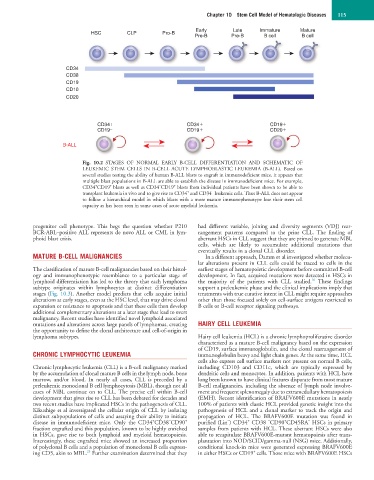
                            Fig.  10.2  STAGES  OF  NORMAL  EARLY  B-CELL  DIFFERENTIATION  AND  SCHEMATIC  OF
                            LEUKEMIC  STEM  CELLS  IN  B-CELL  ACUTE  LYMPHOBLASTIC  LEUKEMIA  (B-ALL).  Based  on
                            several studies testing the ability of human B-ALL blasts to engraft in immunodeficient mice, it appears that
                            multiple blast populations in B-ALL are able to establish the disease in immunodeficient mice. For example,
                                                     −
                                     +
                                +
                                                          +
                            CD34 CD19  blasts as well as CD34 CD19  blasts from individual patients have been shown to be able to
                                                                      −
                                                              +
                            transplant leukemia in vivo and to give rise to CD34  and CD34  leukemic cells. Thus B-ALL does not appear
                            to follow a hierarchical model in which blasts with a more mature immunophenotype lose their stem cell
                            capacity as has been seen in some cases of acute myeloid leukemia.
            progenitor  cell  phenotype.  This  begs  the  question  whether  P210   had  different  variable,  joining  and  diversity  segments  (VDJ)  rear-
            BCR-ABL–positive ALL represents de novo ALL or CML in lym-  rangement  patterns  compared  to  the  prior  CLL.  The  finding  of
            phoid blast crisis.                                   aberrant HSCs in CLL suggest that they are primed to generate MBL
                                                                  cells,  which  are  likely  to  accumulate  additional  mutations  that
                                                                  eventually results in a clonal CLL disorder.
            MATURE B-CELL MALIGNANCIES                              In a different approach, Damm et al investigated whether molecu-
                                                                  lar alterations present in CLL cells could be traced to cells in the
            The classification of mature B-cell malignancies based on their histol-  earliest stages of hematopoietic development before committed B-cell
            ogy  and  immunophenotypic  resemblance  to  a  particular  stage  of   development. In fact, acquired mutations were detected in HSCs in
                                                                                                       26
            lymphoid differentiation has led to the theory that each lymphoma   the  majority  of  the  patients  with  CLL  studied.   These  findings
            subtype  originates  within  lymphocytes  at  distinct  differentiation   support a preleukemic phase and the clinical implications imply that
            stages (Fig. 10.3). Another model predicts that cells acquire initial   treatments with true curative intent in CLL might require approaches
            alterations at early stages, even at the HSC level, that may drive clonal   other than those focused solely on cell-surface antigens restricted to
            expansion or resistance to apoptosis and that these cells then develop   B cells or B-cell receptor signaling pathways.
            additional complementary alterations at a later stage that lead to overt
            malignancy. Recent studies have identified novel lymphoid associated
            mutations and alterations across large panels of lymphomas, creating   HAIRY CELL LEUKEMIA
            the opportunity to define the clonal architecture and cell-of-origin in
            lymphoma subtypes.                                    Hairy cell leukemia (HCL) is a chronic lymphoproliferative disorder
                                                                  characterized as a mature B-cell malignancy based on the expression
                                                                  of CD19, surface immunoglobulin, and the clonal rearrangement of
            CHRONIC LYMPHOCYTIC LEUKEMIA                          immunoglobulin heavy and light chain genes. At the same time, HCL
                                                                  cells also express cell surface markers not present on normal B cells,
            Chronic lymphocytic leukemia (CLL) is a B-cell malignancy marked   including  CD103  and  CD11c,  which  are  typically  expressed  by
            by the accumulation of clonal mature B cells in the lymph node, bone   dendritic cells and monocytes. In addition, patients with HCL have
            marrow,  and/or  blood.  In  nearly  all  cases,  CLL  is  preceded  by  a   long been known to have clinical features disparate from most mature
            preleukemic monoclonal B cell lymphocytosis (MBL), though not all   B-cell malignancies, including the absence of lymph node involve-
            cases  of  MBL  continue  on  to  CLL. The  precise  cell  within  B-cell   ment and frequent splenomegaly due to extramedullary hematopoiesis
            development that gives rise to CLL has been debated for decades and   (EMH). Recent identification of BRAFV600E mutations in nearly
            two recent studies have implicated HSCs in the pathogenesis of CLL.   100% of patients with classic HCL provided genetic insight into the
            Kikushige et al investigated the cellular origin of CLL by isolating   pathogenesis of HCL and a clonal marker to track the origin and
            distinct subpopulations of cells and assaying their ability to initiate   propagation  of  HCL.  The  BRAFV600E  mutation  was  found  in
                                                                                  +
                                                                           −
                                                                                         −
                                                              +
                                                        −
                                                   +
                                                                                                      −
                                                                                              +
            disease  in  immunodeficient  mice.  Only  the  CD34 CD38 CD90    purified (Lin ) CD34  CD38  CD90 CD45RA  HSCs in primary
            fraction engrafted and this population, known to be highly enriched   samples from patients with HCL. These aberrant HSCs were also
            in  HSCs,  gave  rise  to  both  lymphoid  and  myeloid  hematopoiesis.   able to recapitulate BRAFV600E-mutant hematopoiesis after trans-
            Interestingly, these engrafted mice showed an increased proportion   plantation into NOD/SCID/gamma-null (NSG) mice. Additionally,
            of polyclonal B cells and a population of monoclonal B cells express-  conditional knock-in mice were generated expressing BRAFV600E
                                                                                    +
                             25
            ing CD5, akin to MBL.  Further examination determined that they   in either HSCs or CD19  cells. Those mice with BRAFV600E HSCs

