


Page 158 - Hematology_ Basic Principles and Practice ( PDFDrive )
P. 158
116    Part II  Cellular Basis of Hematology


                 A


                        Splenic marginal                     FL,
                        zone lymphoma  Marginal            GCB-type
                                     zone                  DLBCL
                    Naive B            Mantle       Centrocyte                Memory B cell
                      cell             zone   GC B
                                               cell

                                                                                CLL,IGHV
                                                                                 mutated
                  CLL,IGHV        MCL
                  unmutated                               Pre-plasmablast  Plasmablast  Plasma cell
                                                    Centroblast


                                                                       ABC-type
                                                                        DLBCL

                 B
                                                                              Long-term hematopoietic
                         Long-term hematopoietic
                               stem cells                                           stem cells


                                                                           Self renewal


                      Self renewal
                                                                                             Intermediate
                                       Intermediate                                          progenitor
                                       progenitor                                            cells
                                       cells


                                                                          Self renewal


                                     Precursor B cell

                                                                                             Precursor
                                                                                             B cell


                     Self                 Mature B cell
                    renewal               malignancy


                                                                                               Mature B cell
                                                                                               malignancy


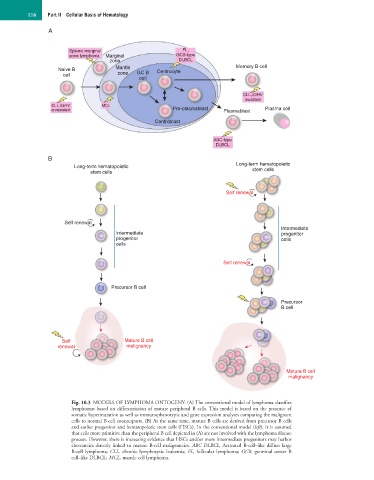
                        Fig. 10.3  MODELS OF LYMPHOMA ONTOGENY. (A) The conventional model of lymphoma classifies
                        lymphomas based on differentiation of mature peripheral B cells. This model is based on the presence of
                        somatic hypermutation as well as immunophenotypic and gene expression analyses comparing the malignant
                        cells to normal B-cell counterparts. (B) At the same time, mature B cells are derived from precursor B cells
                        and earlier progenitor and hematopoietic stem cells (HSCs). In the conventional model (left), it is assumed
                        that cells more primitive than the peripheral B cell depicted in (A) are not involved with the lymphoma disease
                        process. However, there is increasing evidence that HSCs and/or more intermediate progenitors may harbor
                        aberrancies directly linked to mature B-cell malignancies. ABC DLBCL, Activated B-cell–like diffuse large
                        B-cell lymphoma; CLL, chronic lymphocytic leukemia; FL, follicular lymphoma; GCB, germinal center B
                        cell–like DLBCL; MCL, mantle cell lymphoma.

