


Page 1717 - Hematology_ Basic Principles and Practice ( PDFDrive )
P. 1717
Chapter 95  Practical Aspects of Hematologic Stem Cell Harvesting and Mobilization  1527


                                       +
             TABLE   Replenishment of CD34  Cells During Large-Volume   Given these considerations, a number of centers have reported suc-
              95.1   Leukapheresis a                              cessful collection of PBSCs from pediatric patients and donors.
                                                                    Almost all pediatric patients undergo insertion of a venous catheter
                                       +
                                    CD34  Cells                   adequate for the flow rates expected, although older patients (>12
                                        Harvested  Released  Released   years) may tolerate vein-to-vein procedures. The whole blood flow
             UPN    Blood (per µL)  Blood (Total)  (Total)  (Total)  (per min)  rate for the pediatric patient is much reduced compared with that of
                                                                  adult patients, and catheters as small as 5 F may be adequate.
             10,605     6.5      34.9     123.5   88.6   0.3
                                                                    Appropriate  management  of  fluid  balance  during  the  apheresis
             10,698    15.6     603.3    1438.1  540.8   2.1      procedure is critical for the smaller patient. The volume of red blood
             10,849    30.7     109.7     211.1   62.6   0.3      cells contained in the extracorporeal circuit of the continuous-flow
                                                                  apheresis device could represent 30% to 50% of the red cell mass of
             10,920    37.9     214.2     952.8   57.0   1.6
                                                                  a pediatric donor. Although discontinuous-flow devices are appealing
             11,128    66.1     280.6    1010.8  532.7   1.9      because of the feasibility of performing apheresis with a single-lumen
             a Shown are numbers of CD34  cells in the peripheral blood or apheresis   venous access, they may result in even higher extracorporeal volumes
                               +
             component for five patients with acute myelogenous leukemia or multiple   and should be avoided in the smallest patients. The obvious solution
             myeloma undergoing large-volume leukapheresis after granulocyte colony-  to this problem is to prime the apheresis device with ABO-compatible,
             stimulating factor (G-CSF) or chemotherapy plus G-CSF mobilization treatment.
             Blood volumes processed were six times the calculated blood volume of the   irradiated red blood cells (leukocyte-depleted and cytomegalovirus-
             patient. Peripheral blood stem cell collection was performed on the COBE   negative blood is also desirable) when the blood in the extracorporeal
             Spectra. The total number of CD34  cells in the blood (third column) was   circuit  is  expected  to  exceed  15%  of  the  patient’s  blood  volume.
                                  +
                                 +
             calculated from the level of CD34  cells in the blood and the estimated blood   Packed red blood cell units can be diluted with saline or albumin (to
                                          +
             volume of the patient. The total number of CD34  cells released (fifth column)
             was calculated from the total number in the apheresis component and the   reduce  the  loss  of  plasma  protein  that  may  occur).  The  red  cells
             number in the peripheral blood after collection minus the total number in the   remaining in the extracorporeal circuit at the completion of the run
                                                    +
             peripheral blood at the start of the collection procedure. All CD34  cell   need  not  be  returned  (“rinse-back”),  although  if  performed  slowly
             quantities (except blood levels reported per µL) are × 10 . 6  with monitoring of vital signs, rinse-back may actually increase the
             Full data are given in Rowley SD, Yu J, Heimfeld S, et al: Trafficking of CD34   +
             cells into the peripheral circulation during collection of peripheral blood stem   hematocrit after the procedure and otherwise reduce the need for red
             cells by apheresis. Bone Marrow Transplant 28:649, 2001.  cell transfusions for these patients. For the intermediate-size pediatric
                                                                  patient (weight 25–50 kg), the apheresis device can be primed with
                                                                  a 5% albumin solution. This step will reduce the albumin loss that
                                                                  otherwise would occur. However, clotting proteins and other proteins
            higher risk for citrate (or other anticoagulant) toxicity. Patients will   not  contained  in  this  solution  may  decrease  with  repetitive
            also incur a proportional drop in platelet counts and may become   apheresis.
            profoundly thrombocytopenic.                            The  pediatric  patient  may  not  exhibit  or  relate  the  prodromal
                                                          +
              Most reports of LVL describe the collection of more CD34  cells   symptoms associated with citrate toxicity. Continuous calcium glu-
            than are calculated to be present in the peripheral blood at the initia-  conate infusion can be incorporated into the procedure, or heparin
            tion of the apheresis procedure. This results from the ongoing release   can be added to the citrate anticoagulant solution or used as the sole
            of cells from the marrow replacing those cells removed by apheresis   anticoagulant. Sedation of the pediatric patient is usually not neces-
                                                       +
                                      106
            (or returning to the marrow space).  Apheresis of CD34  cells is a   sary  and  hinders  the  ability  to  recognize  the  symptoms  of  citrate
            three-compartment system consisting of the extracorporeal circuit of   toxicity. (Some patients may require antihistamine premedication if
            the  apheresis  device  (including  the  collection  bag),  the  peripheral   the apheresis device is primed with red blood cells.) Centers routinely
            blood, and the marrow. It is not obvious that the apheresis technique   performing pediatric PBSC collection should design an environment
                             +
            itself “mobilizes” CD34  cells. Apheresis-induced mobilization, if it   conducive  to  the  management  of  pediatric  patients  and  develop
            occurs, may be related to a decrease in divalent cations resulting from   support procedures that recognize the unique physical and cognitive
            the citrate anticoagulant, possibly affecting cell adhesion forces.  features of pediatric patients.
              Studies at the Fred Hutchinson Cancer Research Center demon-  The range in blood volumes for pediatric donors of differing ages
                                        +
            strated a continuous release of CD34  cells from the marrow (and,   is greater than the range for adult donors. Therefore, most centers set
                                           106
            presumably, return to the marrow space).  Patients having higher   a goal for volume processed based on the individual’s blood volume
                        +
            levels  of  CD34   cells  in  the  peripheral  blood  appeared  to  have  a   instead of a set volume (e.g., two blood volumes vs. 6 L of blood)
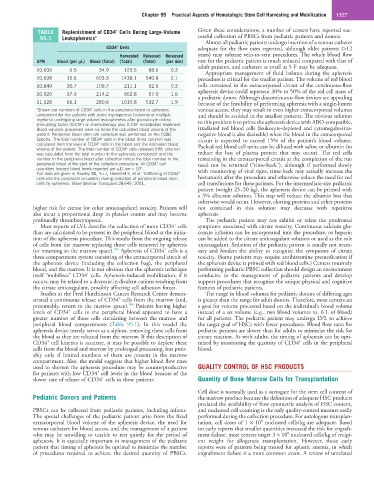
            greater  number  of  these  cells  circulating  between  the  marrow  and   for all patients. The pediatric patient may undergo LVL to achieve
            peripheral  blood  compartments  (Table  95.1).  In  this  model  the   the target goal of HSCs with fewer procedures. Blood flow rates for
            apheresis device merely serves as a siphon, removing these cells from   pediatric patients are slower than for adults to minimize the risk for
            the blood as they are released from the marrow. If this description of   citrate reaction. As with adults, the timing of apheresis can be opti-
                 +
                                                                                                   +
            CD34  cell kinetics is accurate, it may be possible to deplete these   mized by monitoring the quantity of CD34  cells in the peripheral
            cells from the blood and marrow by prolonged processing, but prob-  blood.
            ably  only  if  limited  numbers  of  them  are  present  in  the  marrow
            compartment. Also, the model suggests that higher blood flow rates
            used to shorten the apheresis procedure may be counterproductive   QUALITY CONTROL OF HSC PRODUCTS
                                 +
            for patients with low CD34  cell levels in the blood because of the
                                  +
            slower rate of release of CD34  cells in these patients.  Quantity of Bone Marrow Cells for Transplantation
                                                                  Cell dose is normally used as a surrogate for the stem cell content of
            Pediatric Donors and Patients                         the marrow product because the definition of adequate HSC products
                                                                  predated the availability of flow cytometric analysis of HSC content,
            PBSCs can be collected from pediatric patients, including infants.   and nucleated cell counting is the only quality-control measure easily
            The special challenges of the pediatric patient arise from the fixed   performed during the collection procedure. For autologous transplan-
                                                                                      8
            extracorporeal  blood  volume  of  the  apheresis  device,  the  need  for   tation, cell doses of 1 × 10  nucleated cells/kg are adequate. Based
            venous catheters for blood access, and the management of a patient   on early reports that smaller quantities increased the risk for engraft-
                                                                                               8
            who  may  be  unwilling  or  unable  to  rest  quietly  for  the  period  of   ment failure, most centers target 3 × 10  nucleated cells/kg of recipi-
            apheresis. It is especially important in management of the pediatric   ent  weight  for  allogeneic  transplantation.  However,  those  early
            patient that timing of apheresis be optimal to minimize the number   reports were of patients being treated for aplastic anemia, in which
            of  procedures  required  to  achieve  the  desired  quantity  of  PBSCs.   engraftment failure is a more common event. A review of unrelated

