


Page 1715 - Hematology_ Basic Principles and Practice ( PDFDrive )
P. 1715
Chapter 95  Practical Aspects of Hematologic Stem Cell Harvesting and Mobilization  1525


             500                                                   Physician Prescription for Apheresis and Peripheral Blood Stem Cell
             CD34 +  cells/component × 10 6  350                   The attending physician should be aware of apheresis and laboratory
             450
                                                                   Processing
             400
                                                                   procedures in order to maximize the value of peripheral blood stem
             300
                                                                   cell (PBSC) products. The choices of venous access, anticoagulant(s),
                                                                                                  +
             250
                                                                   blood volume processed, target dose of CD34  cells, and cryopreserva-
                                                                   tion volumes can be individualized. Apheresis unit staff may ask for
             200
                                                                   guidance  regarding  pain  medications,  concurrent  medications,  and
             150
                                                                   blood transfusions (although it is advisable to avoid transfusion during
             100
                                                                   because  changes  in  the  hematocrit  may  affect  the  efficiency  of  the
              50
                                                                                               +
                                                                   collection).  Adequate  numbers  of  CD34   cells  can  be  collected  for
               0                                                   the  apheresis  procedure  because  of  citrate  or  other  reactions,  and
                                                                   more than one cycle of chemotherapy. It is important to communicate
                 0       10       20       30       40      50     with the cryopreservation facility if PBSC components will be used to
                                      +
                                  CD34  cells/µL                   support more than one cycle of chemotherapy or if dimethyl sulfoxide
                                                                   toxicity  is  of  concern,  in  order  to  facilitate  appropriate  packaging  of
                                                        +
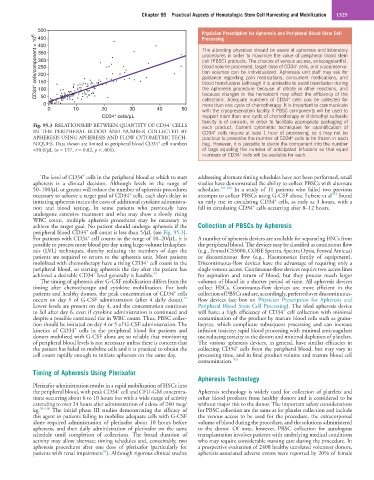
            Fig. 95.3  RELATIONSHIP BETWEEN QUANTITY OF CD34  CELLS   each  product.  Current  cytometric  techniques  for  quantification  of
            IN  THE  PERIPHERAL  BLOOD  AND  NUMBER  COLLECTED  BY   CD34   cells  require  at  least  1  hour  of  processing,  so  it  may  not  be
                                                                       +
            APHERESIS USING APHERESIS AND FLOW CYTOMETRIC TECH-    practical to prescribe the number of CD34  cells to be frozen in each
                                                                                                +
                                                     +
            NIQUES. Data shown are limited to peripheral blood CD34  cell numbers   bag. However, it is possible to divide the component into the number
            <50.0/µL (n = 157, r = 0.82, p < .001).                of  bags  equaling  the  number  of  anticipated  infusions  so  that  equal
                                                                               +
                                                                   numbers of CD34  cells will be available for each.
                            +
              The level of CD34  cells in the peripheral blood at which to start   addressing alternate timing schedules have not been performed, small
            apheresis  is  a  clinical  decision.  Although  levels  in  the  range  of   studies have demonstrated the ability to collect PBSCs with alternate
            50–100/µL or greater will reduce the number of apheresis procedures   schedules. 101,102   In  a  study  of  11  patients  who  failed  two  previous
                                           +
                                                                                                              102
            necessary to achieve a target goal of CD34  cells, each day’s delay in   attempts to collect PBSCs using G-CSF alone, Lefrere et al  found
                                                                                           +
            initiating apheresis incurs the costs of additional cytokine administra-  an early rise in circulating CD34  cells, as early as 3 hours, with a
                                                                                    +
            tion  and  blood  testing.  In  some  patients  who  previously  have   fall in circulating CD34  cells occurring after 8–12 hours.
            undergone extensive treatment and who may show a slowly rising
            WBC  count,  multiple  apheresis  procedures  may  be  necessary  to
            achieve the target goal. No patient should undergo apheresis if the   Collection of PBSCs by Apheresis
                             +
            peripheral blood CD34  cell count is less than 5/µL (see Fig. 95.3).
                              +
            For patients with CD34  cell counts in the range of 10–20/µL, it is   A number of apheresis devices are available for separating HSCs from
            possible to process more blood per day using large-volume leukapher-  the peripheral blood. The devices may be classified as continuous flow
            esis  (LVL)  techniques,  thereby  reducing  the  numbers  of  days  the   (e.g., Fenwal CS3000, COBE Spectra, Spectra Optia, Fenwal Amicus)
            patients are required to return to the apheresis unit. Most patients   or  discontinuous  flow  (e.g.,  Haemonetics  family  of  equipment).
                                                 +
            mobilized with chemotherapy have a rising CD34  cell count in the   Discontinuous-flow devices have the advantage of requiring only a
            peripheral blood, so starting apheresis the day after the patient has   single venous access. Continuous-flow devices require two access lines
                                +
            achieved a desirable CD34  level generally is feasible. 97  for  aspiration  and  return  of  blood,  but  they  process  much  larger
              The timing of apheresis after G-CSF mobilization differs from the   volumes of blood in a shorter period of time. All apheresis devices
            timing  after  chemotherapy  and  cytokine  mobilization.  For  both   collect  HSCs.  Continuous-flow  devices  are  more  efficient  in  the
                                                          +
            patients and healthy donors, the peak concentration of CD34  cells   collection of PBSCs and are, accordingly, preferred over discontinuous-
                                                             71
            occurs  on  day  5  of  G-CSF  administration  (after  4  daily  doses).    flow  devices  (see  box  on  Physician  Prescription  for  Apheresis  and
            Lower levels are present on day 4, and the concentration continues   Peripheral Blood Stem Cell Processing). The ideal apheresis device
                                                                                              +
            to fall after day 6, even if cytokine administration is continued and   will have: a high efficiency of CD34  cell collection with minimal
            despite a possible continued rise in WBC count. Thus, PBSC collec-  contamination of the product by mature blood cells such as granu-
            tion should be initiated on day 4 or 5 of G-CSF administration. The   locytes,  which  complicate  subsequent  processing  and  can  increase
                         +
            kinetics  of  CD34   cells  in  the  peripheral  blood  for  patients  and   infusion toxicity; rapid blood processing with minimal anticoagulant
            donors mobilized with G-CSF alone are so reliable that monitoring   use reducing toxicity to the donor; and minimal depletion of platelets.
            of peripheral blood levels is not necessary unless there is concern that   The various apheresis devices, in general, have similar efficacies in
                                                                              +
            the patient has failed to mobilize cells and it is practical to obtain the   collecting CD34  cells from the peripheral blood, but may vary in
            cell count rapidly enough to initiate apheresis on the same day.  processing time, and in final product volume and mature blood cell
                                                                  contamination. 103
            Timing of Apheresis Using Plerixafor
                                                                  Apheresis Technology
            Plerixafor administration results in a rapid mobilization of HSCs into
                                        +
            the peripheral blood, with peak CD34  cell and CFU-GM concentra-  Apheresis  technology  is  widely  used  for  collection  of  platelets  and
            tions occurring about 6 to 10 hours but with a wide range of activity   other blood products from healthy donors and is considered to be
            extending to over 24 hours after administration of a dose of 240 mcg/  without major risk to the donor. The important safety considerations
            kg. 98–100  The initial phase III studies demonstrating the efficacy of   for PBSC collection are the same as for platelet collection and include
            this agent in patients failing to mobilize adequate cells with G-CSF   the venous access to be used for the procedure, the extracorporeal
            alone  required  administration  of  plerixafor  about  10  hours  before   volume of blood during the procedure, and the solutions administered
            apheresis, and then daily administration of plerixafor on the same   to  the  donor.  Of  note,  however,  PBSC  collection  for  autologous
            schedule  until  completion  of  collections.  The  broad  duration  of   transplantation involves patients with underlying medical conditions
            activity may allow alternate timing schedules and, conceivably, two   who may require considerable nursing care during the procedure. In
            apheresis  procedures  after  one  dose  of  plerixafor  (particularly  for   a prospective evaluation of 2408 healthy unrelated volunteer donors,
                                   94
            patients with renal impairment ). Although rigorous clinical studies   apheresis-associated adverse events were reported by 20% of female

