


Page 1718 - Hematology_ Basic Principles and Practice ( PDFDrive )
P. 1718
1528   Part IX  Cell-Based Therapies


        donor  transplantation  found  that  recipients  of  higher  marrow  cell   cells and time to platelet engraftment than found with the overall
                                                                           +
        doses experienced faster neutrophil and platelet engraftment, as well   number of CD34  cells. Coexpression of adhesion molecules is also
                               107
        as better leukemia-free survival.  Pretreatment of the marrow donor   predictive of hematopoietic recovery, with the same pathways impor-
                                                                                                  112
        with either GM-CSF or G-CSF may increase the number of myeloid   tant for both mobilization and homing of HSCs.  Given the limited
                                                                                                          +
        progenitor cells harvested and decrease the period of posttransplant   range in recovery times when adequate numbers of CD34  cells are
                                                   +
        aplasia to that achievable by PBSC transplantation. CD34  cell dose   collected and infused, however, this additional information is cur-
        is now being correlated with transplant outcomes—with more rapid   rently of limited clinical value.
                                                                     +
        engraftment kinetics, possibly lower transplant-related mortality, and   CD34  cell dose is also predictive of outcome of allogeneic PBSC
                                                                                                    +
        better overall survival, for example, in recipients of allogeneic bone   (and marrow) transplantation. 108,113  Higher CD34  cell doses result
                                                 +
                                                     108
        marrow products containing higher quantities of CD34  cells.  This   in better neutrophil and platelet engraftments after either related or
        assay should be a routine component of bone marrow product quality   unrelated donor transplantation and may correlate with better sur-
        control. 108                                          vival after bone marrow transplantation, but may also be associated
                                                              with the development of more chronic GVHD.
        Definition of Adequate PBSC Component(s)
                                                              Tumor Cell Contamination
                         +
        The quantity of CD34  cells in a PBSC component varies greatly and
        is dependent on the number in the peripheral blood at the time of   The probability that tumor cell contamination of HSC product could
                                                                                                               114
        apheresis, the volume of blood processed, and the efficiency of the   contribute to relapse was demonstrated by Brenner and colleagues
        apheresis device. Therefore, any definition of an adequate component   in  studies  involving  the  autologous  transplantation  of  genetically
                                     +
        cannot include a set number of CD34  cells to be contained in any   marked marrow cells, as well as in individual case reports describing
        single apheresis component. Instead, one or more components will   the transmission of malignancy to allogeneic recipients from donors
        be collected to meet the appropriate dose of these cells for transplan-  with occult disease at time of harvesting. 27,28  Sensitive immunocyto-
                           +
        tation. The dose of CD34  cells required for infusion depends on the   staining  techniques,  clonal  assays,  flow  cytometric  analysis,  and
        intended treatment regimen. For marrow-ablative regimens, increas-  polymerase chain reaction amplification of malignant genetic mate-
                       +
        ingly  higher  CD34   doses  results  in  greater  likelihood  of  rapid   rial detect tumor cells in the autologous PBSC components of many
                                                      +
                                                                                            115
                                   109
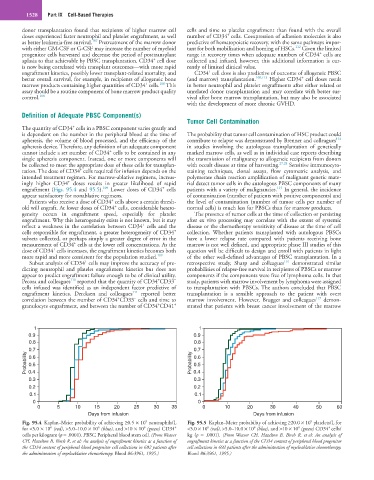
        engraftment  (Figs.  95.4  and  95.5).   Lower  doses  of  CD34   cells   patients with a variety of malignancies.  In general, the incidence
        appear satisfactory for nonablative regimens.         of contamination (number of patients with positive components) and
                                     +
           Patients who receive a dose of CD34  cells above a certain thresh-  the level of contamination (number of tumor cells per number of
                                      +
        old will engraft. At lower doses of CD34  cells, considerable hetero-  normal cells) is much less for PBSCs than for marrow products.
        geneity  occurs  in  engraftment  speed,  especially  for  platelet   The presence of tumor cells at the time of collection or persisting
        engraftment. Why this heterogeneity exists is not known, but it may   after  ex  vivo  processing  may  correlate  with  the  extent  of  systemic
                                                +
        reflect a weakness in the correlation between CD34  cells and the   disease or the chemotherapy sensitivity of disease at the time of cell
                                                          +
        cells responsible for engraftment, a greater heterogeneity of CD34    collection.  Whether  patients  transplanted  with  autologous  PBSCs
        subsets collected, or perhaps simply a greater degree of error in the   have  a  lower  relapse  rate  compared  with  patients  receiving  bone
                         +
        measurement of CD34  cells at the lower cell concentrations. As the   marrow is not well defined, and appropriate phase III studies of this
                  +
        dose of CD34  cells increases, the engraftment kinetics becomes both   question will be difficult to design and enroll with patients in light
        more rapid and more consistent for the population studied. 109  of the other well-defined advantages of PBSC transplantation. In a
                             +
                                                                                              116
           Subset analysis of CD34  cells may improve the accuracy of pre-  retrospective  study,  Sharp  and  colleagues   demonstrated  similar
        dicting  neutrophil  and  platelet  engraftment  kinetics  but  does  not   probabilities of relapse-free survival in recipients of PBSCs or marrow
        appear to predict engraftment failure enough to be of clinical utility.   components if the components were free of lymphoma cells. In that
                                                          −
                                                     +
                        110
        Pecora and colleagues  reported that the quantity of CD34 CD33    study, patients with marrow involvement by lymphoma were assigned
        cells  infused  was  identified  as  an  independent  factor  predictive  of   to transplantation with PBSCs. The authors concluded that PBSC
                                            111
        engraftment  kinetics.  Dercksen  and  colleagues   reported  better   transplantation  is  a  sensible  approach  to  the  patient  with  overt
                                             −
                                        +
                                                                                                        117
        correlation between the number of CD34 CD33  cells and time to   marrow  involvement.  However,  Brugger  and  colleagues   demon-
                                                          +
                                                     +
        granulocyte engraftment, and between the number of CD34 CD41    strated that patients with breast cancer involvement of the marrow
            1                                                     1
          0.9                                                   0.9
          0.8                                                   0.8
          0.7                                                   0.7
          Probability  0.6                                      Probability  0.6
          0.5
                                                                0.5
          0.4
                                                                0.3
          0.3                                                   0.4
          0.2                                                   0.2
           0.1                                                   0.1
            0                                                     0
             0      5     10    15    20     25    30    35        0       10     20     30      40     50     60
                              Days from infusion                                    Days from infusion
                                                                                                       9
                                                 9
        Fig. 95.4  Kaplan–Meier probability of achieving ≥0.5 × 10  neutrophils/L   Fig. 95.5  Kaplan–Meier probability of achieving ≥20.0 × 10  platelets/L for
                                                          +
                                                                                                            +
                                                                                                   6
                                                                     6
                 6
                                 6
                                                                                    6
                                                6
        for <5.0 × 10  (red), >5.0–10.0 × 10  (blue), and >10 × 10  (green) CD34    <5.0 × 10  (red), >5.0–10.0 × 10  (blue), and >10 × 10  (green) CD34  cells/
        cells per kilogram (p = .0001). PBSC, Peripheral blood stem cell. (From Weaver   kg  (p  =  .0001).  (From Weaver  CH,  Hazelton  B,  Birch  R,  et al:  An  analysis  of
        CH, Hazelton B, Birch R, et al: An analysis of engraftment kinetics as a function of   engraftment kinetics as a function of the CD34 content of peripheral blood progenitor
        the CD34 content of peripheral blood progenitor cell collections in 692 patients after   cell collections in 692 patients after the administration of myeloablative chemotherapy.
        the administration of myeloablative chemotherapy. Blood 86:3961, 1995.)  Blood 86:3961, 1995.)

