


Page 1828 - Hematology_ Basic Principles and Practice ( PDFDrive )
P. 1828
1630   Part X  Transplantation

                                                                                          15
                                                              related donor allografting, respectively.  The same study showed that
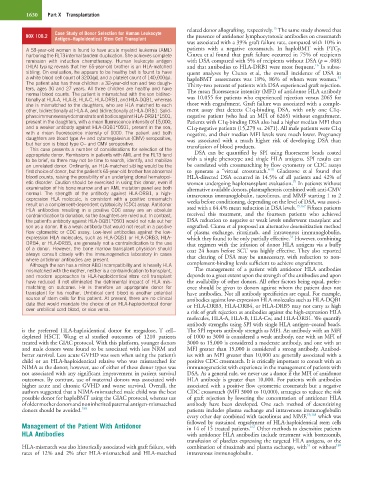
                   Case Study of Donor Selection for Human Leukocyte
         BOX 106.2  Antigen–Haploidentical Stem Cell Transplant  the presence of antidonor lymphocytotoxic antibodies on crossmatch
                                                              was associated with a 39% graft failure rate, compared with 10% in
          A 58-year-old woman is found to have acute myeloid leukemia (AML)   patients  with  a  negative  crossmatch.  In  haploBMT  with  PTCy,
          harboring the FLT3 internal tandem duplication. She achieves complete   Ciurea et al found that graft failure occurred in 75% of recipients
          remission  with  induction  chemotherapy.  Human  leukocyte  antigen   with DSA compared with 5% of recipients without DSA (p = .008)
                                                                                                        16
          (HLA) typing reveals that her 65-year-old brother is an HLA-matched   and that antibodies to HLA-DRB1 were most frequent.  In subse-
          sibling. On evaluation, he appears to be healthy but is found to have   quent  analyses  by  Ciurea  et al,  the  overall  incidence  of  DSA  in
          a white blood cell count of 3200/µL and a platelet count of 140,000/µl.   haploBMT  assessments  was  18%,  86%  of  whom  were  women.
                                                                                                               53
          The patient also has three children: a 32-year-old son and two daugh-  Thirty-two percent of patients with DSA experienced graft rejection.
          ters, ages 30 and 27 years. All three children are healthy and have   The mean fluorescence intensity (MFI) of antidonor HLA antibody
          normal blood counts. The patient is mismatched with the son bidirec-
          tionally at HLA-A, HLA-B, HLA-C, HLA-DRB1, and HLA-DQB1, whereas   was 10,055 for patients who experienced rejection versus 2065 for
          she is mismatched to the daughters, who are HLA matched to each   those with engraftment. Graft failure was associated with a comple-
          other, bidirectionally at HLA-A, and bidirectionally at HLA-DRB1. Solid-  ment  assay  that  detects  C1q-binding  DSA,  with  only  one  C1q-
          phase immunoassays demonstrate antibodies against HLA-DRB1*1501,   negative patient (who had an MFI of 6265) without engraftment.
          present in the daughters, with a mean fluorescence intensity of 15,000,   Patients with C1q-binding DSA also had a higher median MFI than
          and a weaker antibody against HLA-DQB1*0501, present in the son,   C1q-negative patients (15,279 vs. 2471). All male patients were C1q
          with  a  mean  fluorescence  intensity  of  1000.  The  patient  and  both   negative, and their median MFI levels were much lower. Pregnancy
          daughters are blood type A+ and cytomegalovirus (CMV) seropositive,   was  associated  with  a  much  higher  risk  of  developing  DSA  than
          but her son is blood type O− and CMV seropositive.  transfusion of blood products.
           This case presents a number of considerations for selection of the
          appropriate donor. Remissions in patients with AML and the FLT3 tend   DSA  can  be  quantified  by  SPI  using  fluorescent  beads  coated
          to be brief, so there may not be time to search, identify, and mobilize   with  a  single  phenotype  and  single  HLA  antigens.  SPI  results  can
          an unrelated donor. Ordinarily, an HLA-matched sibling would be the   be correlated with crossmatching by flow cytometry or CDC assays
                                                                                         18
          first choice of donor, but the patient’s 65-year-old brother has abnormal   to  generate  a  “virtual  crossmatch.”   Gladstone  et al  found  that
          blood counts, raising the possibility of an underlying clonal hematopoi-  HLA-directed DSA occurred in 14.5% of all patients and 42% of
          etic disorder. Caution should be exercised in using this donor, even if   women undergoing haplotransplant evaluation.  In patients without
                                                                                                 19
          examination of his bone marrow and an AML mutation panel are both   alternative available donors, plasmapheresis combined with anti-CMV
          normal.  The  strength  of  the  antibody  against  HLA-DRB1,  a  high-  intravenous immunoglobulin, tacrolimus, and MMF starting 1 to 2
          expression  HLA  molecule,  is  consistent  with  a  positive  crossmatch   weeks before conditioning, depending on the level of DSA, was associ-
          result on a complement-dependent cytotoxicity (CDC) assay. Antidonor                    19,167
          HLA  antibodies  resulting  in  a  positive  CDC  assay  are  an  absolute   ated with a 64.4% mean reduction in DSA levels.   Fifteen patients
          contraindication to donation, so the daughters are ruled out. In contrast,   received  this  treatment,  and  the  fourteen  patients  who  achieved
          the patient’s antibody against HLA-DQB1*0501 would not rule out her   DSA reduction to negative or weak levels underwent transplant and
          son as a donor. It is a weak antibody that would not result in a positive   engrafted. Ciurea et al proposed an alternative desensitization method
          flow  cytometric  or  CDC  assay.  Low-level  antibodies  against  the  low-  of  plasma  exchange,  rituximab,  and  intravenous  immunoglobulin,
                                                                                                53
          expression HLA molecules, such as HLA-DQB1 or HLA-DRB3, HLA-  which they found to be only partially effective.  However, combining
          DRB4, or HLA-DRB5, are generally not a contraindication to the use   that regimen with the infusion of donor HLA antigens via a buffy
          of  a  donor.  However,  the  bone  marrow  transplant  physician  should   coat 24 hours before SCT was highly effective. They also reported
          always  consult  closely  with  the  immunogenetics  laboratory  in  cases   that  clearing  of  DSA  may  be  unnecessary,  with  reduction  to  non-
          where antidonor antibodies are present.
           Although the son has a minor ABO incompatibility and is heavily HLA   complement-binding levels sufficient to achieve engraftment.
          mismatched with the mother, neither is a contraindication to transplant,   The  management  of  a  patient  with  antidonor  HLA  antibodies
          and  modern  approaches  to  HLA-haploidentical  stem  cell  transplant   depends to a great extent upon the strength of the antibodies and upon
          have  reduced  if  not  eliminated  the  detrimental  impact  of  HLA  mis-  the availability of other donors. All other factors being equal, prefer-
          matching  on  outcome.  He  is  therefore  an  appropriate  donor  for   ence should be given to donors against whom the patient does not
          transplant  for  his  mother.  Umbilical  cord  blood  is  another  potential   have antibodies. Not all antibody specificities are equal. For example,
          source of stem cells for this patient. At present, there are no clinical   antibodies against low-expression HLA molecules such as HLA-DQB1
          data that would mandate the choice of an HLA-haploidentical donor   or HLA-DRB3, HLA-DRB4, or HLA-DRB5 may not carry as high
          over umbilical cord blood, or vice versa.
                                                              a risk of graft rejection as antibodies against the high-expression HLA
                                                              molecules, HLA-A, HLA-B, HLA-Cw, and HLA-DRB1. We quantify
                                                              antibody strengths using SPI with single HLA antigen–coated beads.
        is  the  preferred  HLA-haploidentical  donor  for  megadose,  T  cell–  The SPI reports antibody strength as MFI. An antibody with an MFI
        depleted  HSCT.  Wang  et al  studied  outcomes  of  1210  patients   of 1000 to 3000 is considered a weak antibody, one with an MFI of
        treated with the GIAC protocol. With this platform, younger donors   3000 to 15,000 is considered a moderate antibody, and one with an
        and male donors were found to be associated with less NRM and   MFI greater than 15,000 is considered a strong antibody. Antibod-
        better survival. Less acute GVHD was seen when using the patient’s   ies with an MFI greater than 10,000 are generally associated with a
        child  or  an  HLA-haploidentical  relative  who  was  mismatched  for   positive CDC crossmatch. It is critically important to consult with an
        NIMA as the donor; however, use of either of these donor types was   immunogeneticist with experience in the management of patients with
        not associated with any significant improvement in patient survival   DSA. As a general rule, we never use a donor if the MFI of antidonor
        outcomes. By contrast, use of maternal donors was associated with   HLA  antibody  is  greater  than  10,000.  For  patients  with  antibodies
        higher acute and chronic GVHD and worse survival. Overall, the   associated with a positive flow cytometric crossmatch but a negative
        authors suggested that a NIMA-mismatched male child was the best   CDC crossmatch (MFI 3000 to 10,000), strategies to reduce the risk
        possible donor for haploBMT using the GIAC protocol, whereas use   of  graft  rejection  by  lowering  the  concentration  of  antidonor  HLA
        of older mother donors and noninherited paternal antigen-mismatched   antibody  have  been  developed.  One  such  method  of  desensitizing
        donors should be avoided. 188                         patients includes plasma exchange and intravenous immunoglobulin
                                                              every other day combined with tacrolimus and MMF, 19,168  which was
        Management of the Patient With Antidonor              followed by sustained engraftment of HLA-haploidentical stem cells
                                                                                   167
                                                              in 14 of 15 treated patients.  Other methods to desensitize patients
        HLA Antibodies                                        with antidonor HLA antibodies include treatment with bortezomib,
                                                              transfusion of platelets expressing the targeted HLA antigens, or the
                                                                                                               189
                                                                                                     53
        HLA-mismatch was also historically associated with graft failure, with   combination of rituximab and plasma exchange, with  or without
        rates  of  12%  and  2%  after  HLA-mismatched  and  HLA-matched   intravenous immunoglobulin.

