


Page 1923 - Hematology_ Basic Principles and Practice ( PDFDrive )
P. 1923
Chapter 111  Principles of Red Blood Cell Transfusion  1703


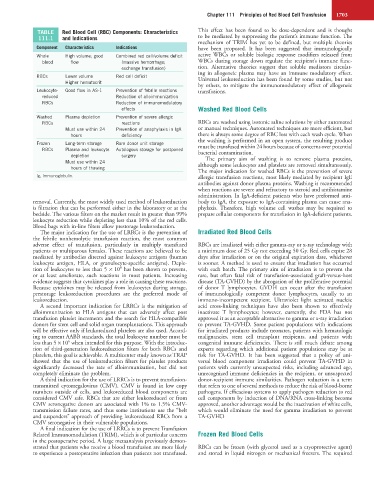
             TABLE   Red Blood Cell (RBC) Components: Characteristics   This  effect  has  been  found  to  be  dose-dependent  and  is  thought
              111.1  and Indications                              to be mediated by suppressing the patient’s immune function. The
                                                                  mechanism  of TRIM  has  yet  to  be  defined,  but  multiple  theories
             Component  Characteristics  Indications              have  been  proposed.  It  has  been  suggested  that  immunologically
             Whole    High volume; good   Combined red cell/volume deficit   active  WBCs  or  soluble  biologic  response  modifiers  released  from
               blood    flow             (massive hemorrhage;     WBCs during storage down regulate the recipient’s immune func-
                                         exchange transfusion)    tion.  Alternative  theories  suggest  that  soluble  mediators  circulat-
                                                                  ing  in  allogeneic  plasma  may  have  an  immune  modulatory  effect.
             RBCs     Lower volume     Red cell deficit           Universal leukoreduction has been found by some studies, but not
                      Higher hematocrit
                                                                  by  others,  to  mitigate  the  immunomodulatory  effect  of  allogeneic
             Leukocyte-  Good flow in AS-1  Prevention of febrile reactions  transfusions.
               reduced                 Reduction of alloimmunization
               RBCs                    Reduction of immunomodulatory
                                         effects                  Washed Red Blood Cells
             Washed   Plasma depletion  Prevention of severe allergic
               RBCs                      reactions                RBCs are washed using isotonic saline solutions by either automated
                      Must use within 24   Prevention of anaphylaxis in IgA   or manual techniques. Automated techniques are more efficient, but
                        hours            deficiency               there is always some degree of RBC loss with each wash cycle. When
                                                                  the washing is performed in an open system, the resulting product
             Frozen   Long-term storage  Rare donor unit storage  must be transfused within 24 hours because of concerns over potential
               RBCs   Plasma and leukocyte   Autologous storage for postponed   bacterial contamination.
                        depletion        surgery
                                                                    The  primary  aim  of  washing  is  to  remove  plasma  proteins,
                      Must use within 24                          although some leukocytes and platelets are removed simultaneously.
                        hours of thawing                          The major indication for washed RBCs is the prevention of severe
             Ig, Immunoglobulin.                                  allergic transfusion reactions, most likely mediated by recipient IgE
                                                                  antibodies against donor plasma proteins. Washing is recommended
                                                                  when reactions are severe and refractory to steroid and antihistamine
                                                                  administration. In IgA-deficient patients who have preformed anti-
            removal. Currently, the most widely used method of leukoreduction   body to IgA, the exposure to IgA-containing plasma can cause ana-
            is filtration that can be performed either in the laboratory or at the   phylaxis.  Therefore,  high  volume  cell  washes  may  be  required  to
            bedside. The various filters on the market result in greater than 99%   prepare cellular components for transfusion in IgA-deficient patients.
            leukocyte reduction while depleting less than 10% of the red cells.
            Blood bags with in-line filters allow prestorage leukoreduction.
              The major indication for the use of LRRCs is the prevention of   Irradiated Red Blood Cells
            the  febrile  nonhemolytic  transfusion  reaction,  the  most  common
            adverse  effect  of  transfusion,  particularly  in  multiply  transfused   RBCs are irradiated with either gamma-ray or x-ray technology with
            patients or multiparous females. These reactions are believed to be   a minimum dose of 25 Gy not exceeding 50 Gy. Red cells expire 28
            mediated by antibodies directed against leukocyte antigens (human   days after irradiation or on the original expiration date, whichever
            leukocyte  antigen,  HLA,  or  granulocyte-specific  antigens).  Deple-  is sooner. A method is used to ensure that irradiation has occurred
                                        6
            tion of leukocytes to less than 5 × 10  has been shown to prevent,   with each batch. The primary aim of irradiation is to prevent the
            or  at  least  ameliorate,  such  reactions  in  most  patients.  Increasing   rare,  but  often  fatal  risk  of  transfusion-associated  graft-versus-host
            evidence suggests that cytokines play a role in causing these reactions.   disease (TA-GVHD) by the abrogation of the proliferative potential
            Because cytokines may be released from leukocytes during storage,   of  donor  T  lymphocytes.  GVDH  can  occur  after  the  transfusion
            prestorage  leukoreduction  procedures  are  the  preferred  mode  of     of  immunologically  competent  donor  lymphocytes,  usually  to  an
            leukoreduction.                                       immuno-incompetent  recipient.  Ultraviolet  light  activated  nucleic
              A  second  important  indication  for  LRRCs  is  the  mitigation  of   acid  cross-linking  techniques  have  also  been  shown  to  effectively
            alloimmunization  to  HLA  antigens  that  can  adversely  affect  post   inactivate  T  lymphocytes;  however,  currently,  the  FDA  has  not
            transfusion platelet increments and the search for HLA-compatible   approved it as an acceptable alternative to gamma or x-ray irradiation
            donors for stem cell and solid organ transplantations. This approach   to prevent TA-GVHD. Some patient populations with indications
            will be effective only if leukoreduced platelets are also used. Accord-  for irradiated products include neonates, patients with hematologic
            ing to current AABB standards, the total leukocyte number must be   malignancies,  stem  cell  transplant  recipients,  and  patients  with
                       6
            less than 5 × 10  when intended for this purpose. With the introduc-  congenital immune deficiencies. There is still much debate among
            tion  of  third-generation  leukoreduction  filters  for  both  RBCs  and   experts  regarding  which  additional  patient  populations  may  be  at
            platelets, this goal is achievable. A multicenter study known as TRAP   risk  for  TA-GVHD.  It  has  been  suggested  that  a  policy  of  uni-
            showed  that  the  use  of  leukoreduction  filters  for  platelet  products   versal  blood  component  irradiation  could  prevent  TA-GVHD  in
            significantly  decreased  the  rate  of  alloimmunization,  but  did  not   patients  with  currently  unsuspected  risks,  including  advanced  age,
            completely eliminate the problem.                     unrecognized immune deficiencies in the recipient, or unsuspected
              A third indication for the use of LRRCs is to prevent transfusion-  donor-recipient immune similarities. Pathogen reduction is a term
            transmitted  cytomegalovirus  (CMV).  CMV  is  found  in  low  copy   that refers to one of several methods to reduce the risk of blood-borne
            numbers outside of cells, and leukoreduced blood components are   pathogens. If efficacious systems to apply pathogen reduction to red
            considered CMV safe. RBCs that are either leukoreduced or from   cell components by induction of DNA/RNA cross-linking become
            CMV seronegative donors are associated with 1% to 1.5% CMV-  approved, another advantage would be the inactivation of white cells,
            transmission failure rates, and thus some institutions use the “belt   which would eliminate the need for gamma irradiation to prevent
            and suspenders” approach of providing leukoreduced RBCs from a   TA-GVHD
            CMV seronegative in their vulnerable populations.
              A final indication for the use of LRRCs is to prevent Transfusion
            Related Immunomodulation (TRIM), which is of particular concern   Frozen Red Blood Cells
            in the postoperative period. A large metaanalysis previously demon-
            strated that patients who receive a blood transfusion are more likely   RBCs can be frozen (with glycerol used as a cryoprotective agent)
            to experience a postoperative infection than patients not transfused.   and stored in liquid nitrogen or mechanical freezers. The required

