


Page 1927 - Hematology_ Basic Principles and Practice ( PDFDrive )
P. 1927
Chapter 111  Principles of Red Blood Cell Transfusion  1707


              Discoveries  during  the  past  two  decades  have  raised  clinical   Citrate
            concern regarding the efficacy and risk of RBC transfusion. Changes
            within the RBC and its supernatant during RBC storage have been   Infusion of large volumes of blood with citrate anticoagulant over a
            associated with reduced tissue oxygenation and other adverse effects   short period may cause plasma citrate levels to reach the toxic range.
            in patients receiving RBC components stored for extended periods.   The primary concern is the cardiovascular effects of hypocalcemia
            The biochemical, structural, and functional changes are collectively   caused by chelation of calcium by citrate. The risk of citrate toxicity
            termed  the  red  cell  storage  lesion. The  alterations  found  with  the   is exacerbated by liver dysfunction or liver immaturity. Despite these
            storage lesion along with the clinical implications will be discussed   theoretical  considerations,  there  is  little  documented  evidence  of
            in this section.                                      clinical  citrate  toxicity,  which  can  usually  be  prevented  by  slower
                                                                  infusion. If large amounts of blood have to be infused over a very
                                                                  short period, administration of calcium gluconate can be considered,
            BIOCHEMICAL CHANGES ASSOCIATED WITH                   but whether the benefits justify the risk is controversial.
            RED BLOOD CELL STORAGE
                                                                  Potassium
            Adenosine Triphosphate Levels
                                                                  Another issue with prolonged storage is the excess potassium in the
            ATP levels appear to be a major determinant of red cell viability. The   RBC supernatant that could potentially cause cardiac arrhythmias.
            drop in cellular ATP levels during storage has been correlated with   At a storage temperature of 4°C, the red cell sodium-potassium pump
            increased cell rigidity and with loss of membrane lipid, leading to   is essentially nonfunctional, and intracellular and extracellular levels
            decreased red cell life span. For this reason, most efforts to extend   gradually  equilibrate.  In  addition,  hemolysis  results  in  increased
            RBC  storage  have  focused  on  ways  to  maintain  intracellular  ATP   potassium in the supernatant. However, because the total volume of
            levels. First, dextrose was introduced into the citrate solution (citrate-  plasma in RBC concentrates is low (approximately 70 mL), the total
            phosphate-dextrose [CPD]: 21 day shelf life), and then adenine was   potassium burden is only approximately 5.5 mEq at product expira-
            added (CPDA-1: 35 day shelf life). Three additive solutions contain-  tion.  Practically  speaking,  the  potassium  load  is  rarely  a  clinical
            ing additional dextrose and adenine (Nutricel, or AS-3) or dextrose   problem except in the setting of preexisting hyperkalemia and renal
            and adenine plus mannitol (Adsol, or AS-1) and (Optisol, or AS-5)   failure  in  adults.  In  children  with  rapid  or  massive  transfusions,
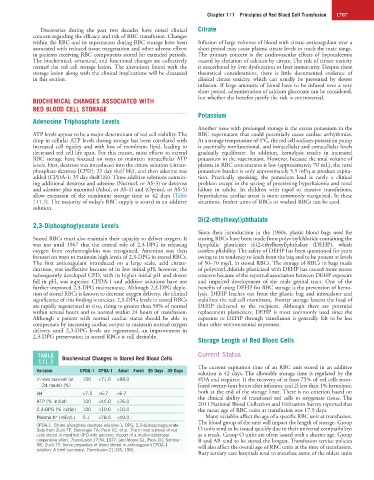
            allow  extension  of  the  maximum  storage  time  to  42  days  (Table   hyperkalemic cardiac arrest is more commonly recognized. In these
            111.3). The majority of today’s RBC supply is stored in an additive   situations, fresher units of RBCs or washed RBCs can be used.
            solution.
                                                                  Di(2-ethylhexyl)phthalate
            2,3-Diphosphoglycerate Levels
                                                                  Since  their  introduction  in  the  1960s,  plastic  blood bags used for
            Stored RBCs must also maintain their capacity to deliver oxygen. It   storing RBCs have been made from polyvinylchloride containing the
            was  not  until  1967  that  the  central  role  of  2,3-DPG  in  releasing   lipophilic  plasticizer  di(2-ethylhexyl)phthalate  (DEHP),  which
            oxygen  from  oxyhemoglobin  was  recognized.  Attention  was  then   confers pliability. The safety of DEHP has been questioned for years
            focused on ways to maintain high levels of 2,3-DPG in stored RBCs.   owing to its tendency to leach from the bag and to be present at levels
            The  first  anticoagulant  introduced  on  a  large  scale,  acid  citrate-  of 50–70 mg/L in stored RBCs. The storage of RBCs in bags made
            dextrose, was ineffective because of its low initial pH; however, the   of polyvinyl chloride plasticized with DEHP has caused more recent
            subsequently developed CPD, with its higher initial pH and slower   concern because of the reported association between DEHP exposure
            fall in pH, was superior. CPDA-1 and additive solutions have not   and  impaired  development  of  the  male  genital  tract.  One  of  the
            further improved 2,3-DPG maintenance. Although 2,3-DPG deple-  benefits of using DEHP for RBC storage is the prevention of hemo-
            tion of stored RBCs is known to decrease oxygen delivery, the clinical   lysis. DEHP leaches out from the plastic bag and intercalates and
            significance of this finding is unclear. 2,3-DPG levels in stored RBCs   stabilizes the red cell membrane. Shorter storage lessens the load of
            are rapidly regenerated in vivo, rising to greater than 50% of normal   DEHP  delivered  to  the  recipient.  Although  there  are  potential
            within several hours and to normal within 24 hours of transfusion.   replacement  plasticizers,  DEHP  is  most  commonly  used  since  the
            Although  a  patient  with  normal  cardiac  status  should  be  able  to   exposure  to  DEHP  through  transfusion  is  generally  felt  to  be  less
            compensate by increasing cardiac output to maintain normal oxygen   than other environmental exposures.
            delivery  until  2,3-DPG  levels  are  regenerated,  an  improvement  in
            2,3-DPG preservation in stored RBCs is still desirable.
                                                                  Storage Length of Red Blood Cells

             TABLE   Biochemical Changes in Stored Red Blood Cells  Current Status
              111.3
                                                                  The current expiration time of an RBC unit stored in an additive
             Variable      CPDA-1 CPDA-1  Adsol  Fresh 35 Days 35 Days
                                                                  solution is 42 days. The allowable storage time is regulated by the
             In vivo survival (at   100  <71.0  <88.0             FDA and requires: 1) the recovery of at least 75% of red cells trans-
               24 hours) (%)                                      fused twenty-four hours after infusion, and 2) less than 1% hemolysis,
             pH             <7.5  <6.7  <6.7                      both at the end of the storage limit. There is no criterion based on
                                                                  the  clinical  ability  of  transfused  red  cells  to  oxygenate  tissue. The
             ATP (% initial)  100  <45.0  <76.0
                                                                  2011 National Blood Collection and Utilization Survey reported that
             2,3-DPG (% initial)  100  <10.0  <10.0               the mean age of RBC units at transfusion was 17.9 days.
             Plasma K  (mEq/L)  5.1  <78.5  <49.0                   Many variables affect the age of a specific RBC unit at transfusion.
                   +
             CPDA-1, Citrate phosphate dextrose adenine-1; DPG, 2,3-diphosphoglycerate.  The blood group of the unit will impact the length of storage. Group
             Data from Zuck TF, Bensinger TA, Peck CC, et al: The in vivo survival of red   O units tend to be issued quickly due to their universal compatibility;
             cells stored in modified CPD with adenine: Report of a multi-institutional   as a result, Group O units are often issued with a shorter age. Group
             cooperative effort. Transfusion 17:34, 1977; and Moore GL, Peck CC, Sohmer   B and AB tend to be stored the longest. Transfusion service policies
             RR, Zuck TF: Some properties of blood stored in anticoagulant CPDA-1   will also affect the overall age of RBC units at the time of transfusion.
             solution: A brief summary. Transfusion 21:135, 1981.
                                                                  Busy tertiary care hospitals tend to transfuse some of the oldest units

