


Page 1926 - Hematology_ Basic Principles and Practice ( PDFDrive )
P. 1926
1706   Part XI  Transfusion Medicine


        by some authorities because of the risk of renal damage and renal   TABLE   Transfusion After ABO Incompatible Hematopoietic
        stones due to adenine metabolites. If CPD RBCs are not available,   111.2  Stem Cell Transplantation
        the additive solution can be removed and the cells washed. RBCs
        preserved  in  additive  solutions  also  have  a  lower  hematocrit  level   ABO Group   Product Selection
        that must be taken into account in making calculations for exchange     Donor  Recipient  Type of Mismatch  RBC  Plasma/Platelets
        transfusion.
           The  humoral  and  cellular  immune  systems  of  the  neonate  are   A  O  Major   O     A
        immature, especially in the premature infant. There is a small but   A  B  Bi-directional  O  AB
        real risk of transfusion-induced GVHD in premature infants receiv-  A  AB  Minor       A     AB
        ing  RBC  transfusions  and  in  the  fetus  undergoing  intrauterine
        transfusion. Irradiation of RBCs should be performed in both set-  B  O  Major         O     B
        tings.  Another  risk  of  transfusion  in  low  birth  weight  (<1500 g)   B  A  Bi-directional  O  AB
        premature infants is the development of clinical CMV infection in   B  AB  Minor       B     AB
        infants of CMV-seronegative mothers. CMV safe blood, either CMV
        seronegative or leukoreduced, should be provided to these infants.   O  A  Minor       O     A
        Some  retrospective  studies  have  suggested  that  other  rare  RBC   O  B  Minor    O     B
        transfusion-associated  complications  in  this  particularly  vulnerable   O  AB  Minor  O  AB
        patient group include necrotizing enterocolitis and intraventricular   AB  A  Major    A     AB
        hemorrhage. However, a causal relationship has yet to be established
        through clinical studies.                              AB      B        Major          B     AB
           Novel ideas to prevent anemia and decrease donor exposure in   AB  O  Major         O     AB
        premature infants and other neonates include delayed cord clamping,   RBC, Red blood cell.
        cord  milking,  umbilical  vein  blood  sampling  from  the  delivered
        placenta, and autologous cord blood transfusion. One review of 10
        delayed cord clamping studies, and demonstrated lower transfusion
        requirements in the delayed versus early clamped group. However, a   red cells. Typically, passenger lymphocyte syndrome involves ABO
        randomized controlled trial by Strauss et al found no difference in   incompatibility, but hemolysis resulting from serologic incompatibil-
        transfusion needs between delayed and early clamped groups. A few   ity  in  other  blood  group  systems  has  been  reported.  If  hemolysis
        studies have looked at autologous cord blood transfusions in neonates.   increases  a  few  days  after  transplantation,  passenger  lymphocyte
        One study found that the amount of blood harvested was insufficient   syndrome should be considered. Once the donor is engrafted and
        to  cover  all  transfusions  in  low  birth  weight  infants.  In  addition,   incompatible recipient red cells are removed, donor red cells will have
        studies have demonstrated that blood processing problems, bacterial   normal survival in the recipient. Major incompatibility is defined by
        contamination, and costs are all barriers to the routine collection and   the  presence  of  blood  group  antibodies  in  recipient  plasma  (e.g.,
        autotransfusion of cord blood.                        group A donor to a group O recipient). Major ABO incompatible
                                                              transplantation  may  result  in  pure  red  cell  aplasia  (PRCA)  due  to
        Red Blood Cell Transfusion in the Allogeneic          persisting incompatible ABO antibody targeting the donor’s engraft-
                                                              ing  erythropoietic  precursors  expressing  ABO  antigens.  Although
        Hematopoietic Stem Cell Transplantation Recipient     there may be no evident hemolysis, the donor red cell engraftment
                                                              could be further delayed and result in prolonged RBC transfusion
        Red  cell  engraftment  is  usually  the  last  phase  of  hematopoietic   support. Finally, bidirectional incompatibility is defined as the pres-
        recovery after stem cell transplantation; therefore, RBC transfusion   ence of incompatible ABO antigens and antibodies contributed by
        is common during the posttransplantation period. As hematopoietic   both donor and recipient (e.g., group A donor to group B recipient).
        stem cells and progenitor cells lack ABO antigens, the transplantation   Bidirectional  incompatible  transplants  may  cause  the  problems
        outcome is not significantly affected by the red cell antigen/antibody   associated with both minor and major ABO incompatible transplants.
        incompatibility between the donor and the recipient. However RBC   To predict the severity of these complications and provide manage-
        transfusion requirements and blood product selection can vary sig-  ment, an ABO antibody titer can be performed on either the stem
        nificantly depending on the type of ABO incompatibility. The phe-  cell product or the recipient. However, titers do not correlate perfectly
        notyping  of  non-ABO/Rh  red  cell  antigens  from  the  donor  and   with  the  clinical  outcomes. When  a  high  titer  incompatible  ABO
        recipient is not required in the absence of a positive red cell antibody   antibody  is  discovered  in  a  minor  incompatibility,  the  stem  cell
        screen in the recipient. Patients with an autologous stem cell trans-  product  can  be  plasma-reduced  to  avoid  an  immediate  hemolytic
        plant have less RBC transfusion requirements when compared with   reaction. Occasionally, in major incompatibilities, plasma exchange
        patients receiving allogeneic stem cell transplantation.  can be considered if the recipient has a high level of incompatible
           In the setting of allogeneic stem cell transplantation, there are four   ABO  antibody  to  prevent  hemolysis  at  the  time  of  transplant  or
        major categories of ABO antigen matching: full compatibility, minor   PRCA.
        incompatibility, major incompatibility, and bidirectional incompati-
        bility.  In  addition,  Rh  type  must  be  taken  into  consideration.  Rh
        positive recipients with Rh negative donors should receive Rh nega-  RED BLOOD CELL PRESERVATION AND STORAGE
        tive RBCs, but Rh negative recipients with Rh positive donors may
        receive  Rh  positive  RBCs.  Apheresis  platelets  and  plasma  may  be   The  first  key  to  the  storage  of  blood  is  a  stable,  minimally  toxic
        given without regard to Rh. The blood product selection algorithm   anticoagulant with preservative properties. During the early 1900s,
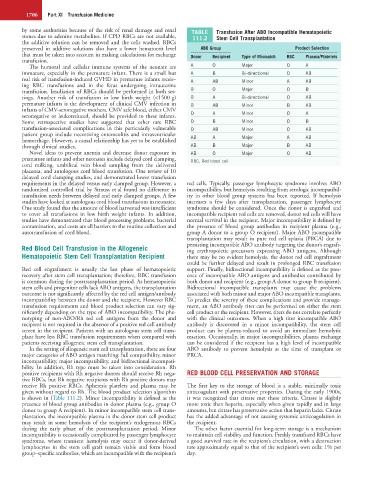
        is shown in (Table 111.2). Minor incompatibility is defined as the   it  was  recognized  that  citrate  met  these  criteria.  Citrate  is  slightly
        presence of blood group antibodies in donor plasma (e.g., group O   more toxic than heparin, especially when given rapidly and in large
        donor to group A recipient). In minor incompatible stem cell trans-  amounts, but citrate has preservative action that heparin lacks. Citrate
        plantation, the incompatible plasma in the donor stem cell product   has the added advantage of not causing systemic anticoagulation in
        may result in some hemolysis of the recipient’s endogenous RBCs   the recipient.
        during  the  early  phase  of  the  posttransplantation  period.  Minor   The other factor essential for long-term storage is a mechanism
        incompatibility is occasionally complicated by passenger lymphocyte   to maintain cell viability and function. Freshly transfused RBCs have
        syndrome,  where  transient  hemolysis  may  occur  if  donor-derived   a good survival rate in the recipient’s circulation, with a destruction
        lymphocytes  in  the  stem  cell  graft  remain  viable  and  form  blood   rate approximately equal to that of the recipient’s own cells: 1% per
        group–specific antibodies, which are incompatible with the recipient’s   day.

