


Page 194 - Hematology_ Basic Principles and Practice ( PDFDrive )
P. 194
146    Part II  Cellular Basis of Hematology


                                                              increased migration and adhesion via very late antigen (VLA)-4 and
                                                              VLA-5 integrins. Moreover, the homing of murine progenitor cells
                                                              to  the  BM  of  mice  deficient  in  P-  and  E-selectin  was  impaired,
                                                              demonstrating  the  crucial  role  of  adhesion  interactions  for  proper
                                                              homing, allowing HSPC rolling on the BM endothelium and reten-
                                                              tion in their stromal supportive niches. Interestingly, SDF-1 is not
                                                              the only chemoattractant factor for HSPC homing; previous studies
                                                              have shown that the chemoattractant lipid sphingosine-1-phosphate
                                                              (S1P)  has  a  role  in  inducing  murine  HSPC  homing  to  the  BM
                                                                                                     5
                                                              by  increasing  progenitor  adhesion  to  stromal  cells.   S1P,  together
                                                              with SDF-1, was indeed reported to have a synergistic effect on the
                                                              migration  of  hematopoietic  progenitor  cells;  however,  this  finding
                                                              was later refuted by Ryser et al, showing no additive effect when both
                                                              chemoattractants are added to the same plate. In contrast, this group
                                                              showed  that  overexpression  of  S1P 1   (S1P  receptor)  on  immature
                                                                         +
                                                              human CD34  cells strongly reduces their migration toward a gradi-
                                                              ent of SDF-1 and in vivo homing via inhibition of CXCR4 signaling
                                                                                6
                                                              (reviewed by Golan et al ).
                                                                 Taken together, manipulation of SDF-1 levels in the target organ
                                                              and CXCR4 on the surface of transplanted stem cells can be used
                                                              to navigate stem cells in vivo. Enhanced SDF-1 production by BM
                                                              stromal  cells  after  host  preconditioning,  crossing  the  blood–BM
                                                              barrier,  and  activation  of  the  adhesion  machinery  are  required  for
                                                              HSPC attachment to BM-supporting niches, allowing their subse-
                                                              quent self-renewal and differentiation (see Fig. 14.1).
                                                              HEMATOPOIETIC STEM AND PROGENITOR CELL
                                                              MOBILIZATION: A DYNAMIC MULTIFACETED PROCESS

                                                              HSPCs are actively retained in the BM via adhesion interactions with
                                                              their stromal microenvironment. In the BM, they undergo extensive
                                                              proliferation and differentiation, giving rise to all mature leukocyte
                                                              and erythrocyte reservoirs, and replenishing the blood with new cells.
                                                              Interestingly, in addition to mature leukocytes, low levels of HSPCs
                                                              are  also  released  to  the  blood  as  part  of  steady-state  homeostasis.
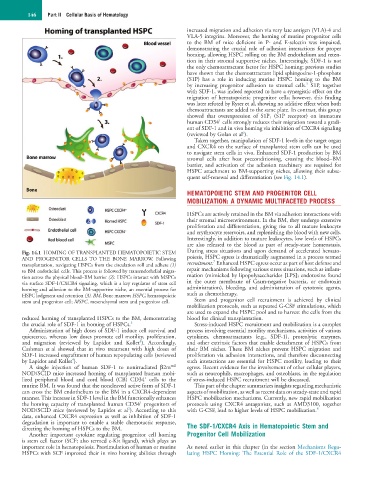
        Fig. 14.1  HOMING OF TRANSPLANTED HEMATOPOIETIC STEM   During  stress  situations  and  upon  demand  of  accelerated  hemato-
        AND  PROGENITOR  CELLS  TO  THE  BONE  MARROW.  Following   poiesis, HSPC egress is dramatically augmented in a process termed
                                                                       7
        transplantation, navigating HSPCs from the circulation roll and adhere (1)   recruitment.  Enhanced HSPC egress occur as part of host defense and
        to BM endothelial cells. This process is followed by transendothelial migra-  repair mechanisms following various stress situations, such as inflam-
        tion across the physical blood–BM barrier (2). HSPCs interact with MSPCs   mation (mimicked by lipopolysaccharides [LPS]; endotoxins found
        via surface SDF-1/CXCR4 signaling, which is a key regulator of stem cell   in  the  outer  membrane  of  Gram-negative  bacteria,  or  endotoxin
        homing and adhesion to the BM-supportive niche, an essential process for   administration),  bleeding,  and  administration  of  cytotoxic  agents,
        HSPC lodgment and retention (3). BM, Bone marrow; HSPC, hematopoietic   such as chemotherapy.
        stem and progenitor cell; MSPC, mesenchymal stem and progenitor cell.   Stem  and  progenitor  cell  recruitment  is  achieved  by  clinical
                                                              mobilization protocols, such as repeated G-CSF stimulations, which
                                                              are used to expand the HSPC pool and to harvest the cells from the
        reduced homing of transplanted HSPCs to the BM, demonstrating   blood for clinical transplantation.
        the crucial role of SDF-1 in homing of HSPCs. 3          Stress-induced HSPC recruitment and mobilization is a complex
           Administration of high doses of SDF-1 induce cell survival and   process involving essential motility mechanisms, activities of various
        quiescence,  whereas  low  doses  promote  cell  motility,  proliferation,   cytokines,  chemoattractants  (e.g.,  SDF-1),  proteolytic  enzymes,
                                               4
        and  migration  (reviewed  by  Lapidot  and  Kollet ).  Accordingly,   and other extrinsic factors that enable detachment of HSPCs from
        Cashman  et al  showed  that  in  vivo  treatment  with  high  doses  of   their  BM  niches. These  BM  niches  prevent  HSPC  migration  and
        SDF-1 increased engraftment of human repopulating cells (reviewed   proliferation via adhesion interactions, and therefore disconnecting
                         4
        by Lapidot and Kollet ).                              such  interactions  are  essential  for  HSPC  motility,  leading  to  their
                                                         null
           A  single  injection  of  human  SDF-1  to  nonirradiated  β2m    egress. Recent evidence for the involvement of other cellular players,
        NOD/SCID mice increased homing of transplanted human mobi-  such as neutrophils, macrophages, and osteoblasts, in the regulation
                                                +
        lized  peripheral  blood  and  cord  blood  (CB)  CD34   cells  to  the   of stress-induced HSPC recruitment will be discussed.
        murine BM. It was found that the noncleaved active form of SDF-1   This part of the chapter summarizes insights regarding mechanistic
        can cross the BM endothelium to the BM in a CXCR4-dependent   aspects of mobilization, as well as recent data on steady-state and rapid
        manner. This increase in SDF-1 level in the BM functionally enhances   HSPC mobilization mechanisms. Currently, new rapid mobilization
                                               +
        the homing capacity of transplanted human CD34  progenitors of   protocols  using  CXCR4  antagonists,  such  as  AMD3100,  together
                                           2
        NOD/SCID  mice  (reviewed  by  Lapidot  et  al ).  According  to  this   with G-CSF, lead to higher levels of HSPC mobilization. 8
        data, enhanced CXCR4 expression as well as inhibition of SDF-1
        degradation  is  important  to  enable  a  stable  chemotactic  response,
        directing the homing of HSPCs to the BM.              The SDF-1/CXCR4 Axis in Hematopoietic Stem and
           Another  important  cytokine  regulating  progenitor  cell  homing   Progenitor Cell Mobilization
        is stem cell factor (SCF; also termed c-Kit ligand), which plays an
        important role in hematopoiesis. Prestimulation of human or murine   As noted earlier in this chapter (in the section Mechanisms Regu-
        HSPCs with SCF improved their in vivo homing abilities through   lating  HSPC  Homing: The  Essential  Role  of  the  SDF-1/CXCR4

