


Page 2003 - Hematology_ Basic Principles and Practice ( PDFDrive )
P. 2003
Chapter 117  Transfusion Therapy for Coagulation Factor Deficiencies  1777


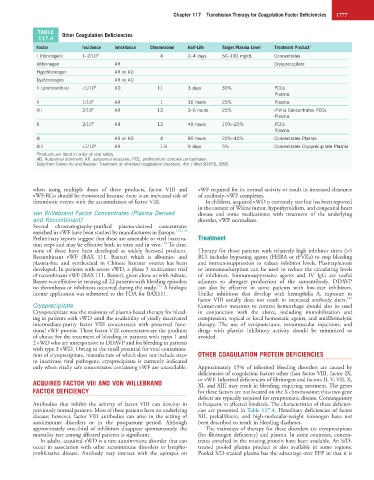
             TABLE   Other Coagulation Deficiencies
              117.4
             Factor         Incidence  Inheritance  Chromosome  Half-Life  Target Plasma Level  Treatment Product a
             I (fibrinogen)  1–2/10 6                4        2–4 days    50–100 mg/dL     Concentrates
             Afibrinogen               AR                                                  Cryoprecipitate
             Hypofibrinogen            AR or AD
             Dysfibrinogen             AR or AD
             II (prothrombin)  <1/10 6  AD          11        3 days      30%              PCCs
                                                                                           Plasma
             V              1/10 6     AR            1        36 hours    25%              Plasma
             VII            2/10 6     AR           13        3–6 hours   25%              rFVIIa Concentrates PCCs
                                                                                           Plasma
             X              2/10 6     AR           13        40 hours    10%–25%          PCCs
                                                                                           Plasma
             XI                        AR or AD      4        80 hours    20%–40%          Concentrates Plasma
             XIII           <1/10 6    AR            1.6      9 days      5%               Concentrates Cryoprecipitate Plasma
             a Products are listed in order of viral safety.
             AD, Autosomal dominant; AR, autosomal recessive; PCC, prothrombin complex concentrates.
             Data from Cohen AJ and Kessler: Treatment of inherited coagulation disorders. Am J Med 99:675, 1995.


            when  using  multiple  doses  of  these  products,  factor  VIII  and   vWF required for its normal activity or result in increased clearance
            vWF:RCo should be monitored because there is an increased risk of   of antibody–vWF complexes.
            thrombotic events with the accumulation of factor VIII.  In children, acquired vWD is extremely rare but has been reported
                                                                  in the context of Wilms tumor, hypothyroidism, and congenital heart
            von Willebrand Factor Concentrates (Plasma Derived    disease  and  some  medications;  with  treatment  of  the  underlying
            and Recombinant)                                      disorder, vWF normalizes.
            Several  chromatography-purified  plasma-derived  concentrates
            enriched in vWF have been studied by manufacturers in Europe. 112,113
            Preliminary reports suggest that these are amenable to viral inactiva-  Treatment
                                                      110
            tion steps and may be effective both in vitro and in vivo.  To date,
            none  of  these  have  been  developed  as  widely  licensed  products.   Therapy for those patients with relatively high inhibitor titers (>5
            Recombinant  vWF  (BAX  111,  Baxter)  which  is  albumin-  and   BU) includes bypassing agents (FEIBA or rFVIIa) to stop bleeding
            plasma-free  and  synthesized  in  Chinese  hamster  ovaries  has  been   and  immunosuppression  to  reduce  inhibitor  levels.  Plasmapheresis
            developed. In patients with severe vWD, a phase 3 multicenter trial   or immunoadsorption can be used to reduce the circulating levels
            of recombinant vWF (BAX 111, Baxter), given alone or with Advate,   of  inhibitors.  Immunosuppressive  agents  and  IV  IgG  are  useful
            Baxter was effective in treating all 22 patients with bleeding episodes;   adjuncts  to  abrogate  production  of  the  autoantibody.  DDAVP
                                                    114
            no thrombosis or inhibitors occurred during the study.  A biologic   can  also  be  effective  in  some  patients  with  low-titer  inhibitors.
            license application was submitted to the FDA for BAX111.  Unlike  inhibitors  that  develop  with  hemophilia  A,  exposure  to
                                                                                                                  115
                                                                  factor  VIII  usually  does  not  result  in  increased  antibody  titers.
            Cryoprecipitate                                       Conservative  measures  to  control  hemorrhage should  also  be  used
            Cryoprecipitate was the mainstay of plasma-based therapy for bleed-  in  conjunction  with  the  above,  including  immobilization  and
            ing in patients with vWD until the availability of virally inactivated   compression, topical or local hemostatic agents, and antifibrinolytic
            intermediate-purity  factor  VIII  concentrates  with  preserved  func-  therapy.  The  use  of  venipunctures,  intramuscular  injections,  and
            tional vWF protein. These factor VIII concentrates are the products   drugs  with  platelet  inhibitory  activity  should  be  minimized  or
            of choice for the treatment of bleeding in patients with types 1 and   avoided.
            2 vWD who are unresponsive to DDAVP and for bleeding in patients
            with type 3 vWD. Owing to the small potential for viral contamina-
            tion of cryoprecipitate, manufacture of which does not include steps   OTHER COAGULATION PROTEIN DEFICIENCIES
            to  inactivate  viral  pathogens,  cryoprecipitate  is  currently  indicated
            only when virally safe concentrates containing vWF are unavailable.  Approximately  15%  of  inherited  bleeding  disorders  are  caused  by
                                                                  deficiencies of coagulation factors other than factor VIII, factor IX,
            ACQUIRED FACTOR VIII AND VON WILLEBRAND               or vWF. Inherited deficiencies of fibrinogen and factors II, V, VII, X,
                                                                  XI, and XIII may result in bleeding, requiring treatment. The genes
            FACTOR DEFICIENCY                                     for these factors are not located on the X chromosome; thus two gene
                                                                  defects are typically required for symptomatic disease. Consanguinity
            Antibodies  that  inhibit  the  activity  of  factor  VIII  can  develop  in   is frequent in affected kindreds. The characteristics of these deficien-
            previously normal patients. Most of these patients have no underlying   cies are presented in Table 117.4. Hereditary deficiencies of factor
            disease;  however,  factor VIII  antibodies  can  arise  in  the  setting  of   XII,  prekallikrein,  and  high-molecular-weight  kininogen  have  not
            autoimmune  disorders  or  in  the  postpartum  period.  Although   been described to result in bleeding diatheses.
            approximately one-third of inhibitors disappear spontaneously, the   The mainstays of therapy for these disorders are cryoprecipitate
            mortality rate among affected patients is significant.  (for fibrinogen deficiency) and plasma. In some countries, concen-
              In adults, acquired vWD is a rare autoimmune disorder that can   trates enriched in the missing protein have been available. An S/D-
            occur in association with other autoimmune disorders or lympho-  treated  pooled  plasma  product  is  also  available  in  some  regions.
            proliferative  disease.  Antibody  may  interact  with  the  epitopes  on   Pooled S/D-treated plasma has the advantage over FFP in that it is

