


Page 2002 - Hematology_ Basic Principles and Practice ( PDFDrive )
P. 2002
1776   Part XI  Transfusion Medicine


                                                              parameters. These factors, particularly the subtype of vWD and the
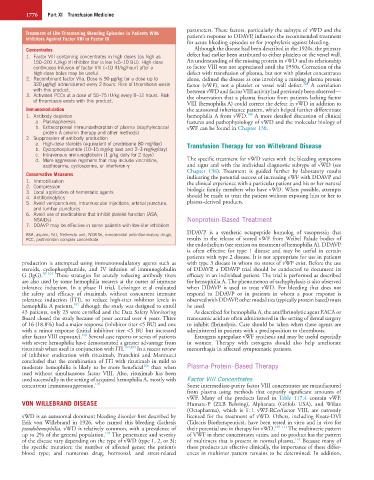
         Treatment of Life-Threatening Bleeding Episodes in Patients With
         Inhibitors Against Factor VIII or Factor IX          patient’s response to DDAVP, influence the recommended treatment
                                                              for acute bleeding episodes or for prophylaxis against bleeding.
          Concentrates                                           Although the disease had been described in the 1920s, the primary
          1.  Factor VIII containing concentrates in high doses (as high as   defect had earlier been attributed to either platelets or the vessel wall.
            150–200 IU/kg) if inhibitor titer is low (<5–10 BU). High-dose   An understanding of the missing protein in vWD and its relationship
            continuous infusion of factor VIII (≈10 IU/kg/hour) after a   to factor VIII was not appreciated until the 1950s. Correction of the
            high-dose bolus may be useful.                    defect with transfusion of plasma, but not with platelet concentrates
          2.  Recombinant factor VIIa. Dose is 90 µg/kg (or a dose up to   alone, defined the disease as one involving a missing plasma protein
            320 µg/kg) administered every 2 hours. Risk of thrombosis exists   factor  (vWF),  not  a  platelet  or  vessel  wall  defect.   A  correlation
                                                                                                    108
            with this product.                                between vWD and factor VIII activity had previously been observed—
          3.  Activated PCCs at a dose of 50–75 IU/kg every 8–12 hours. Risk   the observation that a plasma fraction from patients lacking factor
            of thrombosis exists with this product.
                                                              VIII (hemophilia A) could correct the defect in vWD in addition to
          Immunomodulation                                    the autosomal inheritance pattern, which helped further differentiate
                                                                                  108
          1.  Antibody depletion                              hemophilia A from vWD.  A more detailed discussion of clinical
              a.  Plasmapheresis                              features and pathophysiology of vWD and the molecular biology of
              b.  Extracorporeal immunoadsorption of plasma (staphylococcal   vWF can be found in Chapter 138.
               protein A column therapy and other methods)
          2.  Suppression of antibody production
              a.  High-dose steroids (equivalent of prednisone 80 mg/day)  Transfusion Therapy for von Willebrand Disease
              b.  Cyclophosphamide (10–15 mg/kg load and 2–3 mg/kg/day)
              c.  Intravenous immunoglobulin (1 g/kg daily for 2 days)
              d.  More aggressive regimens that may include vincristine,   The specific treatment for vWD varies with the bleeding symptoms
               azathioprine, cyclosporine, or interferon-γ    and signs and with the individual diagnostic subtype of vWD (see
                                                              Chapter  138).  Treatment  is  guided  further  by  laboratory  results
          Conservative Measures                               indicating the potential success of increasing vWF with DDAVP and
          1.  Immobilization                                  the clinical experience with a particular patient and his or her natural
          2.  Compression                                     biologic family members who have vWD. When possible, attempts
          3.  Local application of hemostatic agents
          4.  Antifibrinolytics                               should be made to treat the patient without exposing him or her to
          5.  Avoid venipunctures, intramuscular injections, arterial puncture,   plasma-derived products.
            and lumbar punctures
          6.  Avoid use of medications that inhibit platelet function (ASA,
            NSAIDs)                                           Nonprotein-Based Treatment
          7.  DDAVP may be effective in some patients with low-titer inhibitors
                                                              DDAVP  is  a  synthetic  octapeptide  homolog  of  vasopressin  that
         ASA, aspirin; BU, Bethesda unit; NSAIDs, nonsteroidal antiinflammatory drugs;
         PCC, prothrombin complex concentrate.                results in the release of stored vWF from Weibel Palade bodies of
                                                              the endothelium (see section on treatment of hemophilia A). DDAVP
                                                              is  often  effective  for  type  1  disease  and  may  be  useful  in  certain
                                                              patients with type 2 disease. It is not appropriate for use in patients
        production  is  attempted  using  immunomodulatory  agents  such  as   with type 3 disease in whom no stores of vWF exist. Before the use
        steroids,  cyclophosphamide,  and  IV  infusion  of  immunoglobulin   of DDAVP, a DDAVP trial should be conducted to document its
        G  (IgG). 98–101  These  strategies  for  acutely  reducing  antibody  titers   efficacy in an individual patient. The trial is performed as described
        are also used by some hemophilia treaters at the outset of immune   for hemophilia A. The phenomenon of tachyphylaxis is also observed
        tolerance  induction.  In  a  phase  II  trial,  Leissinger  et al  evaluated   when  DDAVP  is  used  to  treat  vWD.  For  bleeding  that  does  not
        the  safety  and  efficacy  of  rituximab,  without  concurrent  immune   respond  to  DDAVP  or  in  patients  in  whom  a  poor  response  is
        tolerance  induction  (ITI),  to  reduce  high-titer  inhibitor  levels  in   observed with DDAVP, other modalities (typically protein based) must
                         102
        hemophilia A patients,  although the study was designed to enroll   be used.
        43 patients, only 23 were enrolled and the Data Safety Monitoring   As described for hemophilia A, the antifibrinolytic agent EACA or
        Board closed the study because of poor accrual over 4 years. Three   tranexamic acid are often administered in the setting of dental surgery
        of 16 (18.8%) had a major response (inhibitor titer <5 BU) and one   to inhibit fibrinolysis. Care should be taken when these agents are
        with a minor response (initial inhibitor titer <5 BU but increased   administered in patients with a predisposition to thrombosis.
                            103
        after factor VIII exposure).  Several case reports or series of patients   Estrogens upregulate vWF synthesis and may be useful especially
        with severe hemophilia have demonstrated a greater advantage from   in  women.  Therapy  with  estrogens  should  also  help  ameliorate
        rituximab when used in conjunction with ITI. 104,105  In a recent review   menorrhagia in affected symptomatic patients.
        of  inhibitor  eradication  with  rituximab,  Franchini  and  Mannucci
        concluded that the combination of ITI with rituximab in mild to
                                                106
        moderate  hemophilia  is  likely  to  be  more  beneficial   than  when   Plasma-Protein–Based Therapy
        used  without  simultaneous  factor  VIII.  Also,  rituximab  has  been
        used successfully in the setting of acquired hemophilia A, mostly with   Factor VIII Concentrates
        concurrent immunosuppression. 105                     Some intermediate-purity factor VIII concentrates are manufactured
                                                              from  plasma  using  methods  that  copurify  significant  amounts  of
                                                              vWF.  Many  of  the  products  listed  in  Table  117.4  contain  vWF.
        VON WILLEBRAND DISEASE                                Humate-P  (ZLB  Behring),  Alphanate  (Grifols  USA),  and  Wilate
                                                              (Octapharma),  which  is  1 : 1  vWF:RCo/factor  VIII,  are  currently
        vWD is an autosomal dominant bleeding disorder first described by   licensed  for  the  treatment  of  vWD.  Others,  including  Koate-DVI
        Erik  von  Willebrand  in  1926,  who  named  this  bleeding  diathesis   (Talecris Biotherapeutics), have been tested in vitro and in vivo for
        pseudohemophilia. vWD is relatively common, with a prevalence of   their potential use in therapy for vWD. 109–111  The multimeric pattern
                                   107
        up to 2% of the general population.  The penetrance and severity   of VWF in these concentrates varies, and no product has the pattern
                                                                                                  110
        of the disease vary depending on the type of vWD (type 1, 2, or 3);   of multimers that is present in normal plasma.  Because many of
        the  specific  mutation;  the  number  of  affected  genes;  the  patient’s   these products are effective clinically, the importance of these differ-
        blood  type;  and  numerous  drug,  hormonal,  and  stress-related   ences in multimer pattern remains to be determined. In addition,

