


Page 1998 - Hematology_ Basic Principles and Practice ( PDFDrive )
P. 1998
1772   Part XI  Transfusion Medicine


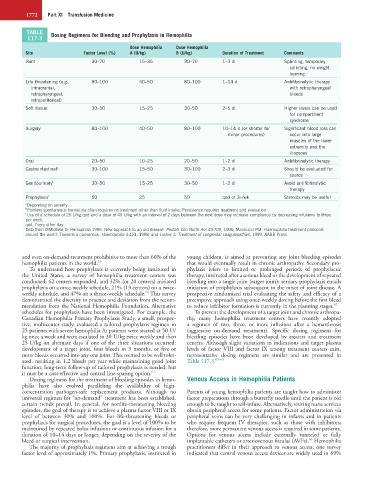
          TABLE   Dosing Regimens for Bleeding and Prophylaxis in Hemophilia
          117.3
                                            Dose Hemophilia   Dose Hemophilia
         Site               Factor Level (%)  A (U/kg)     B (U/kg)       Duration of Treatment  Comments
         Joint                 30–70           15–35         30–70        1–3 d               Splinting, temporary
                                                                                                splinting, no weight
                                                                                                bearing
         Life threatening (e.g.,   80–100      40–50         80–100       1–14 d              Antifibrinolytic therapy
           intracranial,                                                                        with retropharyngeal
           retropharyngeal,                                                                     bleeds
           retroperitoneal)
         Soft tissue           30–50           15–25         30–50        2–5 d               Higher levels can be used
                                                                                                for compartment
                                                                                                syndrome
         Surgery               80–100          40–50         80–100       10–14 d (or shorter for   Significant blood loss can
                                                                            minor procedures)   occur into large
                                                                                                muscles of the lower
                                                                                                extremity and the
                                                                                                iliopsoas
         Oral                  20–50           10–25         20–50        1–2 d               Antifibrinolytic therapy
         Gastrointestinal a    30–100          15–50         30–100       2–3 d               Should be evaluated for
                                                                                                source
         Genitourinary b       30–50           15–25         30–50        1–2 d               Avoid antifibrinolytic
                                                                                                therapy
         Prophylaxis c         50              25            50           qod or 3×/wk        Steroids may be useful
         a Depending on severity.
         b Painless spontaneous hematuria often requires no treatment other than fluid intake. Persistence requires treatment and evaluation.
         c Use of a schedule of 25 U/kg qod and a dose of 40 U/kg with an interval of 2 days between the next dose may increase compliance by decreasing infusions to three
         per week.
         qod, Every other day.
         Data from DiMichele D: Hemophilia 1996. New approach to an old disease. Pediatr Clin North Am 43:709, 1996; Mannucci PM: Haemophilia treatment protocols
         around the world: Towards a consensus. Haemophilia 4:421, 1998; and Lusher J: Treatment of congenital coagulopathies, 1999, AABB Press.


        and even on-demand treatment prohibitive to more than 60% of the   young children, is aimed at preventing any joint bleeding episodes
        hemophilia patients in the world. 59                  that would eventually result in chronic arthropathy. Secondary pro-
           To understand how prophylaxis is currently being instituted in   phylaxis  refers  to  limited  or  prolonged  periods  of  prophylactic
        the  United  States,  a  survey  of  hemophilia  treatment  centers  was   therapy, instituted after a serious bleed or the development of repeated
        conducted: 62 centers responded, and 32% (or 20 centers) initiated   bleeding into a single joint (target joint); tertiary prophylaxis entails
        prophylaxis on a once-weekly schedule, 21% (13 centers) on a twice-  initiation of prophylaxis subsequent to the onset of joint disease. A
                                                 60
        weekly schedule, and 47% on a thrice-weekly schedule.  This survey   prospective randomized trial evaluating the safety and efficacy of a
        demonstrated the diversity in practice and deviation from the recom-  preemptive approach using once-weekly dosing before the first bleed
        mendation from the National Hemophilia Foundation. Alternative   to reduce inhibitor formation is currently in the planning stages. 62
        schedules for prophylaxis have been investigated. For example, the   To prevent the development of a target joint and chronic arthropa-
        Canadian Hemophilia Primary Prophylaxis Study, a small, prospec-  thy,  many  hemophilia  treatment  centers  have  recently  adopted
        tive, multicenter study, evaluated a tailored prophylaxis regimen in   a  regimen  of  two,  three,  or  more  infusions  after  a  hemarthrosis
        25 patients with severe hemophilia A; patients were started at 50 U/  (aggressive  on-demand  treatment).  Specific  dosing  regimens  for
        kg once a week and were escalated to 30 U/kg twice weekly and then   bleeding  episodes  have  been  developed  by  treaters  and  treatment
        25 U/kg  on  alternate  days  if  one  of  the  three  situations  occurred:   centers. Although slight variations in indications and target plasma
        development of a target joint, four bleeds in 3 months, or five or   levels  of  factor VIII  and  factor  IX  among  treatment  centers  exist,
        more bleeds occurred into any one joint. This seemed to be well toler-  representative  dosing  regimens  are  similar  and  are  presented  in
        ated, resulting in 1.2 bleeds per year while maintaining good joint   Table 117.3. 63–65
        function; long-term follow-up of tailored prophylaxis is needed, but
        it may be a cost-effective and central line-sparing option. 61
           Dosing regimens for the treatment of bleeding episodes in hemo-  Venous Access in Hemophilia Patients
        philia  have  also  evolved  paralleling  the  availability  of  high-
        concentration  pathogen-safe  replacement  products.  Although  no   Parents of young hemophilia patients are taught how to administer
        universal regimen for “on-demand” treatment has been established,   factor preparations through a butterfly needle until the patient is old
        certain  trends  prevail.  In  general,  for  nonlife-threatening  bleeding   enough to be taught to self-infuse. Alternatively, visiting nurse services
        episodes, the goal of therapy is to achieve a plasma factor VIII or IX   obtain peripheral access for some patients. Factor administration via
        level  of  between  30%  and  100%.  For  life-threatening  bleeds  or   peripheral veins can be very challenging in infants and in patients
        prophylaxis for surgical procedures, the goal is a level of 100% to be   who  require  frequent  IV  therapies,  such  as  those  with  inhibitors;
        maintained by repeated bolus infusions or continuous infusion for a   therefore, more permanent venous access is required in some patients.
        duration of 10–14 days or longer, depending on the severity of the   Options  for  venous  access  include  externally  tunneled  or  fully
                                                                                                      66
        bleed or surgical intervention.                       implantable catheters or arteriovenous fistulas (AVFs).  Hemophilia
           The majority of prophylaxis regimens aim at achieving a trough   practitioners  differ  in  their  approach  to  venous  access;  one  survey
        factor level of approximately 1%. Primary prophylaxis, instituted in   indicated that central venous access devices are widely used in 89%

