


Page 2078 - Hematology_ Basic Principles and Practice ( PDFDrive )
P. 2078
Chapter 123  The Blood Vessel Wall  1847


            is dependent on multiple attractive and repulsive cues, many of which   lumen  diameter  and  wall  thickness,  requires  both  cell  death  and
            are common to both the nervous and vascular systems. 112,113  Tip cells   proliferation  (as  well  as  remodeling  of  the  ECM).  In  addition  to
            express a distinctive profile of genes with substantially higher expres-  survival signals transmitted by integrins, shear stress is important for
            sion  compared  with  stalk  cells  of  molecular  markers  including   endothelial  survival  and  vessel  healing  after  injury. 117–119   Oxygen
            platelet-derived growth factor (PDGF)-B, VEGFR-2, uncoordinated   tension  is  important  in  vascular  maintenance.  Hypoxia  increases
            (Unc)5b, Delta-like (Dll)4, and VEGFR-3. Whereas VEGF165 acts   levels of VEGF, which provides signals for vessel maintenance and
                                                                                120
            as an attractive cue to the tip cell of the endothelial sprout, Netrin-1   neovascularization.  Hyperoxia, on the other hand, inhibits VEGF
                                                                                                                  121
            signals to Unc5b on the vasculature act as a repulsive cue. Netrin-4   expression, which leads to regression and death of retinal vessels.
            can also bind Neogenin, which in turn recruits and activates Unc5b   In some models, regression of vessels occurs by apoptosis of vascular
            to mediate repulsion. Other guidance pathways implicated in vascular   cells. 122,123  Endothelial cells express several antiapoptotic molecules to
            patterning  and  angiogenesis  are  ephrinB2–EphB4,  plexinD1–  maintain  viability  when  quiescent  and  when  stressed. 124,125   Most
            semaphorin, and Slit–Robo interactions, as well as the neuropilins.   likely,  an  intricate  balance  between  cell  death  and  proliferation  is
            Patterning and specification of small arteries along peripheral nerves   maintained by activators and inhibitors of both processes.
            in the skin of the embryonic limb involves nerve-derived VEGF; in
            other situations, neuronal  patterning  is dependent on  the  vascula-
            ture. 114,115  Thus the congruent patterning of the neural and vascular   Role of Ligand–Receptor Interactions
            systems likely is caused by use of common signals and may require
            cross-talk between the two systems.                   Numerous factors regulate vascular development and differentiation
                                                                  in a positive or negative fashion. Some of the key molecules and their
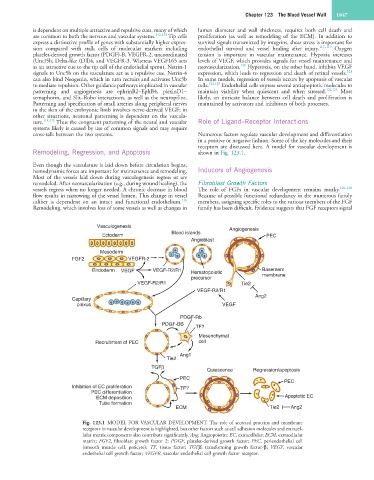
                                                                  receptors  are  discussed  here.  A  model  for  vascular  development  is
            Remodeling, Regression, and Apoptosis                 shown in Fig. 123.1.

            Even though the vasculature is laid down before circulation begins,
            hemodynamic forces are important for maintenance and remodeling.   Inducers of Angiogenesis
            Most of  the vessels  laid down  during  vasculogenesis  regress  or are
            remodeled. After neovascularization (e.g., during wound healing), the   Fibroblast Growth Factors
            vessels regress when no longer needed. A chronic decrease in blood   The  role  of  FGFs  in  vascular  development  remains  murky. 126–128
            flow results in narrowing of the vessel lumen. This change in vessel   Because of possible functional redundancy in the numerous family
                                                            116
            caliber  is  dependent  on  an  intact  and  functional  endothelium.    members, assigning specific roles to the various members of the FGF
            Remodeling, which involves loss of some vessels as well as changes in   family has been difficult. Evidence suggests that FGF receptors signal


                                 Vasculogenesis                             Angiogenesis
                                                         Blood islands
                                  Ectoderm                                              PEC
                                                                Angioblast
                                  Mesoderm
                         FGF2              VEGFR-2
                               Endoderm  VEGF      VEGF-R2/R1   Hematopoietic          Basement
                                                                precursor              membrane
                                              VEGF-R2/R1                        Tie2
                                                                 VEGF-R2/R1
                                                                                    Ang2
                         Capillary
                          plexus                                          VEGF
                                                            PDGF-Rb
                                                      PDGF-BB
                                                                 TF?
                                                                  Mesenchymal
                                Recruitment of PEC                cell

                                                            Ang1
                                                        Tie2
                                                   TGFβ
                                                                     Quiescence     Regression/apoptosis
                                                            PEC
                                                                                              PEC
                        Inhibition of EC proliferation      TF?
                               PEC differentiation
                                ECM depositiion                                               Apoptotic EC
                                 Tube formation
                                                           ECM                           Tie2   Ang2

                            Fig. 123.1  MODEL FOR VASCULAR DEVELOPMENT. The role of secreted proteins and membrane
                            receptors in vascular development is highlighted, but other factors such as cell adhesion molecules and extracel-
                            lular matrix components also contribute significantly. Ang, Angiopoietin; EC, extracellular; ECM, extracellular
                            matrix; FGF2, fibroblast growth factor 2; PDGF, platelet-derived growth factor; PEC, periendothelial cell
                            (smooth  muscle  cell,  pericyte);  TF,  tissue  factor;  TGFβ,  transforming  growth  factor-β;  VEGF,  vascular
                            endothelial cell growth factor; VEGFR, vascular endothelial cell growth factor receptor.

