


Page 2082 - Hematology_ Basic Principles and Practice ( PDFDrive )
P. 2082
Chapter 123  The Blood Vessel Wall  1851


                                                             Endothelium

                                            P2Y                           TM   Heparan SO  T
                                                                        EPCR            4  P
                                                                                           F
                                                CD39    5’-Nuc          Thrombin  AT        I
                                              ATP    AMP  Adenosine PC    aPC                t-PA–PAI-1
                          Anti-thrombogenic  ADP
                                                                         PS   IIa
                                                                                    Xa
                                                                                 IIa
                                       PGI ,NO                          Va VIIIa  XIa  IXa  VIIa  TF
                                         2
                                                                                            Xa
                                     Platelet aggregation                      Coagulation
                                                           Prothrombin           Thrombin   Fibrinolysis
                           Prothrombogenic
                                        vWF                    IX     IXa  X     Xa
                                                                        Villa
                                                                        TF


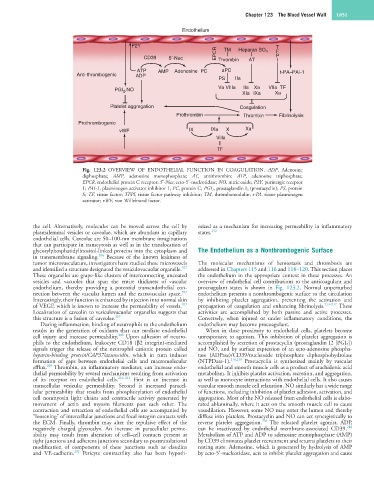
                            Fig.  123.2  OVERVIEW  OF  ENDOTHELIAL  FUNCTION  IN  COAGULATION.  ADP,  Adenosine
                            diphosphate;  AMP,  adenosine  monophosphate;  AT,  antithrombin;  ATP,  adenosine  triphosphate;
                            EPCR, endothelial protein C receptor; 5′-Nuc, ecto-5′-nucleotidase; NO, nitric oxide; P2Y, purinergic receptor
                            1; PAI-1, plasminogen activator inhibitor 1; PC, protein C; PGI 2 , prostaglandin I 2  (prostacyclin); PS, protein
                            S; TF, tissue factor; TFPI, tissue factor pathway inhibitor; TM, thrombomodulin; t-PA, tissue plasminogen
                            activator; vWF, von Willebrand factor.


            the  cell.  Alternatively,  molecules  can  be  moved  across  the  cell  by   esized as a mechanism for increasing permeability in inflammatory
            plasmalemmal vesicles or caveolae, which are abundant in capillary   states. 212
            endothelial cells. Caveolae are 50–100-nm membrane invaginations
            that can participate in transcytosis as well as in the translocation of
            glycosylphosphatidylinositol-linked proteins into the cytoplasm and   The Endothelium as a Nonthrombogenic Surface
                                 206
            in  transmembrane  signaling.   Because  of  the  known  leakiness  of
            tumor microvasculature, investigators have studied these microvessels   The  molecular  mechanisms  of  hemostasis  and  thrombosis  are
                                                            207
            and identified a structure designated the vesiculovacuolar organelle.    addressed in Chapters 115 and 116 and 118–120. This section places
            These organelles are grape-like clusters of interconnecting uncoated   the endothelium in the appropriate context in these processes. An
            vesicles  and  vacuoles  that  span  the  entire  thickness  of  vascular   overview of endothelial cell contributions to the anticoagulant and
            endothelium,  thereby  providing  a  potential  transendothelial  con-  procoagulant  states  is  shown  in  Fig.  123.2.  Normal  unperturbed
                                                            207
            nection between the vascular lumen and the extravascular space.    endothelium presents a nonthrombogenic surface to the circulation
            Interestingly, their function is enhanced by injection into normal skin   by  inhibiting  platelet  aggregation,  preventing  the  activation  and
                                                            207
            of VEGF, which is known to increase the permeability of vessels.    propagation of coagulation and enhancing fibrinolysis. 213–217  These
            Localization of caveolin to vesiculovacuolar organelles suggests that   activities  are  accomplished  by  both  passive  and  active  processes.
            this structure is a fusion of caveolae. 207           Conversely,  when  injured  or  under  inflammatory  conditions,  the
              During inflammation, binding of neutrophils to the endothelium   endothelium may become procoagulant.
            results  in  the  generation  of  oxidants  that  can  mediate  endothelial   When  in  close  proximity  to  endothelial  cells,  platelets  become
                                        208
            cell  injury  and  increase  permeability.   Upon  adhesion  of  neutro-  unresponsive  to  agonists. This  inhibition  of  platelet  aggregation  is
            phils to the endothelium, leukocyte CD18 (β2 integrin)-mediated   accomplished by secretion of prostacyclin (prostaglandin I2 [PGI 2 ])
            signals  trigger  the  release  of  the  neutrophil  cationic  protein  called   and NO, and by surface expression of an ecto-adenosine phospha-
            heparin-binding  protein/CAP37/azurocidin,  which  in  turn  induces   tase  (ADPase)/CD39/nucleoside  triphosphate  diphosphohydrolase
            formation  of  gaps  between  endothelial  cells  and  macromolecular   (NTPDase-1). 216,218   Prostacyclin  is  synthesized  mainly  by  vascular
                209
            efflux.  Thrombin, an inflammatory mediator, can increase endo-  endothelial and smooth muscle cells as a product of arachidonic acid
            thelial permeability by several mechanisms resulting from activation   metabolism. It inhibits platelet activation, secretion, and aggregation,
            of  its  receptor  on  endothelial  cells. 210–212   First  is  an  increase  in   as well as monocyte interactions with endothelial cells. It also causes
            transcellular  vesicular  permeability.  Second  is  increased  paracel-  vascular smooth muscle cell relaxation. NO similarly has a wide range
            lular permeability that results from phosphorylation of endothelial   of functions, including inhibition of platelet adhesion, activation, and
            cell  nonmyosin  light  chains  and  contractile  activity  generated  by   aggregation. Most of the NO released from endothelial cells is elabo-
            movement  of  actin  and  myosin  filaments  past  each  other.  The   rated abluminally, where it acts on the smooth muscle cell to cause
            contraction and retraction of endothelial cells are accompanied by   vasodilation. However, some NO may enter the lumen and thereby
            “loosening” of intercellular junctions and focal integrin contacts with   diffuse into platelets. Prostacyclin and NO can act synergistically to
                                                                                       216
            the  ECM.  Finally,  thrombin  may  alter  the  repulsive  effect  of  the   reverse  platelet  aggregation.   The  released  platelet  agonist,  ADP,
                                                                                                                  218
            negatively  charged  glycocalyx.  An  increase  in  paracellular  perme-  can  be  inactivated  by  endothelial  membrane-associated  CD39.
            ability  may  result  from  alteration  of  cell–cell  contacts  present  at   Metabolism of ATP and ADP to adenosine monophosphate (AMP)
            tight junctions and adherens junctions secondary to posttranslational   by CD39 eliminates platelet recruitment and returns platelets to their
            modification  of  components  of  these  junctions  such  as  claudins   resting state. Adenosine, which is generated by hydrolysis of AMP
                         202
            and  VE-cadherin.   Pericyte  contractility  also  has  been  hypoth-  by ecto-5′-nucleotidase, acts to inhibit platelet aggregation and cause

