


Page 2085 - Hematology_ Basic Principles and Practice ( PDFDrive )
P. 2085
1854   Part XII  Hemostasis and Thrombosis


         Flow


                                                        Activation                                 Diapedesis
                        Tethering and rolling                           Firm adhesion
                           Selectins
                                                                    Integrins – IgSF
                                                                                         CD31  JAM-1   Other
               SLe x
                                                         Leukocyte                      ESAM PVR CD47  CD99
             PSGL-1           L-selectin  α 4 β 7   α 4 β 1    α L β 2    α M β 2  α 4 β 7     α 4 β 1  CD99L2


            P-selectin  E-selectin  PNAd  Nepmucin  MAdCAM-1  VCAM-1  ICAM-2  ICAM-1  MAdCAM-1  VCAM-1
                                                        Endothelium
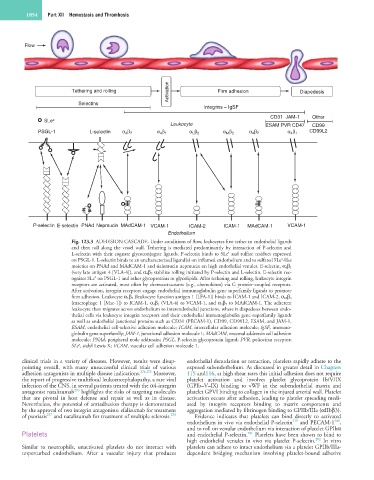
                        Fig. 123.3  ADHESION CASCADE. Under conditions of flow, leukocytes first tether to endothelial ligands
                        and  then  roll  along  the  vessel  wall. Tethering  is  mediated  predominantly  by  interaction  of  P-selectin  and
                                                                            x
                        L-selectin with their cognate glycoconjugate ligands. P-selectin binds to SLe  and sulfate residues expressed
                        on PSGL-1. L-selectin binds to an uncharacterized ligand(s) on inflamed endothelium and to sulfated SLe -like
                                                                                             x
                        moieties on PNAd and MAdCAM-1 and sialomucin nepmucin on high endothelial venules. E-selectin, α 4 β 1
                        (very late antigen 4 [VLA-4]), and α 4β 7 stabilize rolling initiated by P-selectin and L-selectin. E-selectin rec-
                                x
                        ognizes SLe  on PSGL-1 and other glycoproteins or glycolipids. After tethering and rolling, leukocyte integrin
                        receptors are activated, most often by chemoattractants (e.g., chemokines) via G protein–coupled receptors.
                        After activation, integrin receptors engage endothelial immunoglobulin gene superfamily ligands to promote
                        firm adhesion. Leukocyte α L β 2 (leukocyte function antigen 1 [LFA-1]) binds to ICAM-1 and ICAM-2, α Mβ 2
                        (macrophage 1 [Mac-1]) to ICAM-1, α 4β 1 (VLA-4) to VCAM-1, and α 4β 7 to MAdCAM-1. The adherent
                        leukocyte then migrates across endothelium to interendothelial junctions, where it diapedeses between endo-
                        thelial cells via leukocyte integrin receptors and their endothelial immunoglobulin gene superfamily ligands
                        as well as endothelial junctional proteins such as CD31 (PECAM-1), CD99, CD99L2, ESAM, and JAM-1.
                        ESAM, endothelial cell-selective adhesion molecule; ICAM, intercellular adhesion molecule; IgSF, immuno-
                        globulin gene superfamily; JAM-1, junctional adhesion molecule 1; MAdCAM, mucosal addressin cell adhesion
                        molecule; PNAd, peripheral node addressin; PSGL, P-selectin glycoprotein ligand; PVR, poliovirus receptor;
                        SLe , sialyl Lewis X; VCAM, vascular cell adhesion molecule 1.
                           x
        clinical  trials  in  a  variety  of  diseases.  However,  results  were  disap-  endothelial denudation or retraction, platelets rapidly adhere to the
        pointing  overall,  with  many  unsuccessful  clinical  trials  of  various   exposed subendothelium. As discussed in greater detail in Chapters
        adhesion antagonists in multiple disease indications. 274,275  Moreover,   115 and116, at high shear rates this initial adhesion does not require
        the report of progressive multifocal leukoencephalopathy, a rare viral   platelet  activation  and  involves  platelet  glycoprotein  Ib/V/IX
        infection of the CNS, in several patients treated with the α4-integrin   (GPIb–V–IX)  binding  to  vWF  in  the  subendothelial  matrix  and
                         276
        antagonist natalizumab  highlights the risks of targeting molecules   platelet GPVI binding to collagen in the injured arterial wall. Platelet
        that  are  pivotal  in  host  defense  and  repair  as  well  as  in  disease.   activation occurs after adhesion, leading to platelet spreading medi-
        Nevertheless, the potential of antiadhesion therapy is demonstrated   ated  by  integrin  receptors  binding  to  matrix  components  and
        by the approval of two integrin antagonists: efalizumab for treatment   aggregation mediated by fibrinogen binding to GPIIb/IIIa (αIIbβ3).
                277
        of psoriasis  and natalizumab for treatment of multiple sclerosis. 278  Evidence  indicates  that  platelets  can  bind  directly  to  activated
                                                                                                 279
                                                                                                              280
                                                              endothelium in vivo via endothelial P-selectin  and PECAM-1 ,
                                                              and to roll on venular endothelium via interaction of platelet GPIbα
        Platelets                                             and endothelial P-selectin.  Platelets have been shown to bind to
                                                                                  281
                                                                                                        282
                                                              high  endothelial  venules  in  vivo  via  platelet  P-selectin.   In  vitro
        Similar  to  neutrophils,  unactivated  platelets  do  not  interact  with   platelets can adhere to intact endothelium via a platelet GPIIb/IIIa-
        unperturbed  endothelium.  After  a  vascular  injury  that  produces   dependent  bridging  mechanism  involving  platelet-bound  adhesive

