


Page 2154 - Hematology_ Basic Principles and Practice ( PDFDrive )
P. 2154
Chapter 127  Regulatory Mechanisms in Hemostasis  1907


                                                           Platelets      Activated
                                                            (PARs)        Platelets

                                                                                  Fibrinogen


                                                Prothrombin         fIIa
                                                                             fXIII  Fibrin


                                                                             fXIIIa

                                                                                  Crosslinked
                                        TFPI      fXa + fVa     fV               Fibrin polymer

                                                                                    fXI
                                            APC                    AT

                                                          fIXa + fVIIIa  fVIII

                                                  fX
                                       TF+fVIIa                                    fXIa

                                                             fIX
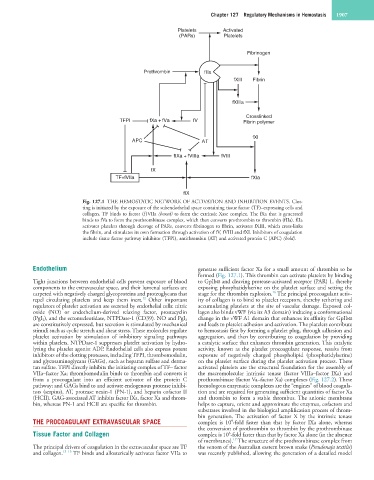
                            Fig. 127.1	 THE	HEMOSTATIC	NETWORK	OF	ACTIVATION	AND	INHIBITION	EVENTS.	Clot-
                            ting	is	initiated	by	the	exposure	of	the	subendothelial	space	containing	tissue	factor	(TF)–expressing	cells	and
                            collagen.	TF	binds	to	factor	(f)VIIa	(boxed)	to	form	the	extrinsic	Xase	complex.	The	fXa	that	is	generated
                            binds	to	fVa	to	form	the	prothrombinase	complex,	which	then	converts	prothrombin	to	thrombin	(fIIa).	fIIa
                            activates	platelets	through	cleavage	of	PARs,	converts	fibrinogen	to	fibrin,	activates	fXIII,	which	cross-links
                            the	fibrin,	and	stimulates	its	own	formation	through	activation	of	fV,	fVIII	and	fXI.	Inhibitors	of	coagulation
                            include	tissue	factor	pathway	inhibitor	(TFPI),	antithrombin	(AT)	and	activated	protein	C	(APC)	(bold).


            Endothelium                                           generate	sufficient	factor	Xa	for	a	small	amount	of	thrombin	to	be
                                                                  formed	(Fig.	127.1).	This	thrombin	can	activate	platelets	by	binding
            Tight	junctions	between	endothelial	cells	prevent	exposure	of	blood	  to	GpIbα	and	cleaving	protease-activated	receptor	(PAR)	1,	thereby
            components	to	the	extravascular	space,	and	their	lumenal	surfaces	are	  exposing	phosphatidylserine	on	the	platelet	surface	and	setting	the
                                                                                          16
            carpeted	with	negatively	charged	glycoproteins	and	proteoglycans	that	  stage	for	the	thrombin	explosion. 	The	principal	procoagulant	activ-
                                                12
            repel	 circulating	 platelets	 and	 keep	 them	 inert. 	 Other	 important	  ity	of	collagen	is	to	bind	to	platelet	receptors,	thereby	tethering	and
            regulators	of	platelet	activation	are	secreted	by	endothelial	cells:	nitric	  accumulating	platelets	at	the	site	of	vascular	damage.	Exposed	col-
            oxide	 (NO)	 or	 endothelium-derived	 relaxing	 factor,	 prostacyclin	  lagen	also	binds	vWF	(via	its	A3	domain)	inducing	a	conformational
            (PgI 2 ),	and	the	ectonucleotidase,	NTPDase-1	(CD39).	NO	and	PgI 2 	  change	in	the	vWF	A1	domain	that	enhances	its	affinity	for	GpIbα
            are	constitutively	expressed,	but	secretion	is	stimulated	by	mechanical	  and	leads	to	platelet	adhesion	and	activation.	The	platelets	contribute
            stimuli	such	as	cyclic	stretch	and	shear	stress.	These	molecules	regulate	  to	hemostasis	first	by	forming	a	platelet	plug,	through	adhesion	and
            platelet	 activation	 by	 stimulation	 of	 inhibitory	 signaling	 pathways	  aggregation,	and	then	by	contributing	to	coagulation	by	providing
            within	platelets.	NTPDase-1	suppresses	platelet	activation	by	hydro-  a	catalytic	surface	that	enhances	thrombin	generation.	This	catalytic
            lyzing	the	platelet	agonist	ADP.	Endothelial	cells	also	express	potent	  activity,	 known	 as	 the	 platelet	 procoagulant	 response,	 results	 from
            inhibitors	of	the	clotting	proteases,	including	TFPI,	thrombomodulin,	  exposure	 of	 negatively	 charged	 phospholipid	 (phosphatidylserine)
            and	glycosaminoglycans	(GAGs),	such	as	heparan	sulfate	and	derma-  on	the	platelet	surface	during	the	platelet	activation	process.	These
            tan	sulfate.	TFPI	directly	inhibits	the	initiating	complex	of	TF–	factor	  activated	platelets	are	the	structural	foundation	for	the	assembly	of
            VIIa–factor	Xa;	thrombomodulin	binds	to	thrombin	and	converts	it	  the	 macromolecular	 intrinsic	 tenase	 (factor	 VIIIa–factor	 IXa)	 and
            from	 a	 procoagulant	 into	 an	 efficient	 activator	 of	 the	 protein	 C	  prothrombinase	(factor	Va–factor	Xa)	complexes	(Fig.	127.2).	These
            pathway;	and	GAGs	bind	to	and	activate	endogenous	protease	inhibi-  homologous	enzymatic	complexes	are	the	“engines”	of	blood	coagula-
            tors	(serpins),	AT,	protease	nexin-1	(PN-1),	and	heparin	cofactor	II	  tion	and	are	required	for	generating	sufficient	quantities	of	factor	Xa
            (HCII).	GAG-associated	AT	inhibits	factor	IXa,	factor	Xa	and	throm-  and	 thrombin	 to	 form	a	 stable	 thrombus.	The	 anionic	membrane
            bin,	whereas	PN-1	and	HCII	are	specific	for	thrombin.  helps	to	capture,	orient	and	approximate	the	enzymes,	cofactors	and
                                                                  substrates	involved	in	the	biological	amplification	process	of	throm-
                                                                  bin	 generation.	The	 activation	 of	 factor	 X	 by	 the	 intrinsic	 tenase
            THE PROCOAGULANT EXTRAVASCULAR SPACE                  complex	 is	 10 -fold	 faster	 than	 that	 by	 factor	 IXa	 alone,	 whereas
                                                                             9
                                                                  the	conversion	of	prothrombin	to	thrombin	by	the	prothrombinase
            Tissue Factor and Collagen                            complex	is	10 -fold	faster	than	that	by	factor	Xa	alone	(in	the	absence
                                                                            6
                                                                             17
                                                                  of	membranes). 	The	structure	of	the	prothrombinase	complex	from
            The	principal	drivers	of	coagulation	in	the	extravascular	space	are	TF	  the	venom	of	the	Australian	eastern	brown	snake	(Pseudonaja textilis)
            and	collagen. 13–15 	TF	binds	and	allosterically	activates	factor	VIIa	to	  was	recently	published,	allowing	the	generation	of	a	detailed	model

