


Page 2157 - Hematology_ Basic Principles and Practice ( PDFDrive )
P. 2157
1910   Part XII  Hemostasis and Thrombosis


                                                     A2

                        N     D’     D3           A1   A3        D4      B1-3   C1    C2   CK   C


                                                      FLOW
                                               Gplb site  A2 Tyr1605  collagen
                                                          Met1606

                  N    D’     D3           A1                     A3       D4       B1-3   C1   C2    CK
                 A


                                    K2                                          K2
                                                  K3


                         K1                                          K1

                                                                                                  GPI


                                N         C                basic region      N
                     B              Alpha Isoform                              Beta Isoform


                                                                                  TM


                                                                                    1
                                                                                EGFs
                                                                                    2
                                                         llai
                                                                                     3
                                lla     serpin                                       4   PC
                                                                                     5
                                                                                        lla
                                                                                    6
                                                                                        CS
                           GAGs                                                               EPCR


                     C                                             D            C-terminus
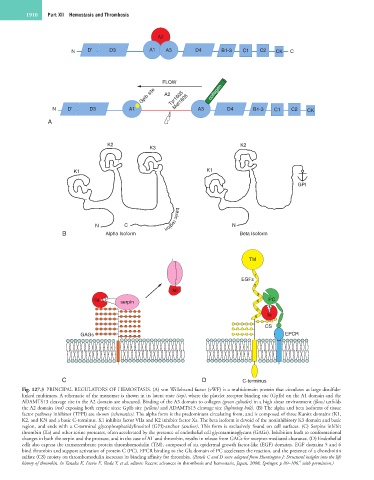
        Fig. 127.3	 PRINCIPAL	REGULATORS	OF	HEMOSTASIS.	(A)	von	Willebrand	factor	(vWF)	is	a	multidomain	protein	that	circulates	as	large	disulfide-
        linked	multimers.	A	schematic	of	the	monomer	is	shown	in	its	latent	state	(top),	where	the	platelet	receptor	binding	site	(GpIb)	on	the	A1	domain	and	the
        ADAMTS13	cleavage	site	in	the	A2	domain	are	obscured.	Binding	of	the	A3	domain	to	collagen	(green cylinder)	in	a	high	shear	environment	(flow)	unfolds
        the	A2	domain	(red)	exposing	both	cryptic	sites:	GpIb	site	(yellow)	and	ADAMTS13	cleavage	site	(lightning bolt).	(B)	The	alpha	and	beta	isoforms	of	tissue
        factor	pathway	inhibitor	(TFPI)	are	shown	(schematics).	The	alpha	form	is	the	predominant	circulating	form,	and	is	composed	of	three	Kunitz	domains	(K1,
        K2,	and	K3)	and	a	basic	C-terminus.	K1	inhibits	factor	VIIa	and	K2	inhibits	factor	Xa.	The	beta	isoform	is	devoid	of	the	noninhibitory	K3	domain	and	basic
        region,	 and	 ends	 with	 a	 C-terminal	 glycophosphatidylinositol	 (GPI)-anchor	 (anchor).	This	 form	 is	 exclusively	 found	 on	 cell	 surfaces.	 (C)	 Serpins	 inhibit
        thrombin	(IIa)	and	other	serine	proteases,	often	accelerated	by	the	presence	of	endothelial	cell	glycosaminoglycans	(GAGs).	Inhibition	leads	to	conformational
        changes	in	both	the	serpin	and	the	protease,	and	in	the	case	of	AT	and	thrombin,	results	in	release	from	GAGs	for	receptor-mediated	clearance.	(D)	Endothelial
        cells	also	express	the	transmembrane	protein	thrombomodulin	(TM),	composed	of	six	epidermal	growth	factor-like	(EGF)	domains.	EGF	domains	5	and	6
        bind	thrombin	and	support	activation	of	protein	C	(PC).	EPCR	binding	to	the	Gla	domain	of	PC	accelerates	the	reaction,	and	the	presence	of	a	chondroitin
        sulfate	(CS)	moiety	on	thrombomodulin	increases	its	binding	affinity	for	thrombin.	(Panels C and D were adapted from Huntington J: Structural insights into the life
                                                                                                   4
        history of thrombin. In Tanaka K, Davie E, Ikeda Y, et al, editors: Recent	advances	in	thrombosis	and	hemostasis, Japan, 2008, Springer, p 80–106,  with permission.)

