


Page 2155 - Hematology_ Basic Principles and Practice ( PDFDrive )
P. 2155
1908   Part XII  Hemostasis and Thrombosis


                                 VIIa  IXa   Xa

                                                                     IIa


                                                            II
                              VIIa

                                                        Xa         F1.2
                                    TF


                           A                Sub-endothelial cell


                              GPIbα
                                                                                GPIbα


                                                      VIII
                                     PAR1                                V             PARs


                                 Platelet                  Activated Platelet
                           B
                                                                       IIa


                                                              II


                            VIIa       IXa      Va        Xa         F1.2


                          C                    Activated Platelet
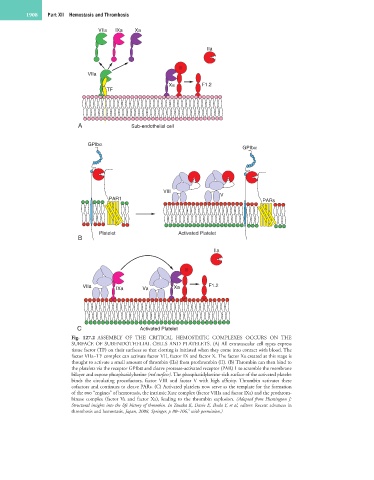
                        Fig.  127.2	 ASSEMBLY	 OF	 THE	 CRITICAL	 HEMOSTATIC	 COMPLEXES	 OCCURS	 ON	 THE
                        SURFACE	OF	SUBENDOTHELIAL	CELLS	AND	PLATELETS.	(A)	All	extravascular	cell	types	express
                        tissue	factor	(TF)	on	their	surfaces	so	that	clotting	is	initiated	when	they	come	into	contact	with	blood.	The
                        factor	VIIa–TF	complex	can	activate	factor	VII,	factor	IX	and	factor	X.	The	factor	Xa	created	at	this	stage	is
                        thought	to	activate	a	small	amount	of	thrombin	(IIa)	from	prothrombin	(II).	(B)	Thrombin	can	then	bind	to
                        the	platelets	via	the	receptor	GPIbα	and	cleave	protease-activated	receptor	(PAR)	1	to	scramble	the	membrane
                        bilayer	and	expose	phosphatidylserine	(red surface).	The	phosphatidylserine-rich	surface	of	the	activated	platelet
                        binds	 the	 circulating	 procofactors,	 factor	 VIII	 and	 factor	 V	 with	 high	 affinity.	Thrombin	 activates	 these
                        cofactors	and	continues	to	cleave	PARs.	(C)	Activated	platelets	now	serve	as	the	template	for	the	formation
                        of	the	two	“engines”	of	hemostasis,	the	intrinsic	Xase	complex	(factor	VIIIa	and	factor	IXa)	and	the	prothrom-
                        binase	 complex	 (factor	Va	 and	 factor	 Xa),	 leading	 to	 the	 thrombin	 explosion.	 (Adapted  from  Huntington  J:
                        Structural insights into the life history of thrombin. In Tanaka K, Davie E, Ikeda Y, et al, editors: Recent	advances	in
                                                               4
                        thrombosis	and	hemostasis, Japan, 2008, Springer, p 80–106,  with permission.)

