


Page 2273 - Hematology_ Basic Principles and Practice ( PDFDrive )
P. 2273
2020   Part XII  Hemostasis and Thrombosis


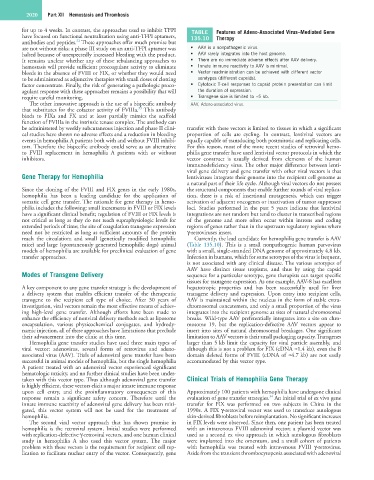
        for up to 4 weeks. In contrast, the approaches used to inhibit TFPI   TABLE   Features of Adeno-Associated Virus–Mediated Gene
        have focused on functional neutralization using anti-TFPI aptamers,   135.10  Therapy
                          32
        antibodies and peptides.  These approaches offer much promise but
        are not without risks; a phase III study on an anti-TFPI aptamer was   •  AAV is a nonpathogenic virus.
        halted because of unexpectedly increased bleeding with the product.   •  AAV rarely integrates into the host genome.
        It remains unclear whether any of these rebalancing approaches to   •  There are no immediate adverse effects after AAV delivery.
        hemostasis will provide sufficient procoagulant activity to eliminate   •  Innate immune reactivity to AAV is minimal.
        bleeds in the absence of FVIII or FIX, or whether they would need   •  Vector readministration can be achieved with different vector
        to be administered as adjunctive therapies with small doses of clotting   serotypes (different capsids).
        factor concentrate. Finally, the risk of generating a pathologic proco-  •  Cytotoxic T-cell responses to capsid protein presentation can limit
        agulant response with these approaches remains a possibility that will   the duration of expression.
        require careful monitoring.                            •  Transgene size is limited to ~5 kb.
           The other innovative approach is the use of a bispecific antibody   AAV, Adeno-associated virus.
                                              33
        that substitutes for the cofactor activity of FVIIIa.  This antibody
        binds  to  FIXa  and  FX  and  at  least  partially  mimics  the  scaffold
        function of FVIIIa in the intrinsic tenase complex. The antibody can
        be administered by weekly subcutaneous injection and phase II clini-  transfer with these vectors is limited to tissues in which a significant
        cal studies have shown no adverse effects and a reduction in bleeding   proportion  of  cells  are  cycling.  In  contrast,  lentiviral  vectors  are
        events in hemophilia A patients both with and without FVIII inhibi-  equally capable of transducing both postmitotic and replicating cells.
        tors. Therefore the bispecific antibody could serve as an alternative   For this reason, most of the more recent studies of retroviral hemo-
        to  FVIII  replacement  in  hemophilia  A  patients  with  or  without   philia gene transfer have used lentiviral vector protocols in which the
        inhibitors.                                           vector  construct  is  usually  derived  from  elements  of  the  human
                                                              immunodeficiency virus. The other major difference between lenti-
                                                              viral gene delivery and gene transfer with other viral vectors is that
        Gene Therapy for Hemophilia                           lentiviruses integrate their genome into the recipient cell genome as
                                                              a natural part of their life cycle. Although viral vectors do not possess
        Since the cloning of the FVIII and FIX genes in the early 1980s,   the structural components that enable further rounds of viral replica-
        hemophilia  has  been  a  leading  candidate  for  the  application  of   tion,  there  is  a  risk  of  insertional  mutagenesis,  which  can  trigger
        somatic cell gene transfer. The rationale for gene therapy in hemo-  activation of adjacent oncogenes or inactivation of tumor suppressor
        philia includes the following: small increments in FVIII or FIX levels   loci.  Studies  performed  in  the  past  5  years  indicate  that  lentiviral
        have a significant clinical benefit; regulation of FVIII or FIX levels is   integrations are not random but tend to cluster in transcribed regions
        not critical as long as they do not reach supraphysiologic levels for   of  the  genome  and  more  often  occur  within  introns  and  coding
        extended periods of time; the site of coagulation transgene expression   regions of genes rather than in the upstream regulatory regions where
        need not be restricted as long as sufficient amounts of the protein   γ-retroviruses insert.
        reach  the  circulation;  and  small  (genetically  modified  hemophilic   Currently, the lead candidate for hemophilia gene transfer is AAV
        mice) and large (spontaneously generated hemophilic dogs) animal   (Table  135.10). This  is  a  small  nonpathogenic  human  parvovirus
        models of hemophilia are available for preclinical evaluation of gene   with a small, single-stranded DNA genome of approximately 4.8 kb.
        transfer approaches.                                  Infection in humans, which for some serotypes of the virus is frequent,
                                                              is not associated with any clinical disease. The various serotypes of
                                                              AAV  have  distinct  tissue  tropisms,  and  thus  by  using  the  capsid
        Modes of Transgene Delivery                           sequence for a particular serotype, gene therapists can target specific
                                                              tissues for transgene expression. As one example, AAV-8 has excellent
        A key component to any gene transfer strategy is the development of   hepatotropic  properties  and  has  been  successfully  used  for  liver
        a  delivery  system  that  enables  efficient  transfer  of  the  therapeutic   transgene delivery and expression. Upon entry into recipient cells,
        transgene  to  the  recipient  cell  type  of  choice.  After  30  years  of   AAV is maintained within the nucleus in the form of stable extra-
        investigation, viral vectors remain the most effective means of achiev-  chromosomal concatemers, and only a small proportion of the virus
        ing  high-level  gene  transfer.  Although  efforts  have  been  made  to   integrates into the recipient genome at sites of natural chromosomal
        enhance the efficiency of nonviral delivery methods such as liposome   breaks. Wild-type AAV preferentially integrates into a site on chro-
        encapsulation,  various  physicochemical  conjugates,  and  hydrody-  mosome  19,  but  the  replication-defective  AAV  vectors  appear  to
        namic injection, all of these approaches have limitations that preclude   insert into sites of natural chromosomal breakages. One significant
        their advancement into the clinic at this time.       limitation to AAV vectors is their small packaging capacity. Transgenes
           Hemophilia gene transfer studies have used three main types of   larger than 5 kb limit the capacity for viral particle assembly, and
        viral  vector:  adenovirus,  several  forms  of  retrovirus  and  adeno-  although this is not a problem for FIX (cDNA ≈1.4 kb), even the B
        associated virus (AAV). Trials of adenoviral gene transfer have been   domain deleted forms of FVIII (cDNA of ≈4.7 kb) are not easily
        successful in animal models of hemophilia, but the single hemophilia   accommodated by this vector type.
        A patient treated with an adenoviral vector experienced significant
        hematologic toxicity, and no further clinical studies have been under-
        taken with this vector type. Thus although adenoviral gene transfer   Clinical Trials of Hemophilia Gene Therapy
        is highly efficient, these vectors elicit a major innate immune response
        upon  cell  entry,  and  the  proinflammatory  consequences  of  this   Approximately 100 patients with hemophilia have undergone clinical
                                                                                         34
        response  remain  a  significant  safety  concern.  Therefore  until  the   evaluation of gene transfer strategies.  An initial trial of ex vivo gene
        innate immune reactivity of adenoviral gene delivery has been miti-  transfer  for  FIX  was  performed  on  two  subjects  in  China  in  the
        gated,  this  vector  system  will  not  be  used  for  the  treatment  of   1990s. A FIX γ-retroviral vector was used to transduce autologous
        hemophilia.                                           skin-derived fibroblasts before reimplantation. No significant increases
           The  second  viral  vector  approach  that  has  shown  promise  in   in FIX levels were observed. Since then, one patient has been treated
        hemophilia  is  the  retroviral  system.  Initial  studies  were  performed   with an intravenous FVIII adenoviral vector; a plasmid vector was
        with replication-defective γ-retroviral vectors, and one human clinical   used as a second ex vivo approach in which autologous fibroblasts
        study  in  hemophilia  A  also  used  this  vector  system.  The  major   were implanted into the omentum, and a small cohort of patients
        problem with these vectors is the requirement for recipient cell rep-  with  hemophilia  was  treated  with  intravenous  FVIII  γ-retrovirus.
        lication to facilitate nuclear entry of the vector. Consequently, gene   Aside from the transient thrombocytopenia associated with adenoviral

