


Page 2272 - Hematology_ Basic Principles and Practice ( PDFDrive )
P. 2272
Chapter 135  Hemophilia A and B  2019


            inhibitors, much less is known about the basic science of FIX inhibi-  Every factor concentrate’s immunogenicity is initially evaluated in
            tors than about FVIII inhibitors. There is, as previously described, a   previously treated patients (PTPs, i.e., those with a minimum of 100
            relationship  between  FIX  inhibitors  and  anaphylaxis  to  FIX  that   to 150 prior exposure days to a FVIII or FIX concentrate). In studies
            generally does not occur with FVIII inhibitors.       of PTPs exposed to new factor concentrates, very few inhibitors have
              FIX  inhibitors  are  primarily  IgG4  subclass  antibodies  although   so far occurred. This suggests that in widespread clinical use, inhibi-
            some are IgG2 subclass.                               tors  will  occur  only  rarely,  if  at  all,  in  PTPs  who  switch  to  new
              Epitopes  for  FIX  inhibitors  have  been  identified  in  the   concentrates.
            γ-carboxyglutamic  acid  domain,  which  is  involved  in  binding  to   There  is  less  experience  using  new  concentrates  in  hemophilia
            phospholipid surfaces, the serine protease domain, and possibly in   patients  that  have  not  yet  been  exposed  to  a  factor  concentrate
            the activation peptide region, at which FIX is activated by activated   (PUPs). Since the risk of both FVIII and FIX inhibitors is greatest
            FXI. As is the case with inhibitory FVIII antibodies, the specificity   early  in  a  patient’s  treatment  course,  the  immunogenicity  of  new
            of these antibodies for epitopes in functionally important regions of   concentrates in PUPs may differ from what occurs in PTPs.
            the  FIX  molecule  explains  their  ability  to  inhibit  FIX’s  coagulant   There are some reasons to suspect that immunogenicity of new
            activity.                                             concentrates  may  not  be  worse  than  that  of  existing  concentrates,
              Because FIX inhibitors are antibodies of the IgG isotype, they are   despite the presence of additional modifications such as Pegylation
            products  of  interaction  between  FIX-specific  B  cells  and  helper T   or fusion to Fc or albumin. For example, pegylated versions of other
            cells, but this process is less well described than is the case for FVIII   protein therapeutics (e.g., asparaginase, granulocyte-colony stimulat-
            inhibitors. The roles of co-stimulatory molecules, immunoregulatory   ing  factor)  have  not  proven  to  be  more  immunogenic  than  their
            genes, and Tregs in FIX inhibitors have not been demonstrated.  nonpegylated  counterparts,  and  there  is  some  animal  evidence  to
                                                                  suggest that FVIII and FIX concentrates that have been fused to the
                                                                  Fc region of IgG may be less immunogenic than standard FVIII or
            Detection of Inhibitors and Antibodies                FIX,  perhaps  because  of  interactions  with  Fc  receptors  present  on
                                                                  cells involved in immune responses. In addition to developing EHL
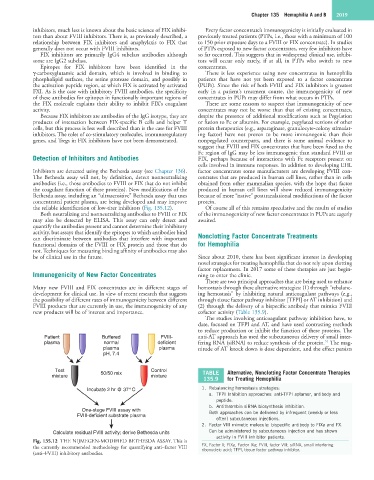
            Inhibitors are detected using the Bethesda assay (see Chapter 136).   factor concentrates some manufacturers are developing FVIII con-
            The  Bethesda  assay  will  not,  by  definition,  detect  nonneutralizing   centrates that are produced in human cell lines, rather than in cells
            antibodies (i.e., those antibodies to FVIII or FIX that do not inhibit   obtained from other mammalian species, with the hope that factor
            the coagulant function of these proteins). New modifications of the   produced  in  human  cell  lines  will  show  reduced  immunogenicity
            Bethesda assay, including an “ultrasensitive” Bethesda assay that uses   because of more “native” posttranslational modifications of the factor
            concentrated patient plasma, are being developed and may improve   protein.
            the reliable identification of low-titer inhibitors (Fig. 135.12).  Of course all of this remains speculative and the results of studies
              Both neutralizing and nonneutralizing antibodies to FVIII or FIX   of the immunogenicity of new factor concentrates in PUPs are eagerly
            may  also  be  detected  by  ELISA.  This  assay  can  only  detect  and   awaited.
            quantify the antibodies present and cannot determine their inhibitory
            activity, but assays that identify the epitopes to which antibodies bind
            can  discriminate  between  antibodies  that  interfere  with  important   Nonclotting Factor Concentrate Treatments
            functional domains of the FVIII or FIX protein and those that do   for Hemophilia
            not. Techniques for measuring binding affinity of antibodies may also
            be of clinical use in the future.                     Since about 2010, there has been significant interest in developing
                                                                  novel strategies for treating hemophilia that do not rely upon clotting
                                                                  factor replacement. In 2017 some of these therapies are just begin-
            Immunogenicity of New Factor Concentrates             ning to enter the clinic.
                                                                    There are two principal approaches that are being used to enhance
            Many  new  FVIII  and  FIX  concentrates  are  in  different  stages  of   hemostasis through these alternative strategies: (1) through “rebalanc-
            development for clinical use. In view of recent research that suggests   ing hemostasis” by inhibiting natural anticoagulant pathways (e.g.,
            the possibility of different rates of immunogenicity between different   through tissue factor pathway inhibitor [TFPI] or AT inhibition) and
            FVIII products that are currently in use, the immunogenicity of any   (2) through the delivery of a bispecific antibody that mimics FVIII
            new products will be of interest and importance.      cofactor activity (Table 135.9).
                                                                    The studies involving anticoagulant pathway inhibition have, to
                                                                  date, focused on TFPI and AT, and have used contrasting methods
                                                                  to reduce production or inhibit the function of these proteins. The
                Patient           Buffered            FVIII-      anti-AT approach has used the subcutaneous delivery of small inter-
                                                                                                           31
               plasma              normal            deficient    fering RNA (siRNA) to reduce synthesis of the protein.  The mag-
                                   plasma            plasma       nitude of AT knock down is dose dependent, and the effect persists
                                   pH, 7.4

                   Test                           Control          TABLE   Alternative, Nonclotting Factor Concentrate Therapies
                  mixture         50/50 mix       mixture
                                                                    135.9  for Treating Hemophilia
                              Incubate 2 hr @ 37° C                1.  Rebalancing hemostasis strategies:
                                                                      a.  TFPI Inhibition approaches: anti-TFPI aptamer, antibody and
                                                                        peptide.
                                                                      b.  Antithrombin siRNA biosynthesis inhibition.
                            One-stage FVIII assay with               Both approaches can be delivered by infrequent (weekly or less
                          FVIII-deficient substrate plasma
                                                                        often) subcutaneous injections.
                                                                   2.  Factor VIII mimetic molecule: bispecific antibody to FIXa and FX.
                  Calculate residual FVIII activity; derive Bethesda units  Can be administered by subcutaneous injection and has shown
                                                                        activity in FVIII inhibitor patients.
            Fig. 135.12  THE NIJMEGEN-MODIFIED BETHESDA ASSAY. This is
            the  currently  recommended  methodology  for  quantifying  anti–factor VIII   FX, Factor X; FIXa, Factor IXa; FVIII, factor VIII; siRNA, small interfering
                                                                   ribonucleic acid; TFPI, tissue factor pathway inhibitor.
            (anti–FVIII) inhibitory antibodies.

