


Page 2274 - Hematology_ Basic Principles and Practice ( PDFDrive )
P. 2274
Chapter 135  Hemophilia A and B  2021


             TABLE                                                   Plasma-derived  Recombinant   Recombinant FVIII +
             135.11  Challenges to Successful Hemophilia Gene Therapy    FVIII          FVIII      Recombinant VWF
             1.  Efficient transgene delivery
             2.  Persistent therapeutic transgene expression
             3.  Host immunologic responses
                a.  To the transgene product: inhibitors                       Severe hemophilia A therapy
                b.  To the vector                                                     2017-2022
                  •  Antivector antibodies
                  •  Antivector cytotoxic T-cell response
                                                                         FVIII         Novel         Modified FVIII
                                                                      conjugates       intrinsic  (e.g., fusion proteins)
            vector  infusion,  there  were  no  adverse  events,  but  none  of  those   (e.g., PEG)  tenase
            approaches increased FVIII or FIX levels beyond a few days, and even
            then, levels were in the 1% to 4% range.
              In contrast, the AAV trials of gene transfer have shown evidence   FVIII    Novel adjunctive
            of therapeutic efficacy. There have now been three completed AAV    gene        therapies
            FIX trials, the first into skeletal muscle and the latter two into liver.   transfer  (i.e., antifibrinolysis,
            Both of the liver-directed trials, the first using hepatic artery delivery   TFPI/PC inhibition)
            of AAV-2 and the second systemic intravenous delivery of AAV-8,
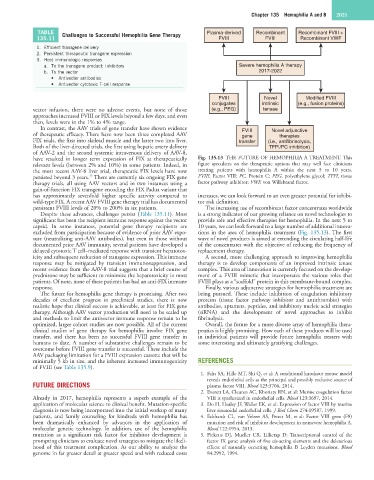
            have  resulted  in  longer  term  expression  of  FIX  at  therapeutically   Fig. 135.13  THE FUTURE OF HEMOPHILIA A TREATMENT. This
            relevant levels (between 2% and 10%) in some patients. Indeed, in   figure  speculates  on  the  therapeutic  options  that  may  well  face  clinicians
            the most recent AAV-8 liver trial, therapeutic FIX levels have now   treating  patients  with  hemophilia  A  within  the  next  5  to  10  years.
                              35
            persisted beyond 3 years.  There are currently six ongoing FIX gene   FVIII, Factor VIII; PC, Protein C; PEG, polyethylene glycol; TFPI, tissue
            therapy  trials,  all  using  AAV  vectors  and  in  two  instances  using  a   factor pathway inhibitor; VWF, von Willebrand factor.
            gain-of-function FIX transgene encoding the FIX Padua variant that
            has  approximately  sevenfold  higher  specific  activity  compared  to   increases, we can look forward to an even greater potential for inhibi-
            wild-type FIX. A recent AAV FVIII gene therapy trial has documented   tor risk definition.
            persistent FVIII levels of 20% to 200% in six patients.  The increasing use of recombinant factor concentrates worldwide
              Despite these advances, challenges persist (Table 135.11). Most   is a strong indicator of our growing reliance on novel technologies to
            significant has been the recipient immune response against the vector   provide safe and effective therapies for hemophilia. In the next 5 to
            capsid.  In  some  instances,  potential  gene  therapy  recipients  are   10 years, we can look forward to a large number of additional innova-
            excluded from participation because of evidence of prior AAV expo-  tions  in  the  area  of  hemophilia  treatment  (Fig.  135.13). The  first
            sure (neutralizing anti-AAV antibodies), but even in those without   wave of novel products is aimed at extending the circulating half-life
            documented prior AAV immunity, several patients have developed a   of the concentrates with the objective of reducing the frequency of
            delayed cytotoxic T cell–mediated response with transient hepatotox-  replacement therapy.
            icity and subsequent reduction of transgene expression. This immune   A second, more challenging approach to improving hemophilia
            response  may  be  mitigated  by  transient  immunosuppression,  and   therapy  is  to  develop  components  of  an  improved  intrinsic  tenase
            recent evidence from the AAV-8 trial suggests that a brief course of   complex. This area of innovation is currently focused on the develop-
            prednisone may be sufficient to minimize the hepatotoxicity in most   ment  of  a  FVIII  mimetic  that  incorporates  the  various  roles  that
            patients. Of note, none of these patients has had an anti-FIX immune   FVIII plays as a “scaffold” protein in this membrane-bound complex.
            response.                                               Finally, various adjunctive strategies for hemophilia treatment are
              The future for hemophilia gene therapy is promising. After two   being  pursued. These  include  inhibition  of  coagulation  inhibitory
            decades  of  excellent  progress  in  preclinical  studies,  there  is  now   proteins  (tissue  factor  pathway  inhibitor  and  antithrombin)  with
            realistic hope that clinical success is achievable, at least for FIX gene   antibodies, aptamers, peptides, and inhibitory nucleic acid strategies
            therapy. Although AAV vector production will need to be scaled up   (siRNA)  and  the  development  of  novel  approaches  to  inhibit
            and methods to limit the antivector immune response remain to be   fibrinolysis.
            optimized, larger cohort studies are now possible. All of the current   Overall, the future for a more diverse array of hemophilia thera-
            clinical  studies  of  gene  therapy  for  hemophilia  involve  FIX  gene   peutics is highly promising. How each of these products will be used
            transfer,  and  there  has  been  no  successful  FVIII  gene  transfer  in   in  individual  patients  will  provide  future  hemophilia  treaters  with
            humans to date. A number of substantive challenges remain to be   some interesting and ultimately gratifying challenges.
            overcome before FVIII gene transfer is successful. These include the
            AAV packaging limitation for a FVIII expression cassette that will be
            minimally 5 kb in size, and the inherent increased immunogenicity   REFERENCES
            of FVIII (see Table 135.9).
                                                                   1.  Fahs SA, Hille MT, Shi Q, et al: A conditional knockout mouse model
                                                                     reveals endothelial cells as the principal and possibly exclusive source of
            FUTURE DIRECTIONS                                        plasma factor VIII. Blood 123:3706, 2014.
                                                                   2.  Everett LA, Cleuren AC, Khoriaty RN, et al: Murine coagulation factor
            Already  in  2017,  hemophilia  represents  a  superb  example  of  the   VIII is synthesized in endothelial cells. Blood 123:3697, 2014.
            application of molecular science to clinical benefit. Mutation-specific   3.  Do H, Healey JF, Waller EK, et al: Expression of factor VIII by murine
            diagnosis is now being incorporated into the initial workup of many   liver sinusoidal endothelial cells. J Biol Chem 274:19587, 1999.
            patients,  and  family  counseling  for  kindreds  with  hemophilia  has   4.  Eckhardt  CL,  van  Velzen  AS,  Peters  M,  et al:  Factor  VIII  gene  (F8)
            been  dramatically  enhanced  by  advances  in  the  application  of   mutation and risk of inhibitor development in nonsevere hemophilia A.
            molecular  genetic  technology.  In  addition,  use  of  the  hemophilic   Blood 122:1954, 2013.
            mutation  as  a  significant  risk  factor  for  inhibitor  development  is   5.  Picketts  DJ,  Mueller  CR,  Lillicrap  D:  Transcriptional  control  of  the
            prompting clinicians to evaluate novel strategies to mitigate the likeli-  factor IX gene: analysis of five cis-acting elements and the deleterious
            hood of this treatment complication. As our ability to analyze the   effects  of  naturally  occurring  hemophilia  B  Leyden  mutations.  Blood
            genome in far greater detail at greater speed and with reduced costs   84:2992, 1994.

