


Page 235 - Hematology_ Basic Principles and Practice ( PDFDrive )
P. 235
Chapter 18  Cell Death  187


                                                                  of a proapoptotic BCL-2 family member, BID, also features caspase-
                                                                  mediated processing to a truncated factor, tBID, which then traffics
                          Apoptosis                Necrosis       to its mitochondrial site of action.

             Cell shrinkage and fragmentation  Cell swelling and lysis  ACTIVATION OF PROCASPASES

             Nuclear condensation      Karyolysis                 Caspases are expressed in healthy cells as zymogens with low-to-absent
                                                                  protease  activity,  with  association  as  homodimers  and  proteolytic
                                                                  processing into large and small subunits required for strong activa-
             Internucleosomal DNA      Random DNA breaks          tion (Fig. 18.4). Downstream or executioner caspases (caspase-3, -6,
             fragmentation                                                                 1
                                                                  and -7) exist as preformed dimers.  Cleavage of a flexible interchain
             Loss of asymmetry of phospholipids Loss of plasma membrane   connector between subunits facilitates the movement of surface loops
             in plasma membrane bilayer  integrity                to form an open active site. Processing of procaspases occurs imme-
                                                                  diately  after  aspartate  residues  within  caspase  recognition  motifs.
             Detachment and engulfment by  Recruitment of         Subsite  specificities  are  distributed  among  caspases  so  that  many
             phagocytes                inflammatory cells         caspase zymogens must be processed in trans by a different caspase,
                                                                  creating  a  hierarchy  of  proteolytic  activation.  Apical  (initiator)
            Fig. 18.1  MORPHOLOGIC FEATURES ASSOCIATED WITH APOP-  caspases (caspase-2, -8, -9, -10) have limited proteolytic (including
            TOSIS AND NECROSIS.                                   autocatalytic) activity at high concentrations without a requirement


                                                       Cell death


                                    Physiologic                            Necrotic


                                              Apoptosis                                Other


                                                                                           X
                                Caspase-dependent                     Caspase-independent


                                         Death receptors (extrinsic)            Mitochondria (intrinsic)

                                          Fig. 18.2  CLASSIFICATION OF CELL DEATH PATHWAYS.


                                                        P4    P3    P2    P1
                                    Caspase-6, -8, -9, -10  L/V  E  X     D

                                    Caspase-2, -3, -7    D     E    X     D
                                    Caspase-1, -4, -5   W      E    H     D


                                                        S4    S3    S2    S1


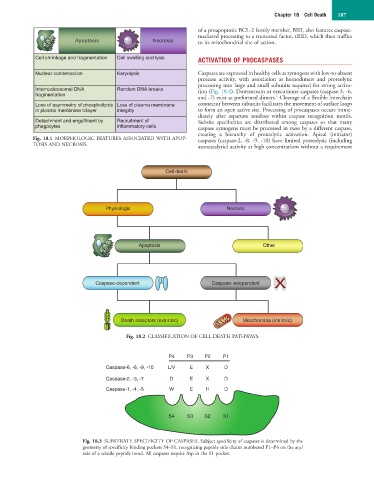
                            Fig. 18.3  SUBSTRATE SPECIFICITY OF CASPASES. Subject specificity of caspases is determined by the
                            geometry of specificity binding pockets S4–S1, recognizing peptide side chains numbered P1–P4 on the acyl
                            side of a scissile peptide bond. All caspases require Asp in the S1 pocket.

