


Page 239 - Hematology_ Basic Principles and Practice ( PDFDrive )
P. 239
Chapter 18  Cell Death  191


                                                        BH4         BH3     BH1    BH2 TM
                              MCL-1
                              BCL-2
                 Antiapoptotic  BCL-X L
                  multidomain
                              BCL-B
                              BCL-w
                              BFL-1/A1
                              BOK/MTD
                  Proapoptotic
                  multidomain  BAK
                              BAX
                              BCL-Rambo
                              BCL-G
                              BIM
                              BID
                              PUMA
                    BH3-only
                              BMF
                              BAD
                              BIK
                              HRK
                              NOXA
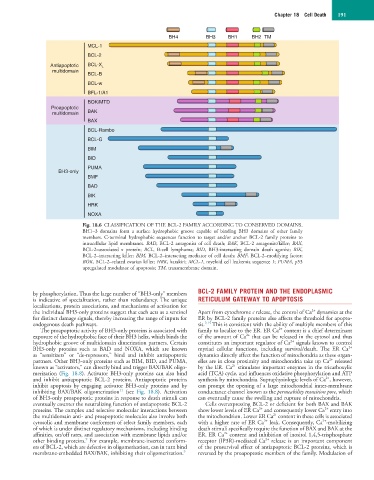
                            Fig. 18.6  CLASSIFICATION OF THE BCL-2 FAMILY ACCORDING TO CONSERVED DOMAINS.
                            BH1–3  domains  form  a  surface  hydrophobic  groove  capable  of  binding  BH3  domains  of  other  family
                            members.  C-terminal  hydrophobic  sequences  function  to  target  and/or  anchor  BCL-2  family  proteins  to
                            intracellular lipid membranes. BAD, BCL-2 antagonist of cell death; BAK, BCL-2 antagonist/killer; BAX,
                            BCL-2–associated  x  protein;  BCL,  B-cell  lymphoma;  BID,  BH3-interacting  domain  death  agonist;  BIK,
                            BCL-2–interacting killer; BIM, BCL-2–interacting mediator of cell death; BMF, BCL-2–modifying factor;
                            BOK, BCL-2–related ovarian killer; HRK, harakiri; MCL-1, myeloid cell leukemia sequence 1; PUMA, p53
                            upregulated modulator of apoptosis; TM, transmembrane domain.


                                                                  BCL-2 FAMILY PROTEIN AND THE ENDOPLASMIC
            by phosphorylation. Thus the large number of “BH3-only” members
            is indicative of specialization, rather than redundancy. The unique   RETICULUM GATEWAY TO APOPTOSIS
            localizations, protein associations, and mechanisms of activation for
                                                                                                       2+
            the individual BH3-only proteins suggest that each acts as a sentinel   Apart from cytochrome c release, the control of Ca  dynamics at the
            for distinct damage signals, thereby increasing the range of inputs for   ER by BCL-2 family proteins also affects the threshold for apopto-
            endogenous death pathways.                            sis. 9,14  This is consistent with the ability of multiple members of this
                                                                                            2+
              The proapoptotic activity of BH3-only proteins is associated with   family to localize to the ER. ER Ca  content is a chief determinant
                                                                                  2+
            exposure of the hydrophobic face of their BH3 helix, which binds the   of the amount of Ca  that can be released in the cytosol and thus
                                                                                                2+
            hydrophobic groove of multidomain dimerization partners. Certain   constitutes an important regulator of Ca  signals known to control
                                                                                                                   2+
            BH3-only  proteins  such  as  BAD  and  NOXA,  which  are  known   myriad  cellular  functions,  including  survival/death.  The  ER  Ca
            as  “sensitizers”  or  “de-repressors,”  bind  and  inhibit  antiapoptotic   dynamics directly affect the function of mitochondria as these organ-
                                                                                                             2+
            partners. Other BH3-only proteins such as BIM, BID, and PUMA,   elles are in close proximity and mitochondria take up Ca  released
                                                                             2+
            known as “activators,” can directly bind and trigger BAX/BAK oligo-  by the ER. Ca  stimulates important enzymes in the tricarboxylic
            merization (Fig. 18.8). Activator BH3-only proteins can also bind   acid (TCA) cycle, and influences oxidative phosphorylation and ATP
                                                                                                            2+
            and  inhibit  antiapoptotic  BCL-2  proteins.  Antiapoptotic  proteins   synthesis by mitochondria. Supraphysiologic levels of Ca , however,
            inhibit apoptosis by engaging activator BH3-only proteins and by   can prompt the opening of a large mitochondrial inner-membrane
                                        11
            inhibiting  BAX/BAK  oligomerization   (see  Fig.  18.8).  Activation   conductance channel known as the permeability transition pore, which
            of BH3-only proapoptotic proteins in response to death stimuli can   can eventually cause the swelling and rupture of mitochondria.
            eventually counter the neutralizing function of antiapoptotic BCL-2   Cells overexpressing BCL-2 or deficient for both BAX and BAK
                                                                                      2+
                                                                                                           2+
            proteins. The complex and selective molecular interactions between   show lower levels of ER Ca  and consequently lower Ca  entry into
                                                                                          2+
            the multidomain anti- and proapoptotic molecules also involve both   the mitochondrion. Lower ER Ca  content in these cells is associated
                                                                                                           2+
                                                                                       2+
            cytosolic and membrane conformers of select family members, each   with a higher rate of ER Ca  leak. Consequently, Ca -mobilizing
            of which is under distinct regulatory mechanisms, including binding   death stimuli specifically require the function of BAX and BAK at the
                                                                          2+
            affinities, on/off rates, and association with membrane lipids and/or   ER. ER Ca  content and inhibition of inositol 1,4,5-trisphosphate
                                                                                        2+
                             9
            other binding proteins.  For example, membrane-inserted conform-  receptor (IP3R)-mediated Ca  release is an important component
            ers of BCL-2, which are defective in oligomerization, can in turn bind   of the prosurvival effect of antiapoptotic BCL-2 proteins, which is
            membrane-embedded BAX/BAK, inhibiting their oligomerization. 9  reversed by the proapoptotic members of the family. Modulation of

