


Page 236 - Hematology_ Basic Principles and Practice ( PDFDrive )
P. 236
188    Part II  Cellular Basis of Hematology


                                  Prodomain                Large                 Small


                                           Asp-X                          Asp-X


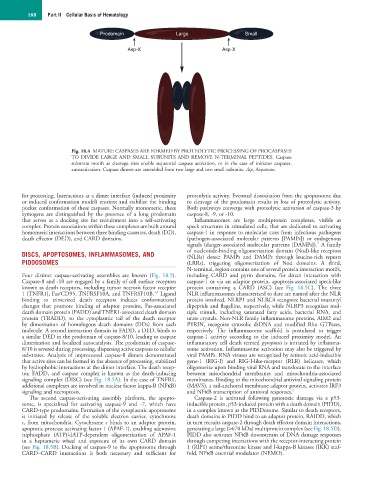
                        Fig. 18.4  MATURE CASPASES ARE FORMED BY PROTEOLYTIC PROCESSING OF PROCASPASES
                        TO DIVIDE LARGE AND SMALL SUBUNITS AND REMOVE N-TERMINAL PEPTIDES. Caspase
                        substrate  motifs  at  cleavage  sites  enable  sequential  caspase  activation,  or  in  the  case  of  initiator  caspases,
                        autoactivation. Caspase dimers are assembled from two large and two small subunits. Asp, Aspartate.


        for processing. Interactions at a dimer interface (induced proximity   proteolytic activity. Eventual dissociation from the apoptosome due
        or induced conformation model) reorient and stabilize the binding   to cleavage of the prodomain results in loss of proteolytic activity.
        pocket conformation of these caspases. Normally monomeric, these   Both pathways converge with proteolytic activation of caspase-3 by
        zymogens  are  distinguished  by  the  presence  of  a  long  prodomain   caspase-8, -9, or -10.
        that  serves  as  a  docking  site  for  recruitment  into  a  self-activating   Inflammasomes  are  large  multiprotein  complexes,  visible  as
        complex. Protein associations within these complexes are built around   speck structures in stimulated cells, that are dedicated to activating
        homomeric interactions between three binding cassettes, death (DD),   caspase-1 in response to molecular cues from infectious pathogens
        death effector (DED), and CARD domains.               (pathogen-associated  molecular  patterns  [PAMPs])  or  endogenous
                                                                                                         5
                                                              signals (danger-associated molecular patterns [DAMPs]).  A family
        DISCS, APOPTOSOMES, INFLAMMASOMES, AND                of nucleotide-binding oligomerization domain (Nod)-like receptors
                                                              (NLRs)  detect  PAMPs  and  DAMPs  through  leucine-rich  repeats
        PIDDOSOMES                                            (LRRs),  triggering  oligomerization  of  Nod  domains.  A  third,
                                                              N-terminal, region contains one of several protein interaction motifs,
        Four  distinct  caspase-activating  assemblies  are  known  (Fig.  18.5).   including  CARD  and  pyrin  domains,  for  direct  interaction  with
        Caspase-8 and -10 are engaged by a family of cell surface receptors   caspase-1 or via an adaptor protein, apoptosis-associated speck-like
        known as death receptors, including tumor necrosis factor receptor   protein  containing  a  CARD  (ASC)  (see  Fig.  18.5C).  The  three
                                                   3,4
        1 (TNFR1), Fas/CD95, TNFRSF10A, and TNFRSF10B.  Ligand   NLR inflammasomes characterized to date are named after the NLR
        binding  to  trimerized  death  receptors  induces  conformational   protein involved. NLRP1 and NLRC4 recognize bacterial muramyl
        changes  that  promote  binding  of  adaptor  proteins,  Fas-associated   dipeptide and flagellins, respectively, while NLRP3 recognizes mul-
        death domain protein (FADD) and TNFR1-associated death domain   tiple  stimuli,  including  saturated  fatty  acids,  bacterial  RNA,  and
        protein  (TRADD),  to  the  cytoplasmic  tail  of  the  death  receptor   urate crystals. Non-NLR family inflammasome proteins, AIM2 and
        by  dimerization  of  homologous  death  domains  (DDs)  from  each   PYRIN,  recognize  cytosolic  dsDNA  and  modified  Rho  GTPases,
        molecule. A second interaction domain in FADD, a DED, binds to   respectively.  The  inflammasome  scaffold  is  postulated  to  trigger
        a similar DED in the prodomain of caspase-8/10, leading to caspase   caspase-1  activity  according  to  the  induced  proximity  model.  An
        dimerization and localized autocatalysis. The prodomain of caspase-  inflammatory cell death termed pyroptosis is initiated by inflamma-
        8/10 is severed during processing, dispersing active caspases to cellular   some activation. Inflammasome activation may also be triggered by
        substrates.  Analysis  of  unprocessed  caspase-8  dimers  demonstrated   viral PAMPs. RNA viruses are recognized by retinoic acid-inducible
        that active sites can be formed in the absence of processing, stabilized   gene-1  (RIG-I)  and  RIG-I-like-receptor  (RLR)  helicases,  which
        by hydrophobic interactions at the dimer interface. The death recep-  oligomerize upon binding viral RNA and translocate to the interface
        tor,  FADD,  and  caspase  complex  is  known  as  the  death-inducing   between  mitochondrial  membranes  and  mitochondria-associated
        signaling complex (DISC) (see Fig. 18.5A). In the case of TNFR1,   membranes. Binding to the mitochondrial antiviral signaling protein
        additional complexes are involved in nuclear factor kappa-B (NFκB)   (MAVS), a tail-anchored membrane adaptor protein, activates IRF3
        signaling and necroptosis.                            and NFκB transcription of antiviral responses. 6
           The  second  caspase-activating  assembly  platform,  the  apopto-  Caspase-2  is  activated  following  genotoxic  damage  via  a  p53-
        some,  is  specialized  for  activating  caspase-9  and  -7,  which  have   inducible protein, p53-induced protein with a death domain (PIDD),
        CARD-type prodomains. Formation of the cytoplasmic apoptosome   in a complex known as the PIDDosome. Similar to death receptors,
        is  initiated  by  release  of  the  soluble  electron  carrier,  cytochrome   death domains in PIDD bind to an adaptor protein, RAIDD, which
        c, from mitochondria. Cytochrome c binds to an adaptor protein,   in turn recruits caspase-2 through death effector domain interactions,
        apoptotic protease activating factor 1 (APAF-1), enabling adenosine   generating a large (>670 kDa) multiprotein complex (see Fig. 18.5D).
        triphosphate  (ATP)/dATP-dependent  oligomerization  of  APAF-1   PIDD also activates NFκB downstream of DNA damage responses
        in  a  heptameric  wheel  and  exposure  of  its  own  CARD  domain   through competing interactions with the receptor-interacting protein
        (see Fig. 18.5B). Docking of caspase-9 to the apoptosome through   1 (RIP1) serine/threonine kinase and I-kappa-B kinases (IKK) scaf-
        CARD–CARD  interactions  is  both  necessary  and  sufficient  for   fold, NFκB essential modulator (NEMO).

