


Page 2356 - Hematology_ Basic Principles and Practice ( PDFDrive )
P. 2356
2098   Part XII  Hemostasis and Thrombosis


        to have venous thrombotic events associated with hematologic and   antibody levels. The frequency was even higher in patients with more
        skin  manifestations.  Children  with  rheumatic  diseases  with  persis-  severe cirrhosis. One review reported that about 20% of patients with
        tently positive criteria aPL assays were reported to have resistance to   chronic hepatitis B and hepatitis C had elevated aPL antibodies, most
        annexin  A5  anticoagulant  activity  compared  with  patients  with   of  which  were  cofactor  independent,  i.e.,  similar  to  antibodies  in
        transiently positive antibodies. The catastrophic form of the syndrome   infections that recognize phospholipid directly rather than antibodies
        has been reported in children, but occurs less frequently than it does   that recognize phospholipid-binding proteins such as β 2GPI. Hepa-
        in adults. Thrombosis is rare in newborns delivered by mothers with   titis C may be an exception because patients can present with “true”
        APS, although aPL antibodies have been found in up to 30% of such   autoimmune  aPL  antibodies;  the  most  common  features  reported
        offspring.                                            were intraabdominal thrombosis and myocardial infarction. Primary
                                                              biliary cirrhosis has also been associated with aPL antibodies.
        “Noncriteria” Clinical Manifestations Associated With
        Antiphospholipid Antibodies and                       Renal	Manifestations
        Antiphospholipid Syndrome
                                                              Several nonthrombotic types of renal lesions have also been identified
        Cardiovascular	Manifestations                         in  APS  patients.  Patients  with  aPL  antibodies  may  present  with
                                                              glomerulonephritis  without  vasoocclusive  disease.  A  review  of  29
                                                              consecutive renal biopsies from patients with primary APS, performed
        In the absence of thrombotic occlusion, coronary artery disease is not   at 2 institutions over 22 years, described 20 cases of APS nephropathy
        a criterion for APS. However, aPL antibodies have been associated   and  identified  9  cases  with  distinct  pathologic  features  including
        with increased susceptibility to atherosclerosis. aPL antibodies also   membranous nephropathy, minimal change disease/focal segmental
        appear  to  be  a  risk  factor  for  adverse  outcomes  after  all  coronary   glomerulonephritis, mesangial C3 nephropathy, and pauci-immune
        revascularization procedures, interventional and surgical.  crescentic glomerulonephritis.
           A remarkably large proportion of patients with the primary APS,
        approximately  35%,  have  cardiac  valvular  abnormalities  detectable
        by  echocardiography. When  patients  with  cardiac  valvular  diseases   Dermatologic	Manifestations
        that were not suspected to be associated with APS were evaluated for
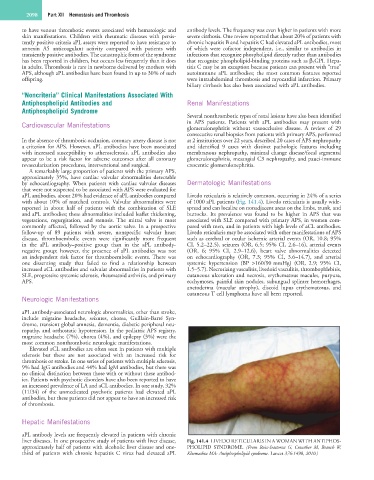
        aPL antibodies, about 20% had evidence of aPL antibodies compared   Livedo reticularis is relatively common, occurring in 24% of a series
        with about 10% of matched controls. Valvular abnormalities were   of 1000 aPL patients (Fig. 141.4). Livedo reticularis is usually wide-
        reported  in  about  half  of  patients  with  the  combination  of  SLE   spread and can localize on nonadjacent areas on the limbs, trunk, and
        and aPL antibodies; these abnormalities included leaflet thickening,   buttocks.  Its  prevalence  was  found  to  be  higher  in  APS  that  was
        vegetations,  regurgitation,  and  stenosis.  The  mitral  valve  is  most   associated with SLE compared with primary APS, in women com-
        commonly  affected,  followed  by  the  aortic  valve.  In  a  prospective   pared with men, and in patients with high levels of aCL antibodies.
        follow-up  of  89  patients  with  severe,  nonspecific  valvular  heart   Livedo reticularis may be associated with other manifestations of APS
        disease,  thromboembolic  events  were  significantly  more  frequent   such as cerebral or ocular ischemic arterial events (OR, 10.8; 95%
        in  the  aPL  antibody–positive  group  than  in  the  aPL  antibody-  CI, 5.2–22.5), seizures (OR, 6.5; 95% CI, 2.6–16), arterial events
        negative  group;  however,  the  presence  of  aPL  antibodies  was  not   (OR,  6;  95%  CI,  2.9–12.6),  heart  valve  abnormalities  detected
        an  independent  risk  factor  for  thromboembolic  events. There  was   on  echocardiography  (OR,  7.3;  95%  CI,  3.6–14.7),  and  arterial
        one  dissenting  study  that  failed  to  find  a  relationship  between   systemic  hypertension  (BP  >160/90 mmHg)  (OR,  2.9;  95%  CI,
        increased aCL antibodies and valvular abnormalities in patients with    1.5–5.7). Necrotizing vasculitis, livedoid vasculitis, thrombophlebitis,
        SLE, progressive systemic sclerosis, rheumatoid arthritis, and primary   cutaneous ulceration and necrosis, erythematous macules, purpura,
        APS.                                                  ecchymoses, painful skin nodules, subungual splinter hemorrhages,
                                                              anetoderma  (macular  atrophy),  discoid  lupus  erythematosus,  and
                                                              cutaneous T cell lymphoma have all been reported.
        Neurologic	Manifestations

        aPL antibody-associated neurologic abnormalities, other than stroke,
        include  migraine  headache,  seizures,  chorea,  Guillain-Barré  Syn-
        drome, transient global amnesia, dementia, diabetic peripheral neu-
        ropathy, and orthostatic hypotension. In the pediatric APS registry,
        migraine headache (7%), chorea (4%), and epilepsy (3%) were the
        most common nonthrombotic neurologic manifestations.
           Elevated aCL antibodies are often seen in patients with multiple
        sclerosis  but  these  are  not  associated  with  an  increased  risk  for
        thrombosis or stroke. In one series of patients with multiple sclerosis,
        9% had IgG antibodies and 44% had IgM antibodies, but there was
        no clinical distinction between those with or without these antibod-
        ies. Patients with psychotic disorders have also been reported to have
        an increased prevalence of LA and aCL antibodies. In one study, 32%
        (11/34)  of  the  unmedicated  psychotic  patients  had  elevated  aPL
        antibodies, but these patients did not appear to have an increased risk
        of thrombosis.

        Hepatic	Manifestations

        aPL antibody levels are frequently elevated in patients with chronic
        liver diseases. In one prospective study of patients with liver disease,   Fig. 141.4  LIVEDO RETICULARIS IN A WOMAN WITH ANTIPHOS-
        approximately half of patients with alcoholic liver disease and one-  PHOLIPID  SYNDROME.  (From  Ruiz-Irastorza  G,  Crowther  M,  Branch W,
        third  of  patients  with  chronic  hepatitis  C  virus  had  elevated  aPL   Khamashta MA: Antiphospholipid syndrome. Lancet 376:1498, 2010.)

