


Page 2353 - Hematology_ Basic Principles and Practice ( PDFDrive )
P. 2353
Chapter 141  The Antiphospholipid Syndrome  2095


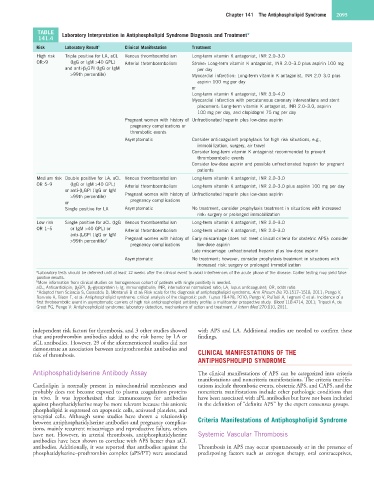
             TABLE   Laboratory Interpretation in Antiphospholipid Syndrome Diagnosis and Treatment*
              141.4
             Risk     Laboratory Result a  Clinical Manifestation  Treatment
             High	risk  Triple	positive	for	LA,	aCL	  Venous	thromboembolism  Long-term	vitamin	K	antagonist,	INR	2.0–3.0
             OR>9       (IgG	or	IgM	>40	GPL)  Arterial	thromboembolism  Stroke:	Long-term	vitamin	K	antagonist,	INR	2.0–3.0	plus	aspirin	100	mg
                      and	anti-β 2 GPI	(IgG	or	IgM	               per	day
                        >99th	percentile)                       Myocardial	infarction:	Long-term	vitamin	K	antagonist,	INR	2.0–3.0	plus
                                                                  aspirin	100	mg	per	day
                                                                or
                                                                Long-term	vitamin	K	antagonist,	INR	3.0–4.0
                                                                Myocardial	infarction	with	percutaneous	coronary	interventions	and	stent
                                                                  placement:	Long-term	vitamin	K	antagonist,	INR	2.0–3.0,	aspirin
                                                                  100	mg	per	day,	and	clopidogrel	75	mg	per	day
                                          Pregnant	women	with	history	of	 Unfractionated	heparin	plus	low-dose	aspirin
                                            pregnancy	complications	or
                                            thrombotic	events
                                          Asymptomatic          Consider	anticoagulant	prophylaxis	for	high	risk	situations,	e.g.,
                                                                  immobilization,	surgery,	air	travel
                                                                Consider	long-term	vitamin	K	antagonist	recommended	to	prevent
                                                                  thromboembolic	events
                                                                Consider	low-dose	aspirin	and	possible	unfractionated	heparin	for	pregnant
                                                                  patients
             Medium	risk Double	positive	for	LA,	aCL	 Venous	thromboembolism  Long-term	vitamin	K	antagonist,	INR	2.0–3.0
             OR	5–9     (IgG	or	IgM	>40	GPL)  Arterial	thromboembolism  Long-term	vitamin	K	antagonist,	INR	2.0–3.0	plus	aspirin	100	mg	per	day
                      or	anti-β 2 GPI	(IgG	or	IgM
                        >99th	percentile)  Pregnant	women	with	history	of	 Unfractionated	heparin	plus	low-dose	aspirin
                      or                    pregnancy	complications
                      Single	positive	for	LA  Asymptomatic      No	treatment,	consider	prophylaxis	treatment	in	situations	with	increased
                                                                  risk:	surgery	or	prolonged	immobilization
             Low	risk  Single	positive	for	aCL	(IgG	 Venous	thromboembolism  Long-term	vitamin	K	antagonist,	INR	2.0–3.0
             OR	1–5     or	IgM	>40	GPL)	or	  Arterial	thromboembolism  Long-term	vitamin	K	antagonist,	INR	2.0–3.0
                        anti-β 2 GPI	(IgG	or	IgM
                        >99th	percentile) b  Pregnant	women	with	history	of	 Early	miscarriage	(does	not	meet	clinical	criteria	for	obstetric	APS):	consider
                                            pregnancy	complications  low-dose	aspirin
                                                                Late	miscarriage:	unfractionated	heparin	plus	low-dose	aspirin
                                          Asymptomatic          No	treatment;	however,	consider	prophylaxis	treatment	in	situations	with
                                                                  increased	risk:	surgery	or	prolonged	immobilization
             a Laboratory tests should be deferred until at least 12 weeks after the clinical event to avoid interferences of the acute phase of the disease. Earlier testing may yield false
             positive results.
             b More information from clinical studies on homogeneous cohort of patients with single positivity is needed.
             aCL, Anticardiolipin; β 2GPI, β 2-glycoprotein I; Ig, immunoglobulin; INR, international normalized ratio; LA, lupus anticoagulant; OR, odds ratio.
             *Adapted from Sciascia S, Cosseddu D, Montaruli B et al: Risk scale for the diagnosis of antiphospholipid syndrome. Ann Rheum Dis 70:1517–1518, 2011; Pengo V,
             Banzato A, Bison E, et al: Antiphospholipid syndrome: critical analysis of the diagnostic path. Lupus 19:428, 2010; Pengo V, Ruffatti A, Legnani C et al: Incidence of a
             first throboembolic event in asymptomatic carriers of high risk antiphospholipid antibody profile: a mulitcenter prospective study. Blood 118:4714, 2011; Tripodi A, de
             Groot PG, Pengo V: Antiphospholipid syndrome: laboratory detection, mechanisms of action and treatment. J Intern Med 270:110, 2011.


            independent risk factors for thrombosis, and 3 other studies showed   with APS and LA. Additional studies are needed to confirm these
            that antiprothrombin antibodies added to the risk borne by LA or   findings.
            aCL antibodies. However, 29 of the aforementioned studies did not
            demonstrate an association between antiprothrombin antibodies and
            risk of thrombosis.                                   CLINICAL MANIFESTATIONS OF THE
                                                                  ANTIPHOSPHOLIPID SYNDROME
            Antiphosphatidylserine	Antibody	Assay                 The clinical manifestations of APS can be categorized into criteria
                                                                  manifestations and noncriteria manifestations. The criteria manifes-
            Cardiolipin  is  normally  present  in  mitochondrial  membranes  and   tations include thrombotic events, obstetric APS, and CAPS, and the
            probably does not become exposed to plasma coagulation proteins     noncriteria manifestations include other pathologic conditions that
            in  vivo.  It  was  hypothesized  that  immunoassays  for  antibodies    have been associated with aPL antibodies but have not been included
            against phosphatidylserine may be more relevant because this anionic   in the definition of “definite APS” by the expert consensus groups.
            phospholipid is expressed on apoptotic cells, activated platelets, and
            syncytial  cells.  Although  some  studies  have  shown  a  relationship
            between antiphosphatidylserine antibodies and pregnancy complica-  Criteria Manifestations of Antiphospholipid Syndrome
            tions, mainly recurrent miscarriages and reproductive failure, others
            have  not.  However,  in  arterial  thrombosis,  antiphosphatidylserine   Systemic	Vascular	Thrombosis
            antibodies have been shown to correlate with APS better than aCL
            antibodies. Additionally, it was reported that antibodies against the   Thrombosis in APS may occur spontaneously or in the presence of
            phosphatidylserine–prothrombin complex (aPS/PT) were associated   predisposing  factors  such  as  estrogen  therapy,  oral  contraceptives,

