


Page 2365 - Hematology_ Basic Principles and Practice ( PDFDrive )
P. 2365
Chapter 142  Venous Thromboembolism  2107


            ventilated but not perfused) has a positive predictive value for PE of   A low clinical pretest probability combined with a normal D-dimer
            more than 90%, obviating the need for additional testing.  excludes PE. Patients with intermediate or high pretest probability
              The relative ease and accessibility of CT scanning has reduced the   should undergo further testing. A negative helical CTPA or a normal
            use of V/Q scanning for the diagnosis of PE. However, V/Q scanning   perfusion  lung  scan  result  rules  out  clinically  significant  PE,  and
            is frequently preferred in two patient populations: young patients and   anticoagulant  therapy  can  be  withheld.  If  an  intraluminal  filling
            those with impaired renal function. CT scanning exposes patients to   defect is seen on helical CTPA or the perfusion scan demonstrates
            a higher dose of radiation than V/Q scanning, raising concern regard-  one or more segmental (or larger) defects and ventilation to these
            ing the risk of subsequent cancer. Although this risk varies depending   regions is normal, a diagnosis of PE is made. Although a V/Q mis-
            on a number of factors, concern about increasing the risk of breast   match supports a diagnosis of PE, a V/Q “match” does not exclude
            cancer in young women has prompted use of V/Q scanning prefer-  PE, and further objective testing is required in these patients. Simi-
            entially in this population. In patients with impaired renal function,   larly, the diagnosis of PE cannot be excluded in patients with small
            contrast  dye  administration  for  the  CT  scan  can  induce  contrast   perfusion defects (one or more subsegmental defects) or those with
            nephropathy, increasing mortality up to 30% after such a procedure.   indeterminate  lung  scan  findings  (in  which  the  perfusion  defects
            V/Q  lung  scanning  should  ideally  be  reserved  for  patients  with   correspond  with  abnormalities  on  the  chest  radiograph).  In  these
            normal chest radiographs because preexisting lung disease may result   patients,  venous  ultrasonography  should  be  performed.  If  DVT  is
            in indeterminate scans.                               documented, a diagnosis of PE can be assumed, and anticoagulant
              Patients with large perfusion defects (involving one or more seg-  therapy should be started. However, if results on these tests are nega-
            ments or more extensive defects) and a V/Q mismatch have a 90%   tive, additional objective investigations (e.g., pulmonary angiography)
            probability of PE. Patients with a normal perfusion scan have less   are required in patients with a high clinical pretest probability. For
            than a 2% probability of having PE, excluding the diagnosis. However,   those with a lower pretest probability of PE, an alternative strategy
            most patients who have V/Q scanning performed will have neither   is to withhold anticoagulants and to perform serial noninvasive tests
            of these findings; rather, they will have either matched defects or small   to detect venous thrombosis.
            perfusion defects (indeterminate scan). Patients with these findings
            require further investigation with either pulmonary angiography or
            objective  tests  for  DVT  of  the  lower  extremities.  A  patient  with   DIAGNOSIS OF ACUTE RECURRENT VENOUS
            suspected PE, an indeterminate V/Q scan result, and positive findings   THROMBOEMBOLISM
            on compression ultrasound examination of the lower extremities can
            be assumed to have PE. A patient with suspected PE, an indetermi-  The  diagnosis  of  acute  recurrent  VTE  is  challenging  because  the
            nate  scan,  and  a  negative  result  on  leg  compression  ultrasound   clinical  manifestations  of  recurrence  are  nonspecific.  In  addition,
            examination  requires  additional  testing  (e.g.,  serial  compression   there are no clinical prediction rules specifically validated for patients
            ultrasound examination after 7 days) because the thrombus may have   with suspected recurrence, and diagnostic tests for acute VTE have
            completely embolized to the lungs.                    limitations in this setting. Following treatment of acute DVT, incom-
                                                                  plete  resolution  of  thrombosis  may  be  evident  as  chronic  venous
                                                                  occlusion on compression ultrasound, making it difficult to identify
            Diagnostic Strategy for Pulmonary Embolism            new abnormalities. With respect to PE, the interpretation of repeat
                                                                  CTPA or V/Q scanning may be difficult because of thrombus migra-
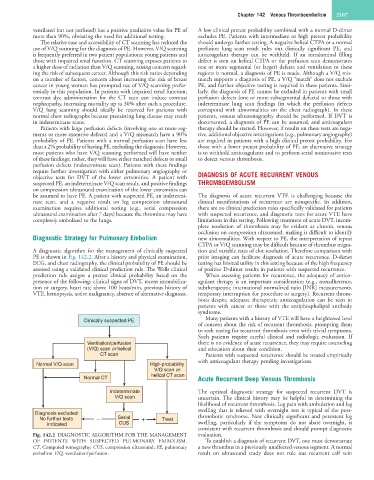
            A diagnostic algorithm for the management of clinically suspected   tion and variable rates of clot resolution. Therefore comparison with
            PE is shown in Fig. 142.2. After a history and physical examination,   prior imaging can facilitate diagnosis of acute recurrence. D-dimer
            ECG, and chest radiography, the clinical probability of PE should be   testing has limited utility in this setting because of the high frequency
            assessed using a validated clinical prediction rule. The Wells clinical   of positive D-dimer results in patients with suspected recurrence.
            prediction  rule  assigns  a  pretest  clinical  probability  based  on  the   When assessing patients for recurrence, the adequacy of antico-
            presence of the following: clinical signs of DVT, recent immobiliza-  agulant therapy is an important consideration (e.g., nonadherence,
            tion or surgery, heart rate above 100 beats/min, previous history of   subtherapeutic international normalized ratio [INR] measurements,
            VTE, hemoptysis, active malignancy, absence of alternative diagnosis.   temporary interruption for procedure or surgery). Recurrent throm-
                                                                  bosis  despite  adequate  therapeutic  anticoagulation  can  be  seen  in
                                                                  patients  with  cancer  or  those  with  the  antiphospholipid  antibody
                                                                  syndrome.
                            Clinically suspected PE                 Many patients with a history of VTE will have a heightened level
                                                                  of concern about the risk of recurrent thrombosis, prompting them
                                                                  to seek testing for recurrent thrombosis even with trivial symptoms.
                                                                  Such  patients  require  careful  clinical  and  radiologic  evaluation.  If
                              Ventilation/perfusion               there is no evidence of acute recurrence, they may require counseling
                              (V/Q) scan or helical               and education about their condition.
                                  CT scan                           Patients with suspected recurrence should be treated empirically
                                                                  with anticoagulant therapy pending investigations.
             Normal V/Q scan                      High-probability
                                                   V/Q scan or
                            Normal CT             helical CT scan  Acute Recurrent Deep Venous Thrombosis

                                     Indeterminate                The  optimal  diagnostic  strategy  for  suspected  recurrent  DVT  is
                                       V/Q scan                   uncertain. The  clinical  history  may  be  helpful  in  determining  the
                                                                  likelihood of recurrent thrombosis. Leg pain with ambulation and leg
                                                                  swelling  that  is  relieved  with  overnight  rest  is  typical  of  the  post-
            Diagnosis excluded:
              No further tests   −      Serial  +     Treat       thrombotic syndrome. New clinically significant and persistent leg
                indicated               CUS                       swelling,  particularly  if  the  symptoms  do  not  abate  overnight,  is
                                                                  consistent with recurrent thrombosis and should prompt diagnostic
            Fig. 142.2  DIAGNOSTIC ALGORITHM FOR THE MANAGEMENT   evaluation.
            OF  PATIENTS  WITH  SUSPECTED  PULMONARY  EMBOLISM.     To establish a diagnosis of recurrent DVT, one must demonstrate
            CT, Computed tomography; CUS, compression ultrasound; PE, pulmonary   a new thrombus in a previously unaffected venous segment. A normal
            embolism V/Q, ventilation/perfusion.                  result  on  ultrasound  study  does  not  rule  out  recurrent  calf  vein

